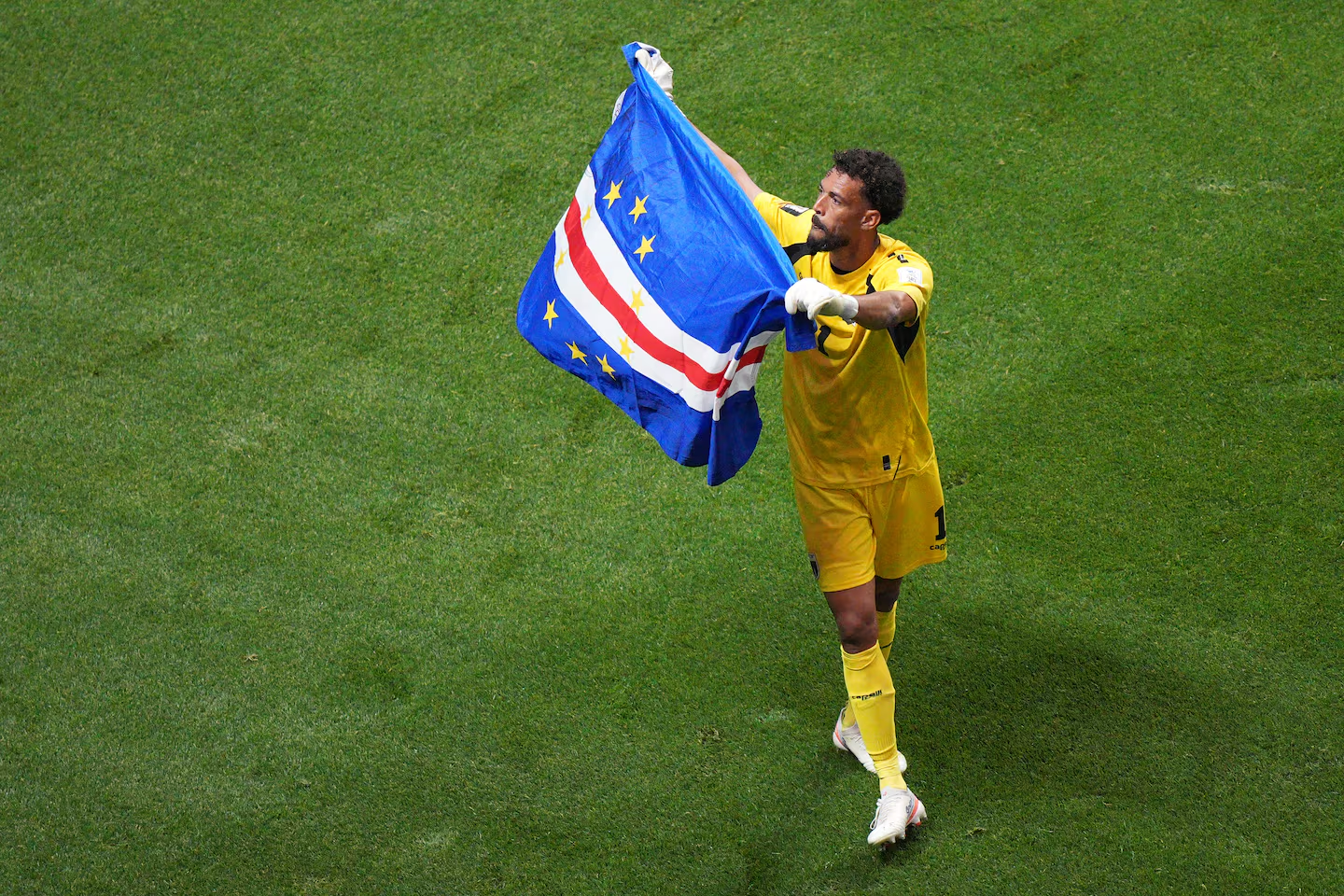
The World Cup group stage was supposed to be a feeding frenzy. So far, not so much.
For its quadrennial tournament spanning a globe that is more than two-thirds water, soccer divides the participating World Cup countries largely into sharks and minnows.
Read more Vance meets Iranian negotiators in Switzerland to work on details of deal. Follow live updates.
The sharks — Argentina, Brazil, France, Spain, and Germany, et al. — habitually feast upon minnows such as Saudi Arabia, Panama, South Africa, and Tunisia.
With this year’s field expanded from 32 to 48 entrants, observers predicted that there’d be a bunch of unsightly mismatches in group play. Turns out that some of the minnows can bite like piranhas.
With the group stage still underway, we’ve already seen several startling outcomes. Cape Verde 0, Spain 0. Congo 1, Portugal 1. Qatar 1, Switzerland 1. Curacao 0, Ecuador 0.
Not that there haven’t been some predictably lopsided results. Germany 7, Curacao 1. Sweden 5, Tunisia 1. Norway 4, Iraq 1. Yet it’s clear that the tournament has become decidedly more competitive even while it has expanded.
We saw this four years ago when the Saudis beat Argentina, Tunisia knocked off France, Japan handled Germany, and Morocco knocked out Spain and Portugal en route to the semifinals.
A major cause for the leveling of the planetary playing field has been the ongoing rise of African and Asian teams. The main reason for that is that FIFA, which sets the continental allotments, finally has been letting more of those nations in.
Asia, which has nine entrants in the field, was allowed just one until 1986 and only two until 1998. Africa, which numbers 54 countries, was granted only one berth before 1982 and didn’t get five until 1998. Now it has double that.
As we’ve seen with the NCAA men’s basketball tournament, which once was limited to 16 teams, intriguing things happen when you let in four times that many. UMBC beat Virginia and the little guys realized that it’s possible.
As the game has become truly global, more players have been leaving their homelands to perform abroad, often for top clubs in Europe.
Cape Verde’s players suit up in 14 nations from Portugal and the United States to Russia, Ireland, and Cyprus. Curacao’s players line up in the Netherlands, Saudi Arabia, Turkey, Malaysia, and elsewhere.
When Haiti made its only previous appearance in 1974, only one member of its roster played beyond the island. This time, only one plays domestically. The others are employed by clubs in 14 countries ranging from France and the United States to Slovakia and Iran.
For the ambitious expats, the week-to-week experience of playing against foreign competitors not only has raised the technical quality of their games, it also has demystified their opponents.
So the minnows have been unafraid to engage with the sharks, even to go on the attack. What do they have to lose? Spain, which has qualified for 13 consecutive Cups and claimed the trophy in 2010, was ranked second coming in. Cape Verde, making its debut, was 67th.
So a 0-0 draw, one of the biggest upsets in tournament history, was viewed as a triumph for the squad known as the Blue Sharks and inspired its fellow minnows.
Some of them may only have one surprise in them. Qatar, the previous host that qualified on its own for the first time, was hammered 6-0 by Canada after playing the final three dozen minutes with nine men.
Yet even an unlikely draw can scramble a group. Switzerland, which gave up the equalizer to Qatar on an own goal in the 94th minute, went on to beat Bosnia-Herzegovina, 4-1.
Since the Swiss took only one point instead of three, Canada needs only draw with them on Wednesday to win the group.
The Portuguese are at a disadvantage to Colombia, which won its opener against Uzbekistan by two goals. Spain needs to beat the Saudis on Sunday to avoid a must-win finale against Uruguay.
Nobody wants their survival to come down to goal differential. That’s what happened to the Germans last time when they lost the tiebreaker because Spain busted Costa Rica, 7-0, in its first match.
That’s why the Mannschaft cannonaded Curacao this time. After failing to advance in the last two tournaments the Germans simply had to go through.
So they bled themselves dry against Ivory Coast on Saturday afternoon, coming from behind to win on Deniz Undav’s second goal in the 94th minute and punched their ticket.
Italy, which lifted the trophy for the fourth time in Berlin two decades ago, has been spiraling downward ever since. The Azzurri didn’t survive their group in 2010 and 2014 and haven’t qualified since.
This time the Norwegians, known more for their skill on skis than in cleats, beat them twice in group play by a combined 7-1. Then the Italians lost the playoff to Bosnia-Herzegovina on penalty kicks. Even with a swollen field, just getting here is an accomplishment.
Oddsmakers reckoned that the minnows would be gobbled up en masse by the sharks this time and that might yet happen. None of them are expected to still be wriggling when group play ends at the end of next week. But at least they haven’t been served up as a snack.
Read more In Taylor Swift’s beach town, every clue becomes a wedding rumor





Post Comment