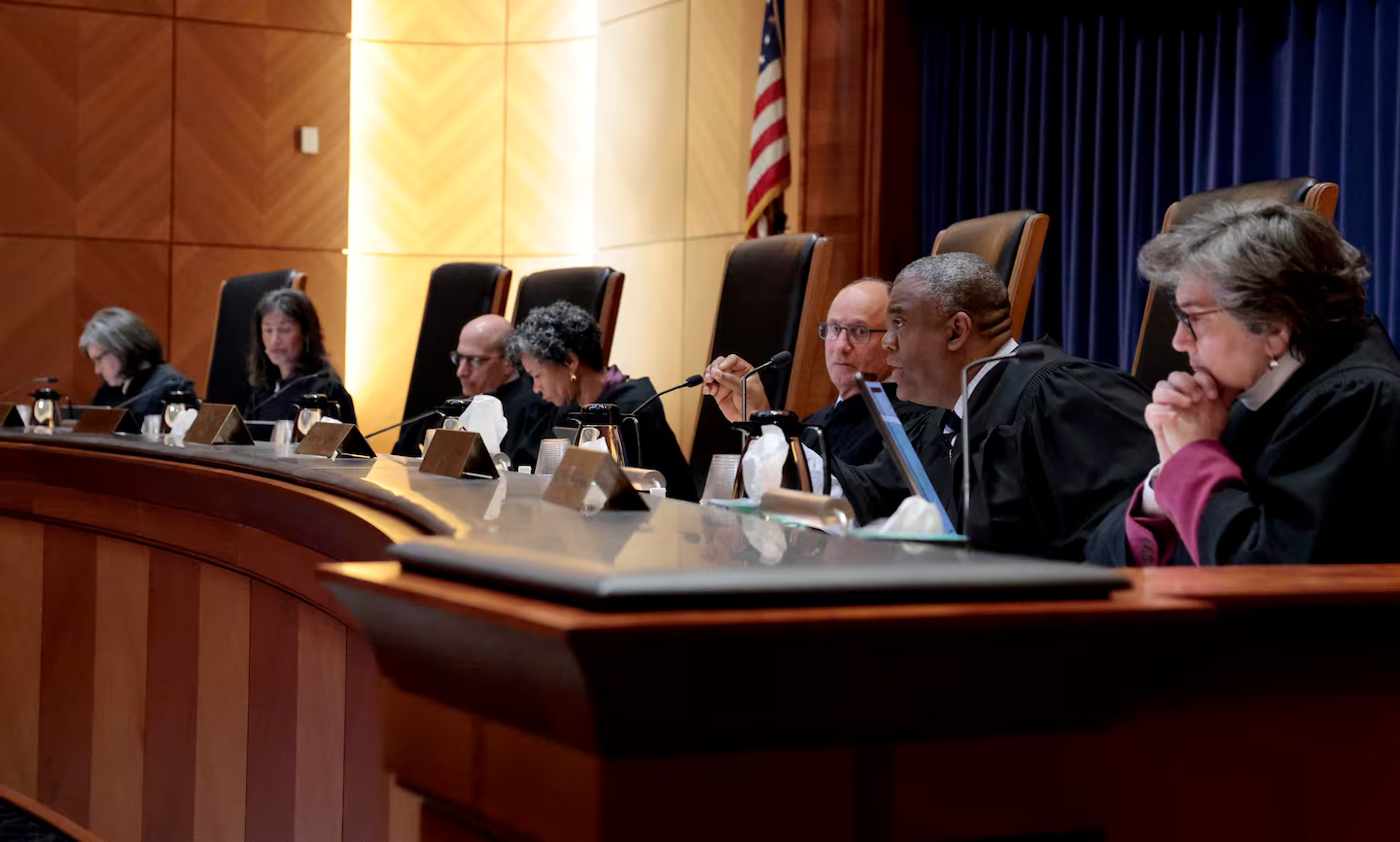
Mass. high court rules proposal to slash income tax can’t appear on November ballot
The state’s highest court on Thursday rejected a ballot question that would have cut the state income tax from 5 percent to 4 percent, ruling that it cannot proceed to the November ballot and dealing a blow to business groups who argued the state is too expensive for residents and businesses.
Read more Oklahoma pastor who was backed by Trump exits GOP House runoff after reports of inappropriate texts
The battle over the ballot question pitted members of the state’s business community who wanted to lower taxes against legislative leaders and unions who warned it would lead to a disastrous reduction in state revenues.
In an 18-page ruling, Justice Serge Georges Jr. wrote that a constitutionally required summary of the ballot question prepared by Attorney General Andrea Campbell’s office was not “fair” because it did not inform voters that the question, if passed, would also cut the state’s long-term capital gains tax rate.
“The summary’s contrary statement is not a minor imprecision. It is significantly misleading and likely to influence voters,” Georges wrote for the court. “… The summary does not merely leave something unsaid. It affirmatively tells voters, in ordinary language, that capital gain income is outside the proposed tax reduction when, under current law, most long-term capital gain income would be affected.”
The ballot question would have gradually slashed the state’s income tax rate to 4 percent over three years. It was backed by the Massachusetts High Technology Council, a trade group representing technology companies; the Massachusetts Competitive Partnership, a group of prominent business leaders; and the Pioneer Institute, a Boston-based libertarian-leaning think tank.
Chris Keohan, a spokesperson for the campaign behind the ballot question, said the Supreme Judicial Court’s decision “underscores the critical importance of accuracy and impartiality in drafting materials intended for the electorate.”
“This decision disenfranchises millions of Massachusetts voters,” Keohan said in a statement. “We’re deeply disappointed that due to the Attorney General’s summary, voters won’t have the opportunity to decide on a measure with significant implications for their finances and for the state’s competitiveness.”
Keohan said the campaign is “exploring next steps,” including trying to resubmit the question for the ballot in two years.
A group of community organizers and Massachusetts residents, with the support of the union-backed “Protect Massachusetts’ Future” campaign, filed the lawsuit.
David Sullivan, an attorney who worked with those behind the challenge, said the attorney general’s summary was “badly flawed.”
“The attorney general’s summary was wrong, and therefore the question can’t appear on the ballot. It’s not rocket science, and it shouldn’t be,” Sullivan said in an interview.
Campbell is required to issue a “fair, concise summary” of ballot questions to help voters understand what they are deciding.
In the summary of the state income tax reduction, Campbell’s office said the ballot question would lower tax rates on personal taxable income consisting of interest and dividends and personal taxable income “other than interest, dividends or capital gain income, such as wages and salaries.”
Read more US allows more than a dozen ships through to Iranian ports, lifting blockade under deal, Vance says
Sydney Weiser, a spokesperson for Campbell, said the Democrat’s office respects “the SJC’s decision and will continue to work diligently to ensure that ballot initiatives are summarized fairly and transparently.”
In court documents, Assistant Attorney General Grace Gohlke had argued that the summary was fair because it “neutrally described the main features of the petition without commentary on their possible interaction with existing law not directly amended by the measure.”
Georges wrote that the proposed law would have reduced the tax rate for Part B taxable income, including income derived from wages and salaries. In doing so, the question would also have reduced the tax rate for long-term capital gains, because current law ties the two rates together.
Lawmakers have cast the proposed cut as a catastrophic blow to public services because it could eventually reduce annual tax collections by as much as $5 billion.
The Supreme Judicial Court has blocked questions from the ballot in recent years, including in 2018 when it struck down the first iteration of a proposal for the so-called millionaires tax, and in 2022, when the court rejected a measure that could have reshaped how gig economy workers are classified in Massachusetts.
But the decision to reject a ballot question because of a flawed summary from the attorney general’s office is rare, as noted by both supporters and opponents.
Keohan said the high court’s ruling “challenges nearly a century of legal precedent.”
The court itself relied, in part, on a decision from 1951 that undid a public welfare law approved by voters the prior year because a 40-word summary printed on the ballot to describe the petition was not “fair” and “did not comply with the Constitution,” according to the Globe’s reporting of the ruling at the time.
In this year’s decision, Georges wrote that campaign materials and the full text of the petition were “unlikely to cure this kind of error in the attorney general’s neutral summary.”
“The petition itself does not mention capital gain income,” Georges wrote. “A voter reading the petition and the summary together would see a summary that expressly excludes capital gain income and a petition that says nothing to contradict that statement.”
Jim Stergios, the executive director of the Pioneer Institute, said the Supreme Judicial Court’s decision “is a serious disappointment for Commonwealth families struggling under one of the highest tax and cost burdens in the nation.”
“Today’s decision means that a technical defect in a summary prepared by the government can prevent voters from considering a question that otherwise qualified for the ballot,” Stergios said.
Read more Residents return to war-ravaged southern Lebanon with hope and sorrow after the US-Iran deal


Post Comment