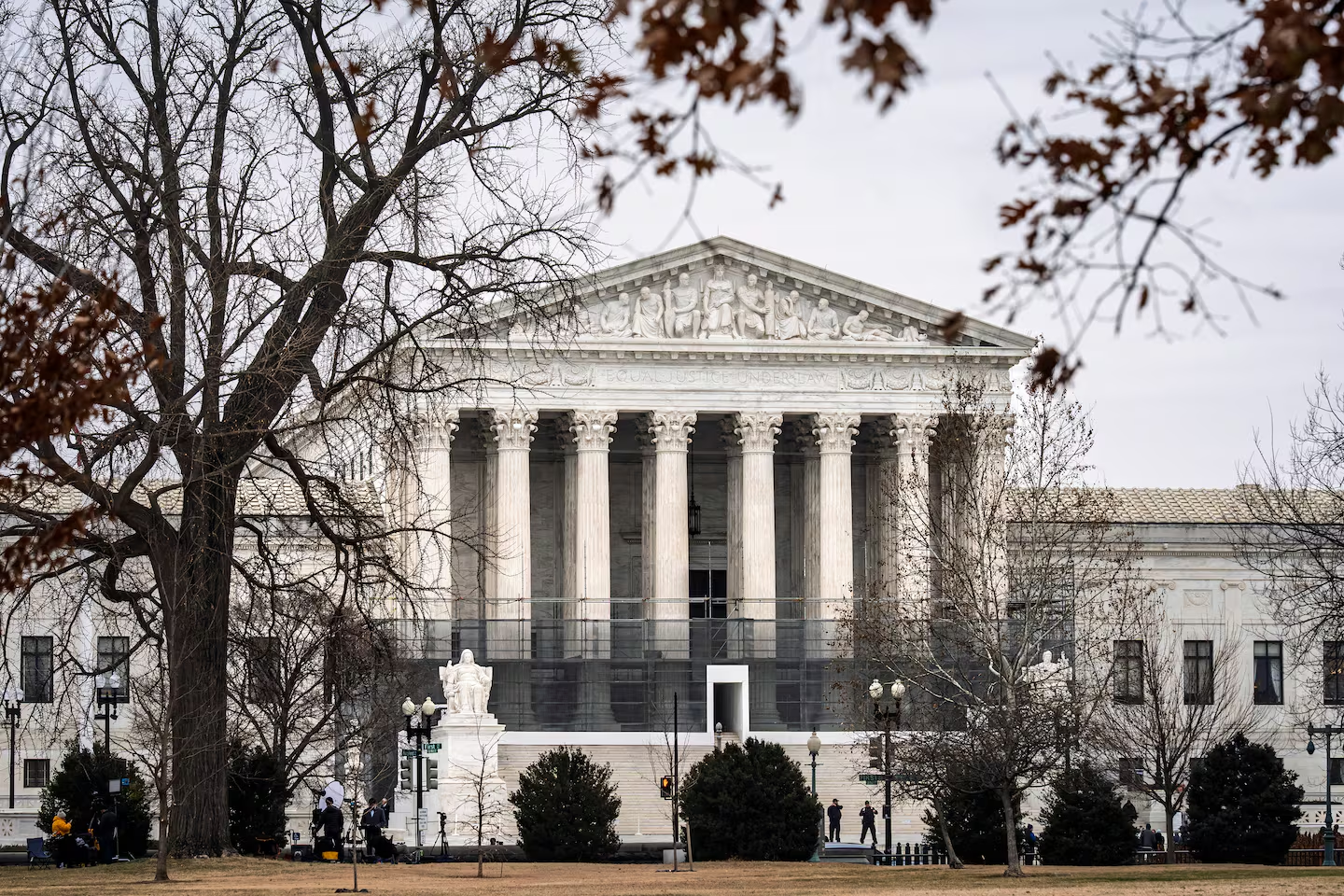
Here are the top cases before the Supreme Court and what they mean for Trump’s agenda
This year’s Supreme Court docket features a number of highly-anticipated decisions, including cases tied directly to President Trump’s second term policies.
Read more Massachusetts primary care would be overhauled under Senate bill slated for vote Thursday
The court, with a 6–3 conservative majority, granted Trump several wins in 2025, including ending self identification of gender on passports, allowing race to be considered in certain immigration checks in Southern California, and permitting the administration to cut nearly $800 million in NIH grants.
During his second term, Trump has frequently turned to the court’s emergency docket to seek temporary relief from lower court rulings while the cases proceeded through the legal system. So far the court has issued 28 emergency orders in cases related to Trump’s second administration.
Here are some of the biggest cases this term, and a list of the court’s major decisions that have wide-reaching impacts on issues including voting laws, Trump’s tariffs, and LGBTQ+ rights.
Independence of federal agencies: Trump v. Slaughter
Argued on Dec. 8
Rebecca Slaughter, the last Democratic member of the Federal Trade Commission, is challenging her removal by Trump. On Sept. 18, Chief Justice John Roberts allowed Trump to remove her while awaiting a ruling by the Supreme Court.
During arguments in December, the court’s conservative majority signaled it could give presidents broader authority to remove officials from independent agencies that they’ve traditionally exercised, potentially overturning a 90-year-old precedent that limits when presidents can fire agencies’ board members.
Trump first tried to remove Slaughter in March 2025. She challenged the move, and lower courts ordered her reinstated, arguing that the president can removecommissioners can be removed only for misconduct or neglect.
Campaign spending: National Republican Senatorial Committee v. Federal Election Commission
Argued on Dec. 9
During arguments which lasted more than two hours, conservative justices appeared to back a Republican effort to lift limits on how much political parties can spend in coordination with congressional and presidential candidates.
The case involves Vice President JD Vance, who joined the challenge when he was a senator in Ohio.
Democrats argue that removing the spending caps would let wealthy donors funnel large sums to favored candidates, increasing their influence over elections.
Transgender athletes in woman’s sports: Little v. Hecox, West Virginia v. B.P.J.
Argued on Jan. 13
During more than three hours of arguments, the Supreme Court appeared likely to uphold state laws that ban transgender athletes from competing in girls and women sports teams.
The cases come from Idaho and West Virginia, where laws prohibit transgender athletes from competing on girls’ teams.
Firing a member of the Federal Reserve: Trump v. Cook
Argued on Jan. 20
During arguments, Supreme Court justices appeared skeptical aboutTrump’s effort to fire Lisa Cook from the Federal Reserve.
In October, the justices temporarily allowed Cook to retain her seat after the administration requested an emergency order to oust her. The White House turned to the high court after an appeals court blocked the removal.
The effort to remove Cook represents an unprecedented attempt to reshape the Fed board. In its 112-year history, no sitting Fed governor has ever been fired by a president.
Mail-in ballot: Watson v. Republican National Committee
Argued on March 23
Justices are weighing a law in Mississippi that allows the counting of late-arriving mail ballots, a decision that could impact dozens of states.
Read more State Senator invokes Noah Kahan in push for ticket pricing overhaul
During arguments in March, the Supreme Court’s conservative majority sounded skeptical of Mississippi’s laws, which allows mail ballots to be counted if they arrive within five business days of the election and are postmarked by Election Day.
The case pits the Trump administration against Mississippi’s GOP-led government. Despite strong evidence to the contrary, Trump continues to spread baseless claims about election fraud andmail ballot security.
In January, the Supreme Court , to revive a challenge to a similar law in Illinois from Republican Representative Mike Bost. Lower courts had dismissed his lawsuit saying the late ballots were unlikely to affect the outcome in his district.
Trump’s birthright citizenship: Trump v. Barbara
Argued on April 1
Justices heard arguments for more than two hours in April on the president’s executive order to end birthright citizenship for children born on US soil to immigrants in the country illegally or temporarily.
Several justices raised doubts about the constitutionality of Trump’s order, which hinges on the 14th Amendment of the Constitution. Trump attended the arguments in person, the first sitting US president to do so.
The court’s pending decision could potentially redefine what it means to be an American and impact an estimated 200,000 babies who are born in the US each year to immigrants who lack legal status.
Trump’s sweeping unilateral tariffs: Trump v. V.O.S. Selections, Learning Resources, Inc. v. Trump
The was issued on Feb. 20
The Supreme Court struck down Trump’s far-reaching global tariffs in February, finding that the president could not unilaterally set and change tariffs because taxation power clearly belongs to Congress.
Three conservative justices — Brett Kavanaugh, Samuel Alito, and Clarence Thomas — dissented. Chief Justice John Roberts, Justice Amy Coney Barrett (whom Trump appointed to the court), and Justice Neil Gorsuch joined the court’s three liberal justices in the decision.
Trump has tried to rebuild his so-called tariff wall in the months following the ruling but has repeatedly hit legal roadblocks. In June, the White House proposed placing double-digit tariffs on products from dozens of major US trading partners after an investigation into goods allegedly made with forced labor. Those tariffs, however, do not take effect immediately and are subject to public comment and review.
Ban on conversion therapy for transgender minors: Chiles v. Salazar
The was issued on March 31
Justices struck down a Colorado law in March that banned “conversion therapy” for LGBTQ+ kids, siding with a Christian counselor who argued that the law violated the First Amendment.
The Supreme Court found that the law, which banned talk therapy, violated the counselor’s free speech. The only justice to dissent was Justice Ketanji Brown Jackson, who wrote that the decision “opens a dangerous can of worms” for how states can regulate health care.
Three-three states have laws barring health care providers from offering “conversion therapy” for minors, and another four have more limited restrictions.
Race and voting districts: Louisiana v. Callais
The was issued on April 29
The Supreme Courtdealta blow to the Voting Rights Act in April after striking down a majority Black congressional district in Louisiana, finding that the district’s map relied too heavily on race.
The ruling hollowedout a key provision of the Civil Rights-era law signed by President Lyndon Johnson. The court’s three liberal justices dissented, with Justice Elena Kagan writing that the decision could “systematically dilute minority citizens’ voting power.”
The decision comes amid a nation-wide scramble to redraw congressional maps, which was sparked by Trump pushing Republican-led states to give the party an advantage ahead of the midterm elections.
Material from the Associated Press was used in this report.


Post Comment