Alabama’s Senate primary runoff again tests Trump’s hold on GOP
The Republican Senate primary runoff in Alabama crystallizes how two midterm election themes seem to be at odds: Many Republican voters deeply trust President Donald Trump’s judgment on endorsements, and many are hungry for outsiders.
Read more Interim US-Iran peace deal sparks anger among Israelis, who lash out at Netanyahu
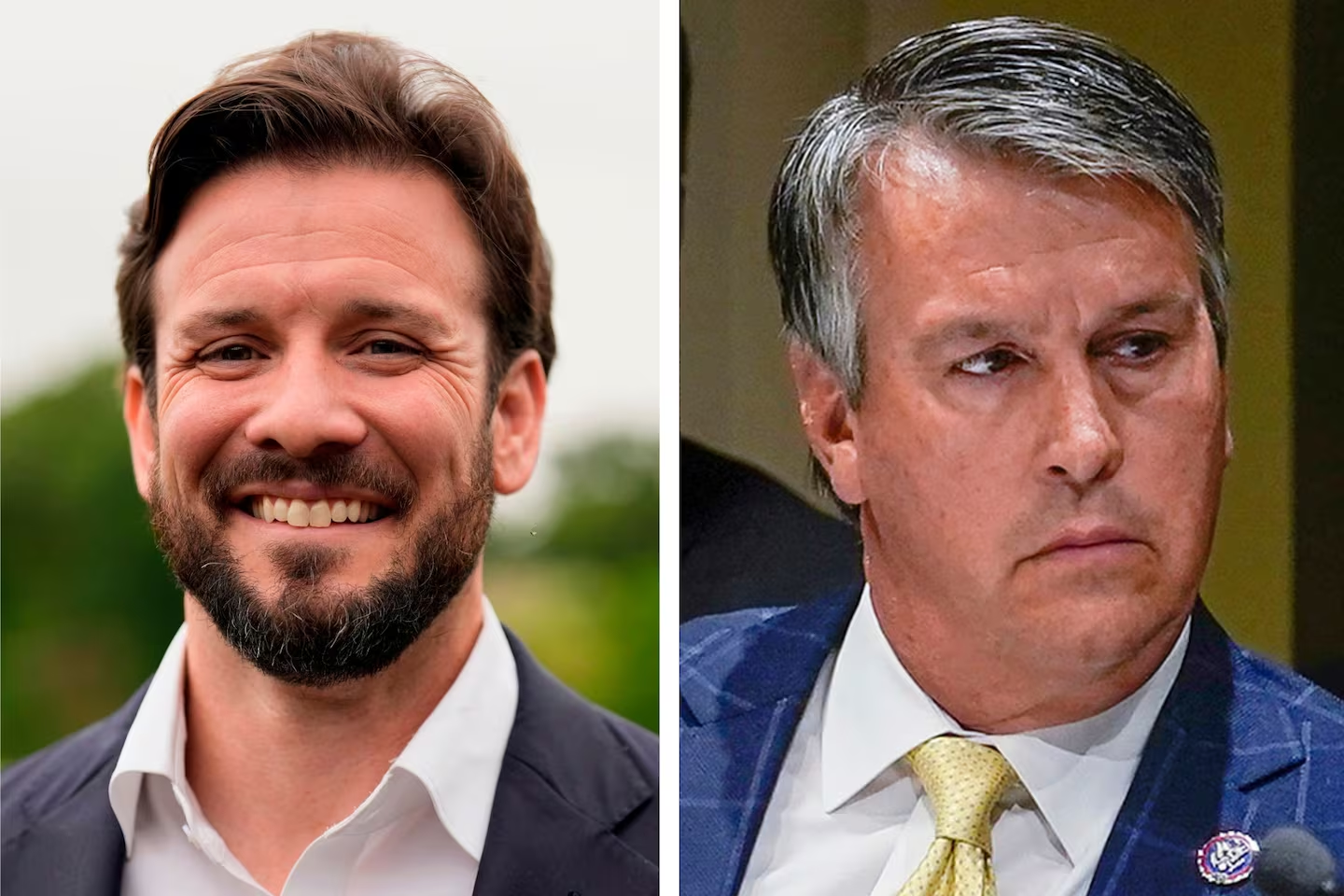
On Tuesday, voters in Alabama will choose between Rep. Barry Moore, who secured the president’s endorsement in January and is running as an unflagging Trump loyalist, and Jared Hudson, a former Navy SEAL and political newcomer running an antiestablishment campaign.
Little about the primary race has gone as expected. The early front-runner, Steve Marshall, the state attorney general, slipped in the polls after Trump endorsed Moore. Then, Marshall missed the runoff altogether, finishing about 15 percentage points behind Moore and about 1 point behind Hudson in the May 19 primary.
Now some polls show Hudson leading in the runoff, though survey data is limited.
“We may have switched the front-runners three times,” Bill Armistead, a former chair of the Alabama Republican Party, said with a chuckle. “On the one hand, the weight of the president’s endorsement has put Barry Moore where he is,” Armistead said. But on the other, Hudson’s outsider pitch has “really caught on with the people of Alabama.”
The election will decide a successor to Sen. Tommy Tuberville, a Republican who is vacating his seat to run for governor. Both Senate candidates say they have no significant points of disagreement with the president, and both celebrate his performance during his second term. But Moore, who has called Trump the “greatest president in my lifetime,” has particularly deep connections to him.
Moore, 59, was a state lawmaker in 2015 and endorsed Trump early during his first run for president, declaring his support at a rally in Mobile, Alabama, just two months after Trump rode down the golden Trump Tower escalator.
Trump, in turn, endorsed Moore early in the Senate race, saying on Truth Social that Moore had “been with me from the very beginning,” and that he was a “good friend, fighter, and WINNER.”
Moore, a third-term member of Congress from a deeply conservative district in the southern part of the state, has put that endorsement at the heart of his campaign.
His campaign website opens to a pop-up video of Trump speaking about Moore and describes the candidate as a “Trump Conservative.” He speaks about using relationships with the White House to help Alabama, and he says he will fight for the administration.
“When I call the president, he takes our calls, and those sort of things matter,” Moore said in an interview, dismissing Hudson’s campaign as empty talk. “There’s rhetoric. And there’s a record.”
On Thursday, Trump joined Moore for a virtual rally that almost 40,000 people joined, according to the Moore campaign.
Read more Rhode Island skips out on the Great American State Fair, joining growing list
Hudson’s campaign website lays out few policies. But he has said he wants to take on the system, in part by instituting 12-year term limits for members of both chambers of Congress. He has also said Moore is trying to “ride the coattails” of the president to the Senate.
“The people of Alabama understand that they elect their next senator — not the president, not anybody else,” Hudson, 40, said in an interview. He has nonetheless cast himself as the candidate who has more in common with Trump. “The people of Alabama love President Trump, and they voted for President Trump to make sure they had an outsider and a fighter.”
Hudson, who ran for Jefferson County sheriff in 2022 and was the first candidate to join the Senate race, is seeking to overcome the president’s imposing endorsement track record this year.
The president has proved to be a kingmaker in Southern states: Among his successes were endorsements of primary challengers to Sen. Bill Cassidy of Louisiana and Rep. Thomas Massie of Kentucky, two sitting Republicans who lost their bids for reelection.
Still, Trump’s run of endorsement wins hit a snag two weeks ago in Iowa, where voters rejected his chosen candidate for governor, Rep. Randy Feenstra, in favor of Zach Lahn, another conservative contender who ran as a political outsider.
And Trump has missed in Senate races in Alabama before.
In 2022, he initially endorsed Rep. Mo Brooks for Senate but then pulled the endorsement as Brooks struggled to gain traction. And in 2017, he endorsed Sen. Luther Strange, who suffered a primary defeat to Roy S. Moore, a conservative firebrand. (Moore, engulfed in scandal, went on to lose the general election to Doug Jones, a Democrat.)
After Strange lost the primary, it appeared that Trump, then early in his first term, deleted some of his social media posts supporting the senator.
Trump has won in Alabama by at least 25 percentage points in each of the last three presidential elections. But David Mowery, a Republican strategist in Alabama, said voters there tended to live out the state motto, a Latin phrase that translates to “We dare defend our rights” but that some roughly interpret to mean “Don’t tell me what to do.”
“Even when it’s President Trump,” Mowery said, “sometimes the Alabama electorate is preternaturally against the guy that’s the front-runner, or the guy that they’re supposed to vote for.”
Read more Trump says Iran deal will lead to ‘a lot of success’ for the world as he opens talks at G7 summit
This article originally appeared in The New York Times.


Post Comment