Trump at 80: A president ‘really uncomfortable’ with aging
WASHINGTON — He stays up late, phoning lawyers and lawmakers, while posting up to 150 times a night on Truth Social. His mornings involve calls with world leaders about the war in the Middle East, or talks with landscapers about replanting a bothersome tree. When he arrives in the Oval Office, his unstructured days unfold like a time-lapse video, with people zipping around him as he stays seated at the center of the frame.
Read more Trump tried to block state AI regulations, but some states are forging ahead
As President Trump turns 80 on Sunday, he is so intent on projecting an image of relentless energy that he has installed a massive, mixed martial arts octagon on the South Lawn for the occasion. After watching the fight, Trump will depart Washington in the middle of the night and cross an ocean for a diplomatic summit in France. It is a schedule that seems devised to ward off questions about age and stamina as he begins his ninth decade.
But even for a president known for imposing his own reality on every situation, Trump is facing scrutiny over his age that has grown more intense with each passing year. A Reuters/Ipsos poll taken in February showed that nearly 6 in 10 Americans think Trump is growing more erratic.
On Monday, Trump appeared to doze off during a New York Knicks game at Madison Square Garden. That episode prompted such intense speculation that James Dolan, a prominent ally and the team’s owner, was compelled to weigh in publicly, saying the president “was very much awake.”
On June 4, during an hourlong appearance in the Oval Office, Trump leaned to the side in his chair, closing his eyes for a few seconds as Lee Zeldin, administrator of the Environmental Protection Agency, spoke about the importance of coal.
This month, legions of online observers speculated, as they had before, that Trump was ailing when his public schedule contained no public events for nearly a week, a streak that began just after a physical examination at Walter Reed National Military Medical Center. Three days after that evaluation was completed, the president’s physician, Dr. Sean P. Barbabella, declared in a summary that the 79-year-old Trump “remains in excellent health, demonstrating strong cardiac, pulmonary, neurological and overall physical function.”
So the oldest president ever to be inaugurated and his advisers spend a lot of time hitting back at people who have drawn a different set of conclusions about his health based on what they believe they can plainly see.
This week, senior White House officials, speaking on the condition of anonymity to talk about Trump’s health, said that when the president appears to slump or lean over at his desk in the Oval Office, as he did during an event earlier this month, he is doing it to lean closer to better hear someone speaking. (He leaned away from Zeldin and closed his eyes during the event on June 4.)
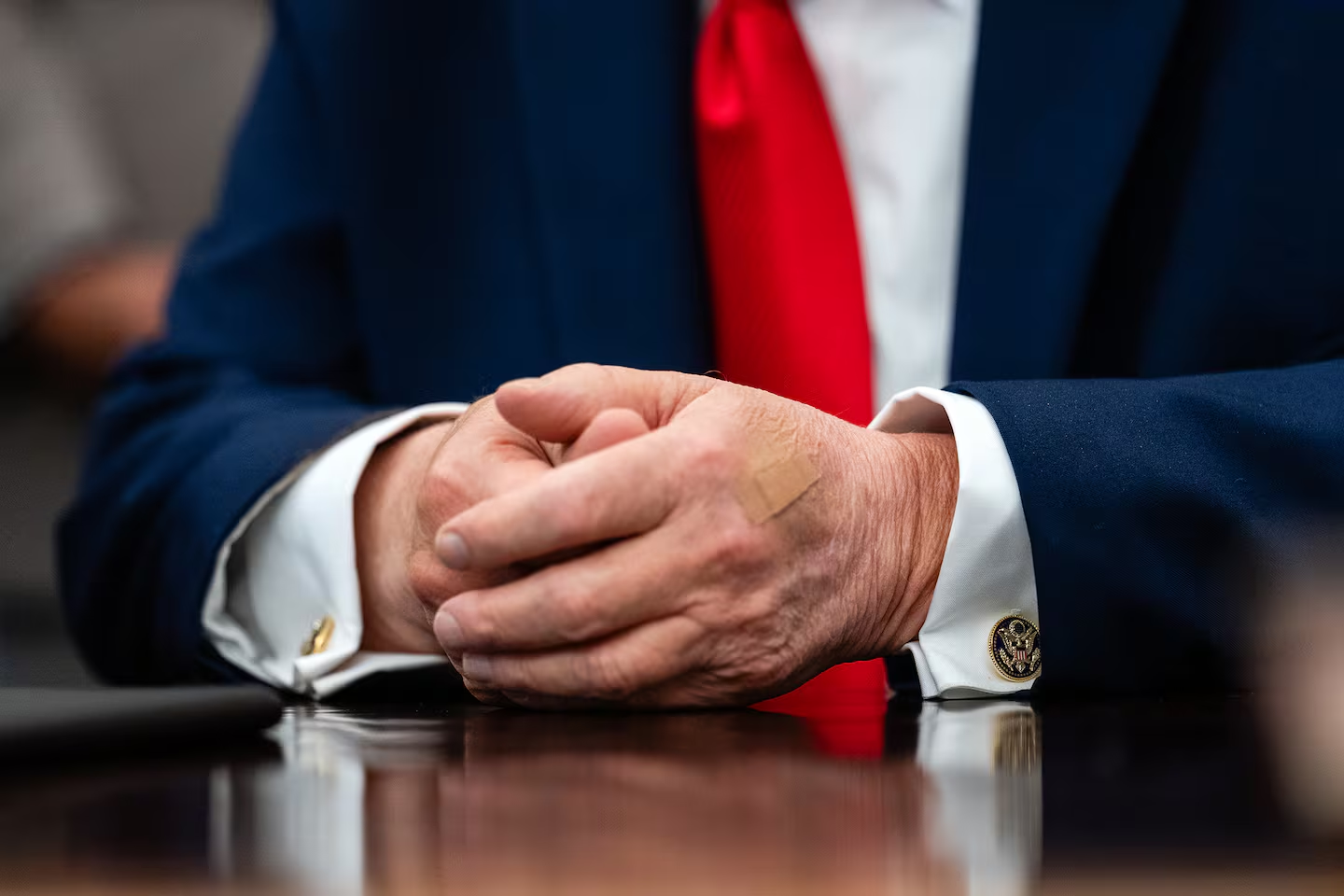
Trump’s hand is frequently bruised and bandaged, but the White House officials said that was from all of the handshaking he likes to do. And he is not sleeping during public events, such as the game at Madison Square Garden. He is just looking down, they said, or actively listening with his eyes closed. Other times, they believe he is the victim of selective editing or unflattering camera angles.
Still, Trump, like any president or medical patient, only discloses what he wants the public to know. His physicians have evaded questions about his health for years, including after a gunman’s bullet grazed his ear in Butler, Pa., and when he was sick with COVID-19 in 2020. Presidents are not legally required to share their most sensitive health information with the public, and the summaries they do share are in keeping with modern tradition rather than obligation.
Some White Houses have been more aggressive than others at obscuring the truth of an aging president’s condition. As President Joe Biden physically declined, his aides went to great lengths to obscure the signs of his aging. No one in Biden’s inner circle discouraged him from trying to run for the presidency again, despite indications that he was growing more frail.
As he ages, Trump has taken a different approach. He lets the cameras pick up his slumps, swollen ankles, and bandaged hand. He continues to take a tall stairway wheeled up to Air Force One, often navigating the stairs carefully. He continues to appear before the news media, fielding questions from friendlier faces and lashing out at journalists who ask him questions he perceives as unflattering.
Read more Yawkeys make largest gift ever, to Dana-Farber, totaling $50 million
More often than not, he meanders far beyond the topic he has appeared before reporters to discuss.
Trump’s public appearances are still limited compared with his first term, with most events falling between noon and 4 p.m., according to a recent analysis of his public schedule.
According to several people with knowledge of his schedule and habits, Trump gets somewhere between four and five hours of sleep a night. His late-night Truth Social sprees are conducted either by the president or by an aide, Natalie Harp, who has access to his account and shares flurries of posts with his approval.
The president heads to the Oval Office between 9 a.m. and 10 a.m., but sometimes arrives as late as 11 a.m. He often starts his workdays on the phone in the White House residence before heading downstairs. Once he is in the Oval Office, Trump’s appointments often run long or bleed into each other, with aides and visitors staying for unrelated meetings.
In response to follow-up questions about the president’s most recent health exam and about Trump’s whereabouts during the weeklong period when he was out of public view, the White House provided The New York Times with a 15-page schedule of the president’s activities, many of which did not appear on his official schedule, from May 27 through June 10.
The document reveals a White House where Trump’s days often unfold in an unstructured cascade of phone calls during and between scheduled meetings and unscheduled ones. On the morning of May 27, the day after his physical, the president participated in eight phone calls, with the earliest at 7:15 a.m., before participating in a briefing to prepare for a Cabinet meeting.
His afternoon included seven more meetings, including one about his White House ballroom project that ran for nearly two hours. He participated in three more calls, two of which were about Iran negotiations.
Several of Trump’s allies who have spent time with him lately at the White House, who were granted anonymity to describe their interactions with the president, said that he is more or less the same person he used to be, without any signs of diminished faculties. In one meeting, Trump forgot someone’s name. One recent Oval Office guest noted that in another meeting, Trump seemed more tired than usual, which that person attributed to his night-owl tendencies and late-night posting sessions catching up with him as he ages.
Defenders say that Trump has not lost a step, largely because he still takes questions from reporters.
Late on a Friday evening two weeks ago, Trump’s physician released a summary of the president’s latest Walter Reed exam. The president had last visited the medical center in October for what his aides said was a semiannual checkup after a visit in April 2025.
In his latest report, Barbabella wrote that the president had been evaluated by a team of 22 medical professionals, without noting their specialties. The president had an echocardiogram and an ultrasound of the heart, after increased testing of his cardiovascular system last year and a diagnosis of chronic venous insufficiency, a condition that occurs when veins have trouble moving blood back to the heart. Trump has taken two medications to lower his LDL cholesterol levels.
Read more Judge orders Trump administration to restore National Park changes at sites that ‘disparaged’ US
This article originally appeared in The New York Times.


Post Comment