For Boston’s Cabo Verdeans, finally, a seat at the World Cup table
Manny Coleta was supposed to be there for the 3 p.m. kickoff Thursday, and when he didn’t show some of the guys at the back of The Banshee in Dorchester started asking Ray Butler where he was.
“He’ll be here,” said Butler, who runs the best soccer pub in the city, his arms crossed, his eyes on the TV above the bar. “Manny’s not going to miss this.”
As Mexico and South Africa turned out for the first of 104 games in this World Cup, it was 15 degrees warmer in Dorchester than Mexico City. The crowd at The Banshee cheered the kickoff.
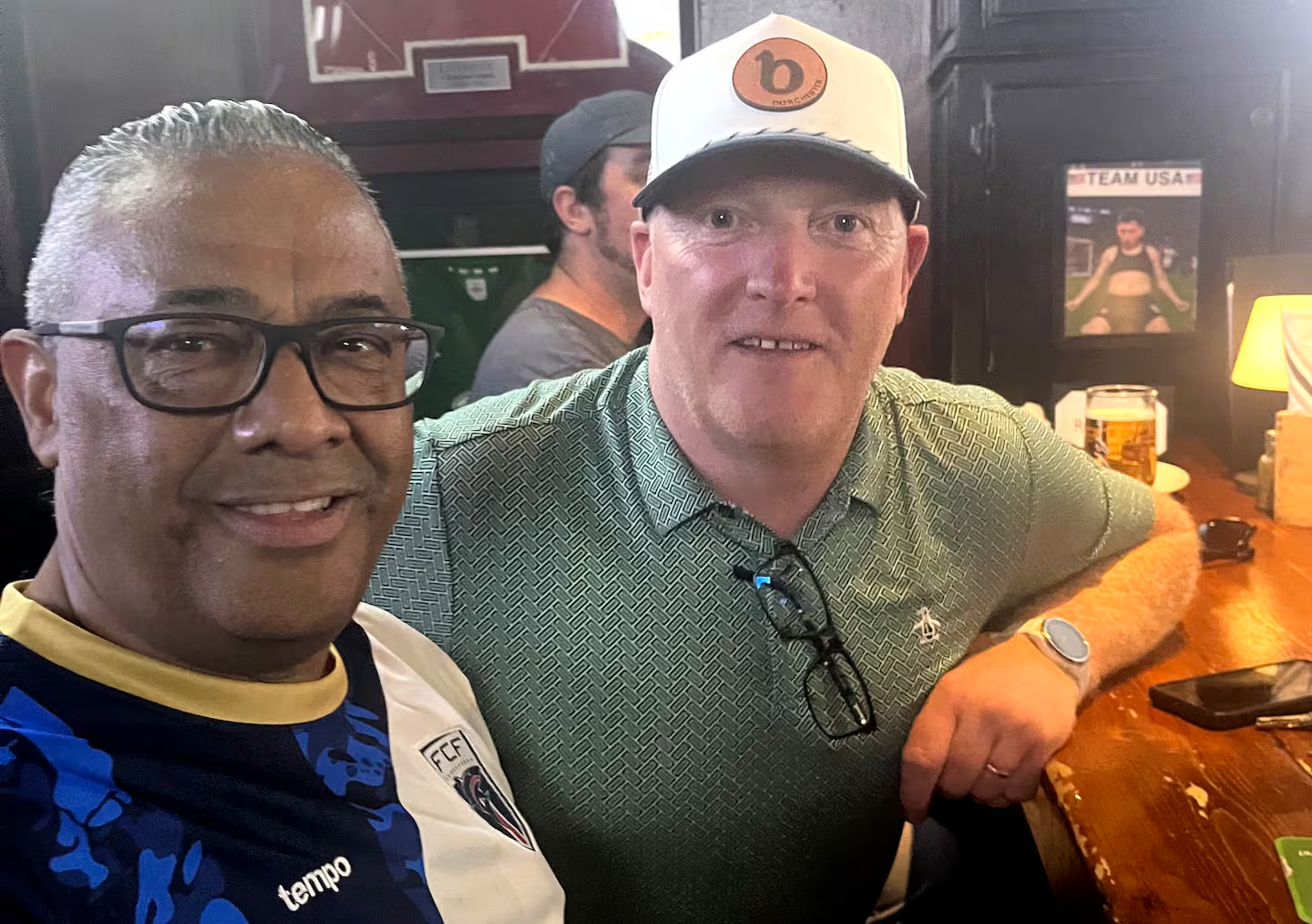
At the back of the pub, the cheers went up again when Manny Coleta walked in, 23 minutes after kickoff, wearing the jersey of Cabo Verde’s national team.
“Traffic,” he said, rolling his eyes, taking a seat at the bar that Butler had saved for him. “There was an accident on the Expressway.”
Everybody nodded knowingly, because they’ve all been there before.
But, as a native of Cabo Verde, Coleta had never been in this position before: sitting down to a World Cup that includes the Blue Sharks, Cabo Verde’s national team.
Manny Coleta is 62 years old. He works for the Massachusetts Convention Center Authority. He was born on Fogo, one of Cabo Verde’s islands. Fogo means fire in Portuguese, and the island has an active volcano. But like so many other Cabo Verdeans,Coleta and his family left the archipelago off the coast of West Africa for Boston not because they feared an eruption but because they longed for opportunity.
“I was 12 when I got here, to Boston,” he said. “Soccer was all I knew. It was my life.”
In high school, he played on one of those great Madison Park teams that won a city championship, then transferred to Boston Tech.
He played semi-pro, but any dreams of going beyond that broke down along with his gimpy right knee.
“It’s hard to explain today, but when I was a kid, soccer was everything in the Cabo Verdean community,” he said. “We didn’t play basketball, no baseball, no football. Now it’s different, Cabo Verdean kids are playing everything.”
With a population of around 500,000 people, and a diaspora that is estimated at 700,000 to 1 million, Cabo Verde never got near a seat at the World Cup table.
Portugal colonized Cabo Verde, and even after the island won its independence in 1975 the exploitation of natural resources extended to taking the island’s best players, Coleta explained.
The last few generations, however, have produced young men who want to play for their country.
“We’ve got some really good players,” Coleta said,including those who qualify to play for the country through their parents. “We’ve got a guy, Pico Lopes, who grew up in Ireland and is the captain of Shamrock Rovers, right Ray?”
Butler, a native of Ireland who knows the League of Ireland well, leaned in.
“He’s a very good center back,” Butler said of Lopes.
The good people of Crumlin, the Dublin neighborhood where Lopes grew up, and where his Cabo-Verdean born father settled, gave him a rousing send-off the other day.
Read more Georgia’s vote-counting method will soon be banned. Lawmakers will try to find a fix this week.
Both Butler and Coleta like that symmetry, because the Irish and Cabo Verdeans share an immigrant history in Boston.
Marty Walsh, whose parents were from the Gaeltacht in Connemara, an Irish-speaking region, was the first Boston mayor whose parents’ native language was not English. He once told me how when he looked at the Cabo Verdean kids playing basketball at the Boys and Girls Club in Dorchester near where he grew up, he saw Irish kids from a century before.
“Poor kids from a colonized island that couldn’t provide them jobs,” Walsh said. “A lot of them came to Boston to make a life for themselves and their families.”
The Irish struggled when first arriving in Boston in large numbers. But they assimilated and went on to run the town.
Immigrants from Cabo Verde faced similar struggles, but the community has become one of the most enduring and vibrant in the city.
In more recent years, many Cabo Verdeans who used to live in Dorchester have moved to Brockton, Coleta explained, because the cost of housing in Boston continued to soar.
That means the Cabo Verde team is being cheered on in Brockton and Pawtucket and other places in New England as loudly as in Dorchester.
Cabo Verde plays its first game Monday, in Atlanta, against Spain, one of the favorites to win the World Cup, in what is billed as a David vs. Goliath matchup.
Manny Coleta will be there, part of a group of 14 guys who grew up together in Dorchester, playing soccer on Franklin Field, where a slide tackle left the outside of your thigh looking like it had a run-in with a giant cheese grater.
As immigrant kids who grew up in Boston, they’re used to being underdogs.
“We grew up together. We played together. We scored goals together. But nothing can top this, watching Cabo Verde in the World Cup together,” Manny Coleta said.
Coleta and his childhood buddies were at Cesaria’s, the Dorchester restaurant on Bowdoin Street, to watch the qualifying match when Cabo Verde punched its ticket to the World Cup last October.
“I would compare it to what Americans felt when the US hockey team beat the Soviet Union in the Olympics,” Coleta said. “It was more than just a game. It was a moment in history, a feeling you never forget, a pride bursting out of your chest. It was like the day my son was born, that feeling.”
Coleta and his buddies went back to Cesaria’s Friday, but it wasn’t a late night.
They had to get up Saturday morning for the flight to Atlanta, to cheer on the Blue Sharks, to remember where they came from, to celebrate where they landed, and to chase this idea, this crazy idea, that says anything’s possible.
Read more Fleet re-sign F Susanna Tapani, but lose one more to PWHL expansion



Post Comment