In trying to control Washington’s most independent agency, Trump risks economic damage
WASHINGTON — Jerome Powell, the former head of the Federal Reserve, hunched under an umbrella with his wife, Elissa Leonard, as they hustled through a spring squall into the John F. Kennedy Presidential Library and Museum in Dorchester.
Read more Follow live updates on the Trump administration
Later, as heprepared to address more than 700 people at a black tie dinner in a tent outside, another wave of heavy rain drummed on the roof.
The metaphor practically wrote itself. The agency Powell recently led, designed by Congress to be insulated from political influence because of its crucial role in the economy, has faced a storm of criticism from President Trump in his second term. And the soft-spoken Powell, 73, has been the lightning rod.
But, rare in Washington these days, Powell managed to survive the Trump tempest.
In May, he left the Fed chairmanship on his own terms, not Trump’s. Moreover, he will continue to wield influence at the agency Trump sought to bring to heel as he will remain on the Fed board for up to 18 more months. From that perch, he now gets to watch how his successor, Kevin Warsh, wrestles with Trump’s relentless demands to lower interest rates.
Powell’s ability to withstand the brunt of Trump’s intense pressure campaign is what brought him to this rain-swept corner of Boston on May 31, to accept the JFK Profile in Courage Award for “protecting the independence” of the nation’s central bank.
And in his trademark low-key manner, Powell accepted the award by saying he was, essentially, only doing his duty.
“What the public has every right to expect is that we will make our decisions based only on our best economic analysis of what would most benefit the people we serve,” Powell, who remains on the Fed’s board after his term as chair ended May 22, told the crowd. “We do not take into account the fortunes of any political party or politician in making those decisions.”
Presidents have long craved low rates to boost economic growth in the short term — and their political fortunes, as well — despite the longer-term danger they could fuel higher prices by making the cost of borrowing too cheap. In 1971, President Richard Nixon succeeded in pressuring the Fed chair to lower interest rates heading into his reelection campaign despite a growing economy.
Nixon won, but the country lost.
Those low rates contributed to a decade of raging inflation, and the episode became a cautionary tale of the risks of political interference in monetary policy. Subsequent presidents took note and adopted a hands-off approach.
Until Trump.
During his first term, he publicly criticized Powell — a Republican he picked for Fed chair in 2017 — for raising interest rates. After returning to the White House in 2025, Trump took his pressure campaign to new levels.
In addition to more intense and frequent derision of Powell — “stubborn moron,” “knucklehead,” “real dummy” — Trump called for him to resign. When Powell refused, Trump publicly mused about firing him.
Trump has done this throughout the government in his second term, handing out pink slips to commissioners at independent agencies and members of government boards before their terms expired while firing or pushing out more than 200,000 federal workers as his administration dramatically shrank — and in some cases dismantled — many departments.
But Fed officials are unique. They can’t be fired on a presidential whim, only “for cause.” That led Trump to take steps over the past year — including appointing a new Fed chair — that critics say threaten the central bank’s independence and risk higher inflation.
“The fact that he ran against inflation, he knows that this is very unpopular politically,” said Princeton economist Alan S. Blinder, who served as vice chair of the Fed from 1994-96. “I’m not sure he ever put two and two together that if he had his way, emasculating the leadership of the Fed in favor of the White House would lead to more inflation.”
Although it’s just a couple blocks from the White House, presidents rarely visit the Fed’s historic Washington, D.C., headquarters to avoid any appearance of undue influence.
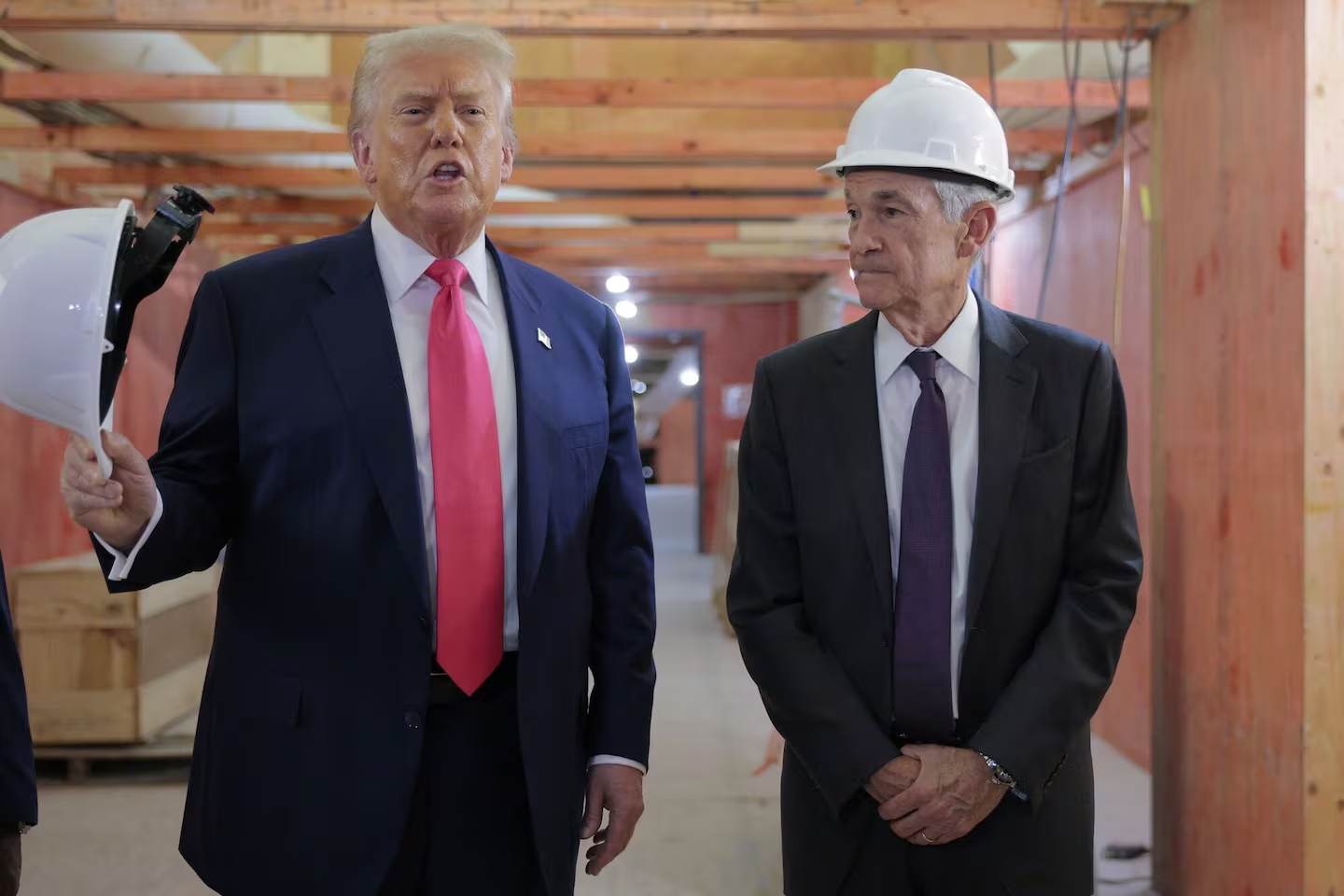
But last summer there was Trump one day in a bizarre scene that could have been filmed for “The Apprentice,” wearing a white hard hat as he toured the major renovation underway at the Fed building.
Trump was searching for a “cause” to fire Powell and had zeroed in on the rising cost, which had ballooned to about $2.5 billion from $1.9 billion. Trump suggested days earlier that Powell might have to step down because of fraud related to the project and he wanted to personally take a look.
With Powell in his own hard hat standing beside him, Trump told reporters the cost overruns had increased.
“It looks like it’s about $3.1 billion,” he said. “It went up a little bit, or a lot.”
Powell shook his head.
“I’m not aware of that, Mr. President,” he said. Trump pulled a piece of paper from his jacket pocket and gave it to Powell, who put on his glasses.
“You’re including the Martin renovation,” Powell said, referring to a different Fed building. “We finished Martin five years ago.”
Trump was undeterred. Asked by a reporter what he would have done as a real estate developer to a project manager who was over budget, Trump said, “Generally speaking . . . I’d fire him.”
His words aside, Trump by that point had signaledfiring Powell was off the table due to the uncertainty his dismissal and subsequent legal battle would cause on Wall Street.
Trump got a taste of that a few months earlier when financial markets tanked as a Powell firing appeared imminent, forcing Trump to publicly declare he had “no intention” of making such a move.
Fed officials only directly control a short-term rate that domestic banks use to lend money to each other that they hold at one of the 12 regional Fed banks. But, trusting their judgement, bankers and investors follow the Fed’s lead when they set longer-term rates for car loans, mortgages, and other lending.
If the Fed’s monetary policy decisions are viewed as motivated by politics and not economics, they would lose their impact, said Eric Rosengren, former president of the Federal Reserve Bank of Boston.
“If people become concerned that the Fed will not be independent, and you’re concerned that inflation will be rising over time, you’ll have short rates go down, but you’ll have long rates go up,” he said. “Both Turkey and Argentina are countries where there have been issues with central bank independence, and the result in those cases have been very, very high inflation rates.”
With firing Powell potentially destabilizing, Trump tried other tactics to push him out.
One month after the construction site tour, Trump announced he was firing Fed board member Lisa Cook alleging she had committed mortgage fraud,the first ever of a Fed official. Cook denied the allegations and a federal judge put the dismissalon hold pending a legal challenge that the Supreme Court is expected to decide this month.
Then in January, the Fed headquarters renovation became a flashpoint again. Powell announced that the Justice Department was conducting a criminal investigation into whether he had lied to Congress about the project.
“To have the president have this continuous amount of ad hominem attacks and legal assaults, that’s really unprecedented amounts of bullying,” said Gary Richardson, an economics professor at the University of California Irvine, who served as the Fed’s official historian from 2012 to 2016. “It’s an order of magnitude more than has ever happened.”
Congressional Democrats and even some Republicans strongly criticized the probe,which seemed intended to pressure Powell to resign. But he said he wasn’t leaving until his term as chair ended.
“This is about whether the Fed will be able to continue to set interest rates based on evidence and economic conditions,” Powell said at the time,“or whether instead monetary policy will be directed by political pressure or intimidation.”
In late May, for the first time in nearly four decades, the swearing in of a Fed chair took place at the White House. And Trump was clearly thrilled.
“I expect he will go down as one of the truly great chairmen of the Federal Reserve that we’ve ever had. I really believe that,” Trump gushed at a ceremony in which he frequently applauded enthusiastically for Warsh, his pick to replace Powell.
Trump has described Warsh, 56, as straight from central casting: a Harvard Law graduate with Wall Street experience who had served as a Fed governor from 2006-11. And in introducing him at the May 22 event, Trump made a point of saying he wanted Warsh “to be totally independent.”
“Don’t look at me, don’t look at anybody, just do your own thing and do a great job,” Trump told a crowd in the East Room that included top administration officials.
For his part, Warsh said in brief remarks that the Fed works best when it pursues its statutory mission “with wisdom and clarity, independence and resolve.” It echoed his promise of independence during his Senate confirmation hearing.
But some people are dubious.
Known for years as a monetary policy “hawk” — someone who puts a greater value on preventing runaway inflation with higher interest rates than stimulating job growth with lower ones — Warsh started advocating for lower rates around the same time Trump began searching for Powell’s replacement.
After nominating Warsh, Trump told reporters he had not asked for a commitment to push for rate cuts because that was “inappropriate, probably.”
“But he certainly wants to cut rates,” Trump said.
Massachusetts Senator Elizabeth Warren, the top Democrat on the Senate Banking Committee, predicted Warsh would simply be a “sock puppet” for Trump. She and all but one Senate Democrat opposed his confirmation. The 54-45 vote was the narrowest since 1977, when Senate approval was first required for the president’s picks for Fed chair.
That requirement is one of several changes made by Congresssince the Fed was created in 1913 to wall it off from the president.
For its first two decades, the Treasury secretary also led the Fed, giving the president strong sway. Congress changed that in 1935, establishing a chair who would be appointed by the president, but — unlike a Cabinet secretary — could only be “removed for cause,” generally interpreted to mean malfeasance or dereliction of duty.
Trump nominated Warsh on Jan. 30 ahead of Powell’s second four-year term as chair expiring on May 22. But the criminal probe of Powell created a problem with a key Republican, North Carolina Senator Thom Tillis, who was angered by the move.
The path was cleared for Warsh’s confirmation in late April after Jeanine Pirro, US attorney for Washington, D.C., announced she had directed her office to close the investigation. That satisfied Tillis. But not Powell.
He broke with tradition and decided to stay on at the Fed as a member of the board, as his 14-year term lasts until early2028. He told reporters he would not leave “until this investigation is well and truly over with transparency and finality.”
The move denied Trump a Fed vacancy he could try to fill with an appointee in line with his desire for lower interest rates.
White House spokesman Kush Desai said concerns about Trump meddling with Fed decisions are misplaced, pointing to Trump’s comments about independence at the May 22 ceremony.
“The president, however, maintains his First Amendment right as an American citizen and duty as commander in chief to call out policy mistakes that undermine America and the American people,” Desai said.
Translation: Trump is likely to keep the pressure on Warsh.
Blinder, who was appointed Fed vice chair by former President Bill Clinton, said Warsh was a better choice than other reported candidates. But Trump’s obsession with low interest rates still worries him.
“Warsh convinced Trump to appoint him, even though Warsh has a lifetime record of being a hawk on inflation,” he said. “I’d like to know . . . what kind of a deal was cut between Warsh and Trump.”
Given the recent rise in inflation amid high gas prices caused by the Iran war, most economists don’t expect the Fed to cut interest rates at Warsh’s first meeting June 16-17. Some believe the Fed might instead need to raise interest rates. In an interview that aired on June 7, Trump said that would be unacceptable.
“Kevin is fantastic, and I want him to do whatever he wants,” Trump told NBC’s “Meet the Press,” saying the traditional thing before adding, “I don’t want to have a big influence on him.”
Then Trump made clear what he wants Warsh to do: “We should actually lower interest rates.”
It’s highly unlikely Warsh could get a majority of the 12 voting members of the central bank’s monetary policy committee to agree to such a move right now, Blinder said.
”Whether that will make Donald Trump blow his stack or not, I don’t know,” he said.
And Powell won’t have to worry about being at the center of the storm anymore.
Still, as a highly respected former chair, he’s likely to retain some influence over the committee’s interest rate decisions and continue to be a voice for the central bank’s independence.
“We’re just waiting to see how long it takes for Warsh and the president to be at odds, because fundamentally they will be,” said Richardson, the former Fed historian. To be viewed favorably by history, he added, Warsh will have to withstand the presidential pressure the way Powell did.
“He will most be remembered . . . for the way he handled the attacks on the Fed,” Richardson said of Powell, “and the way he stood up for the independence of this institution.”
Read more Brooks Koepka goes on late birdie run and shares Canadian Open lead with five players


Post Comment