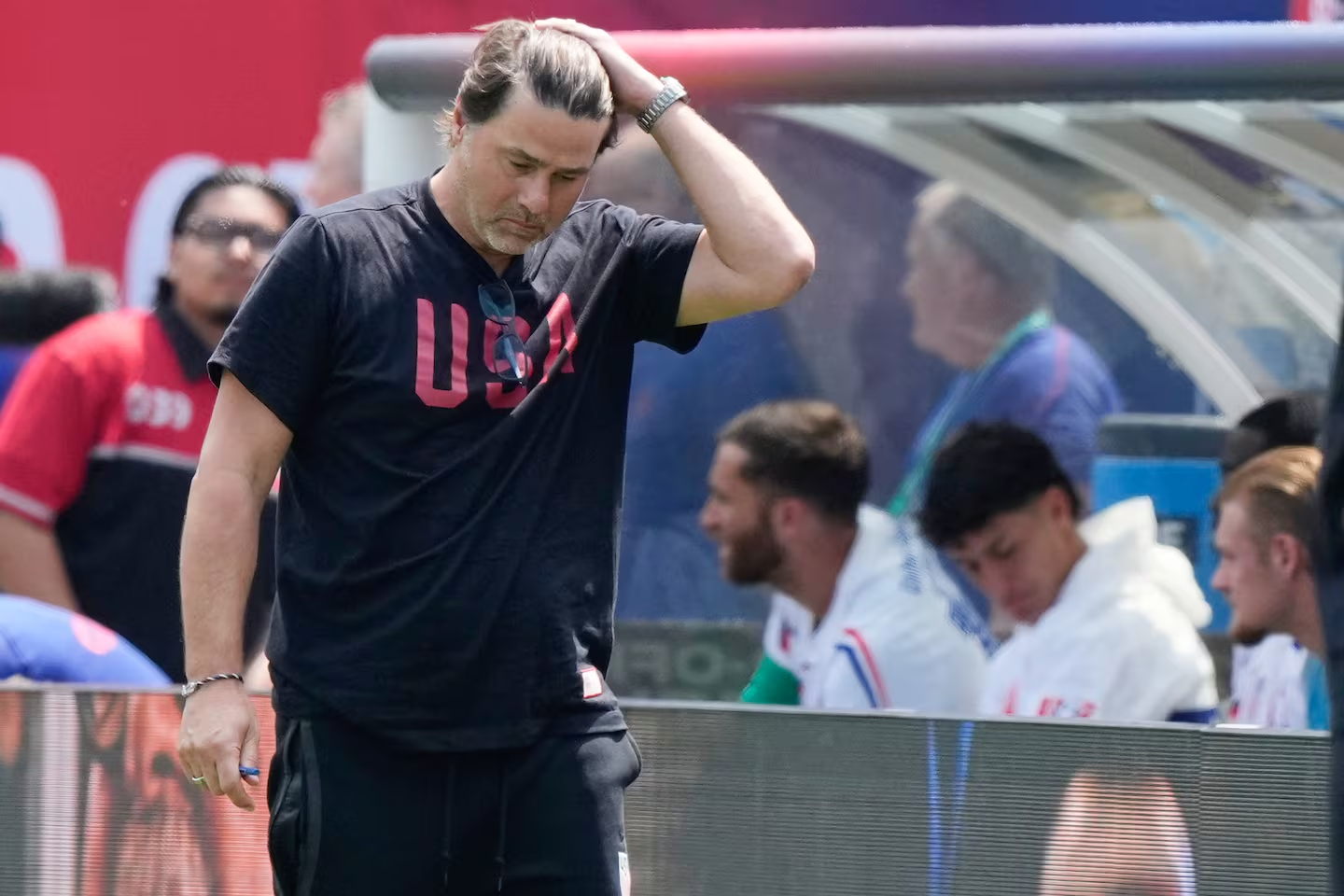
The state of Team USA entering the World Cup: Americans should advance, but how far?
The United States men’s soccer team has everything it needs to succeed in the quadrennial World Cup that begins Thursday.
Read more Twelve high school tournament takeaways from a Tuesday that had it all
A home base on the West Coast with minimal travel. Stadiums filled with star-spangled supporters. An experienced lineup with eight starters back from the squad that reached the second round in 2022. And the most favorable draw since the Americans returned to the tournament in 1990 after four decades away.
While winning the gilded trophy is highly unlikely (they’re 60-1 long shots) the cohosts have a realistic chance to advance to the quarterfinals, which the United States hasn’t done since 2002.
The United States at least should survive its group of Paraguay (Friday evening in Inglewood, Calif.), Australia, and Turkiye, none of whom rank among the global top 20.
Customarily, the United States is thrown in with at least one heavyweight — Italy, Germany, Portugal, England — yet still manages to survive, as it has four times since 1998. This time, Uncle Sam is the heavyweight in the group, ranked 17th.
But the Yanks won’t have a fast lane to the second round of the 48-country field. Group D is the only one of the 12 that includes nobody outside of the top 40. No Curacaos, no Haitis, no New Zealands.
And recent experience against their preliminary rivals indicates that the Americans will have to grind their way forward.
Last year, the Turks beat them, 2-1, in a friendly in East Hartford after the United States had scored in the opening minute. Then the Americans had to rally to beat Australia, 2-1, and go to the 71st minute to edge Paraguay by the same score.
That said, it’s rare for the hosts (in this case the United States, Canada, and Mexico) to go three-and-out. Since the inaugural tournament in 1930, only South Africa (2010) and Qatar (2022) have failed to go through.
Winning the group, which the United States has managed only once (in 2010 on goal differential over England), is crucial to avoiding more difficult obstacles further along.
If the Americans top their foursome they’ll face a third-place team in the Round of 32. If they’re second, they’d possibly draw Iran, which knocked them out of the 1998 tournament and pushed them to the limit in the group finale last time. After that would loom defending champion Argentina.
If the United States places third it would be up against a group victor, probably two-time former titlist France, Portugal or Belgium.
However the Americans come out of the group their road forward runs through Europe, which has proven all but impassable in previous tournaments.
Since 1990, the United States has played 20 Cup matches against countries from the Continent and won just one, a 3-2 shocker over Portugal in the 2002 opener.
This year’s runup has been less than auspicious. The Yanks took a 5-2 beating from the Belgians and a 2-0 blanking from the Portuguese in Atlanta within three days at the end of March.
Last Saturday in Chicago, the United States gave up a goal to Germany in the second minute of its sendoff match but fought back to draw even before conceding the winner in the 57th minute.
Read more Minnesota Lynx guard Olivia Miles making a splash in her rookie season
“An amazing challenge for us to see how we react,” mused coach Mauricio Pochettino. “How we show character, how we show togetherness, how we play under pressure.”
Pochettino, who played for Argentina in the 2002 World Cup and managed Tottenham Hotspur, Paris Saint-Germain, and Chelsea, hadn’t directed a national team until he succeeded Gregg Berhalter in the late summer of 2024.
His primary task was to sort through the candidate pool to identify players with the savvy and versatility to play Pochettino’s high-octane style.
Since the United States didn’t have to qualify, he had the luxury of checking out more than 80 hopefuls and starting more than 50 players in 26 matches.
What Pochettino settled on was a 26-man roster that includes half of the 2022 squad. Some of his decisions raised eyebrows.
He left off Diego Luna, the promising attacking midfielder, in favor of the mercurial Gio Reyna, who was nearly sent home from Qatar four years ago for attitude issues. And he bypassed defensive midfielder Tanner Tessmann, who’d been injured in May.
This American squad breaks out with alacrity with striker Folarin Balogun, forward Christian Pulisic, and midfielder Weston McKennie creating dangerous chances and backs Antonee “Jedi” Robinson and Sergino Dest adding offensive oomph on the wings.
The perennial question for the United States is how well the back line will hold up under assault, especially with Chris Richards, its sterling defender, still iffy after tearing ankle ligaments last month.
One of the central defenders, captain Tim Ream, is 38. Another, Alex Freeman, is 21. If Richards can’t go, the man on the spot could be Arlington native Miles Robinson, whose mistakes led to both German goals last weekend.
Historically, three flaws have hampered US teams in Cup play: Letting in an early goal. Conceding one shortly before halftime. And failing to hold a lead or a draw late.
The Americans never have won a match (21 and counting since 1990) when allowing the first goal, which they’ve done eight times in the opening 10 minutes.
So when an unmarked Kai Havertz headed in a free kick on Germany’s first shot at Soldier Field, the here-we-go-again feeling was palpable.
“We could have easily crumbled and it could have been a very, very bad day to be going into the tournament with,” observed Antonee Robinson, who brought his mates level with a 37th-minute rocket. “But we fought back and at times played some really good football.”
The notable words are “at times.” The Americans undoubtedly can play with anyone on the planet. What they need to prove during the upcoming weeks is that they can do it for 90 and beyond every time out.
Their motto this time is: “Never Chase Reality.” What it needs to be is: Never Chase the Game.



Post Comment