Days before World Cup, focus on public safety, human trafficking
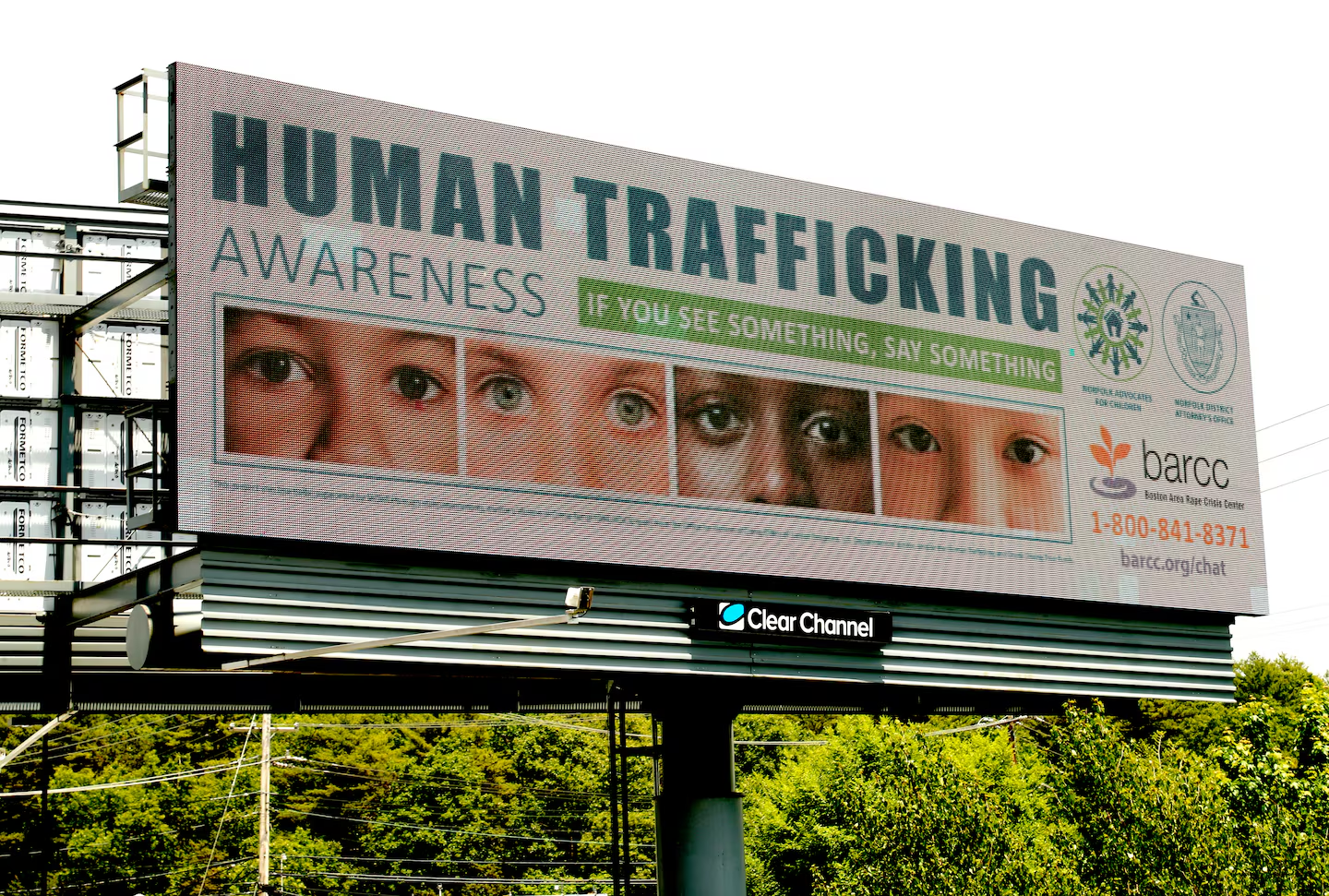
FOXBOROUGH — Just south of Gillette Stadium in Foxborough, a billboard looms over busy Route 1: “Human trafficking” it says in large bold letters over close-ups of several people’s eyes. “If you see something, say something.”
Read more J.T. Poston handles the wind at Memorial for low round of tournament and 36-hole lead
It’s a public safety awareness push ahead of the World Cup, with a specific focus: Starting when games begin next week in Foxborough, crowds will descend on the area — men looking to pay a fee for sex, and operators of an illicit industry built on exploitationwho arelooking to capitalize.
“Events like the World Cup can create conditions that attract human traffickers seeking to exploit vulnerable people, regardless of age, sex, race, or ethnicity,” FBI Boston Special Agent in Charge Ted Docks said at a press conference Thursday in the State House.
Over the last week, public safety officials and victim advocates announced a series of public safety plans tied to the World Cup games here, with more than 2 million visitors expected to descend on Boston. On Thursday, Boston Mayor Michelle Wu outlined efforts to keep the city safe, including the opening of a new command center.
The next morning, officials stood on the Gillette field that soon will host Haiti playing Scotland and, against a backdrop of workers and construction equipment, gave otherfinal safety reminders : Don’t bring drones or fireworks, do drink water, and, of course, if you see something, say something.
The FBI has been monitoring for any dangers, and there is no credible threat as of now, said Docks. This is a challenging environment, he said, with multiple locations including watch parties and fan festivals, where security will be heightened as the largest sporting event in the world brings a higher security risk.
At multiple events over the week, he mentioned human trafficking. At the Thursday event that focused on it, Docks was among more than a dozen members of law enforcement, activists for exploited people, and government officials who announced the public-awareness campaign and other efforts aimed at cracking down on trafficking for sex and labor. They said they’re working especially with people in hotels, restaurants, and other hospitality or transit entities to spot and report trafficking, but they are asking the public at large to be aware and ready to call 911 or the national human-trafficking hotline, which is 1-888-373-7888.
“Silence is really not an option here,” Lieutenant Governor Kim Driscoll said at the press conference. “This is everybody’s business.”
Driscoll announced $390,000 in grants for anti-trafficking work, including a campaign with posters encouraging people to alert authorities if they see trafficking happening — or if they themselves are victims of it. The billboard in Wrentham was put up by the Boston Area Rape Crisis Center, the Norfolk Advocates for Children, and the Norfolk County District Attorney’s Office.
Gina Kwon, secretary of the Executive Office of Public Safety and Security, said authorities are in communication with restaurants, transit hubs, hotels and other places that will handle crowds during the tournament.
The Norfolk County DA’s Office, which covers Foxborough, said in a statement to the Globe that it’s been working to train police officers in handling large-scale events, and police who focus on trafficking have similarly been reaching out to hotels and motels in the area, teaching workers to notice conduct like what advocates described.
“Training is routinely conducted on this topic because it is occurring in our community every day even when the World Cup isn’t here,” the office said in a statement.
Read more Bad weather halts third round of the Memorial with J.T. Poston and Ryan Gerard still in front
Fears of human trafficking follow many major national and international sporting events, including the Super Bowl and the Olympics.
The World Cup will be a drawn out affair. It begins June 11 with games in 16 locations across the US, Canada, and Mexico. That includes Foxborough, where the first game is at 9 p.m. Saturday, June 13. Crowds are expected in Boston and the surrounding area, including hotels closer to Foxborough and in Providence, Rhode Island.
Across multiple appearances, officials and advocates have stressed that, to some extent, it’s up to the public to try and keep the games safe.
“Every member of our communities can be an ally and has the responsibility to report it if you suspect that someone is being trafficked for labor or for sex,” said Audrey Morrissey of My Life My Choice, a Boston-based nonprofit that helps women escape the sex trade.
Morrissey herself was trafficked decades ago in Boston’s infamous “Combat Zone” downtown. She said she teaches people to look for various signs: young people with clothes and items that look overly expensive or with dollar signs drawn on them getting in and out of cars with people they don’t seem to know.
“Ask the questions and be aware,” she said.
Other areas hosting World Cup games are running similar campaigns. The state of New Jersey — the site of some matches including the final in July — has rolled out its own public awareness campaign and other local initiatives. So have Seattle-area authorities, with a training program aimed at teaching people working at businesses like restaurants and hotels to spot trafficking.
A spokesperson for Suffolk District Attorney Kevin Hayden, whose office covers Boston, said there have been ongoing efforts to target traffickers that will continue through the tournament.
“These are pro-active efforts targeting traffickers and buyers,” said the spokesperson, James Borghesani, in a statement, “and violators will face severe consequences.”
Several of the members of law enforcement at the press conference Thursday said some of the exploitation and solicitation happens in person, but much now takes place in the dark corners of the internet. Phillipa King, CEO of It’s A Penalty, an international anti-exploitation group, said at the press conference that online ads for girls soared during the Olympics in France two years ago, increasing in both number and price.
“It’s one of the fastest growing criminal industries in the world,” she said. And while major sporting events bring a risk, “It happens 365 days a year — every town, every city, every country.”
Read more Providence-Syracuse, UConn-Michigan men’s basketball to play at TD Garden next season



Post Comment