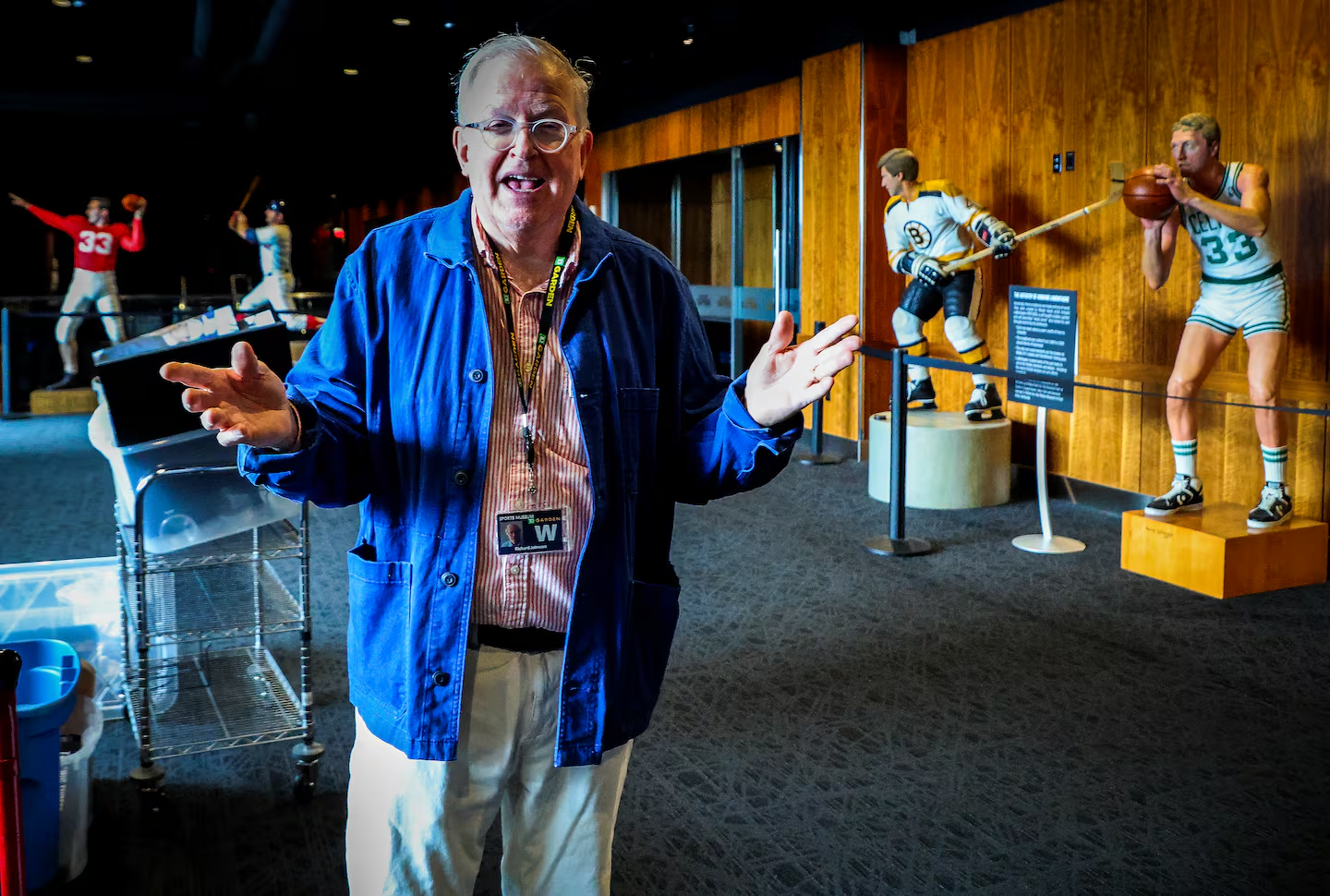
Richard Johnson, heart and soul of The Sports Museum, is retiring. Someone will get the job, but he will never be replaced.
Hall of Famer Dave Cowens had many notable teammates.
John Havlicek is in the Basketball Hall of Fame. Jo Jo White is in the Hall of Fame. Charlie Scott is in the Hall of Fame. Paul Westphal is in the Hall of Fame. Don Nelson (coach) and Satch Sanders (contributor) are in the Hall of Fame. Paul Silas should be in the Hall of Fame. Hambone Williams was an effervescent assist machine.
So, Dave, who was your favorite of them all?
“Richard Johnson is the best teammate I ever had,” Big Red declares.
Who?
That would be Richard Johnson, the pride of Worcester, Lawrence Academy, and Bates College. The Richard Johnson who has just retired from full-time duty at The Sports Museum. The Richard Johnson who has been the museum’s curator from Day 1 as its first employee and who has been its heart and soul every day of its existence these past 44 years.
The feeling is mutual.
”I cannot tell you what a privilege it was to be in a foxhole with Dave Cowens,” Johnson says.
Messrs. Johnson and Cowens worked together for about 10 years during the museum’s formative years in the Herter Building on Soldiers Field Road. It moved to the CambridgeSide Galleria before settling at the TD Garden 26 years ago. Let’s just say those early years were pretty rough, starting with the fact that nobody was making any money.
That it now flourishes as an important Boston institution is due, in large measure, to the relentless enthusiasm of Richard Johnson, 70.
“No curator had to do what Richard Johnson had to do,” Cowens maintains. “It’s like taking over an expansion club and turning it into a championship team.”
Cowens’s involvement came at the behest of Johnson. He was a trustee, but it was Johnson who persuaded him to become more “engaged.”
Not surprisingly, Cowens took his job very seriously.
“I said to him, ‘Dave, you’re diving on the floor for us,’ ” Johnson recalls.
Johnson’s admiration for Cowens knows no bounds.
“He reminds me of Jimmy Stewart,” Johnson says. “He’s Jimmy Stewart in ‘Mr. Smith Goes to Washington.’ ”
Who else thinks in these terms?
As for Johnson himself, “I don’t know where to start,” says museum executive director Rusty Sullivan. “He’s a unicorn in the best sense of the word.”
Supervising a sports museum was not uppermost in his mind during Johnson’s college days. He was interested in emulating the career path of older brother Robert, who actually is an art museum curator. Upon graduation he took a job as an associate arts editor at Houghton Mifflin. But he learned about the formation of a sports museum to celebrate Boston sports and said, “Sign me up.”
Johnson likewise induced Sullivan to come aboard.
“He recruited me. He recruited Rusty,” Cowens says. “He’s also a headhunter.”
Oh, have I mentioned that in addition to his tireless museum duties Johnson has written or edited 25 books? His all-encompassing knowledge of Boston and New England sports is staggering. He is the Venerable Bede of Boston sports authorities. When we have a question, we all know where to turn.
The sobering truth is that Richard Johnson can probably outwrite any of us. When he’s got nothing else to do he writes clever song parody lyrics. His observations on current events are often hilarious and prescient.
But the ultimate focus has been on building a proper museum. He dazzled Cowens with his ability to unearth items, but it’s been his people skills that have helped get the museum where it is today.
Read more Nelly Korda seizes share of third-round lead at US Women’s Open with late birdie spree
“He has generated so much good will that has benefited the museum,” Sullivan asserts. “And he has done it out of the goodness of his heart.”
That’s a polite way of saying that his calling has not exactly made him wealthy.
The adage is that behind every good man there is a good woman. In this case, her name is Mary Johnson, whose work as an attorney has helped put food on the Johnson table.
It should be noted that Richard Johnson has not just been a sports observer. In his youth he was a sports participant. He ran cross-country for Lawrence Academy and Bates, and as a Lawrence Academy student he ran the 1974 Boston Marathon in less than three hours. How about that!
“It was a $5 entry fee,” he laughs.
Among other distinctions, he could be the chief spokesman for the city of Worcester.
“It was a great place to grow up,” he says. “We played everything, and we were close enough to Boston. That was kind of the Emerald City.”
But Worcester is where he developed his appreciation of museums. He was particularly fond of the Higgins Armony Museum, and he was alternately despondent and angry when it closed in 2013.
“They didn’t try hard enough to keep it,” he moans.
Richard Johnson wants the world to know that The Sports Museum is far more than a place to gaze at memorabilia. Under his supervision the museum has launched many writing projects for youths. And under Sullivan’s watch the museum sponsors a vital Boston vs. Bullies program.
“These are programs that have saved lives,” he maintains. “We have served over 335,000 kids.”
Someone else will get Johnson’s job, but he will never be adequately replaced.
“I don’t know where you’ll find a more dedicated person,” Cowens says. “He was doing what he was put on earth to do, and he made it look easy.”
It will come as no shock that he will still be hanging around in a Popovichian way. It will be a predictably slow withdrawal.
One more thing. For years he’s been talking about a book on the great Boston sports cartoonists of the past.
Read more Saturday’s tournament roundup: Christian Maranian spearheads Acton-Boxborough’s second-half surge
“I’m working on it,” he says.
Of course he is. And it will be a keeper.



Post Comment