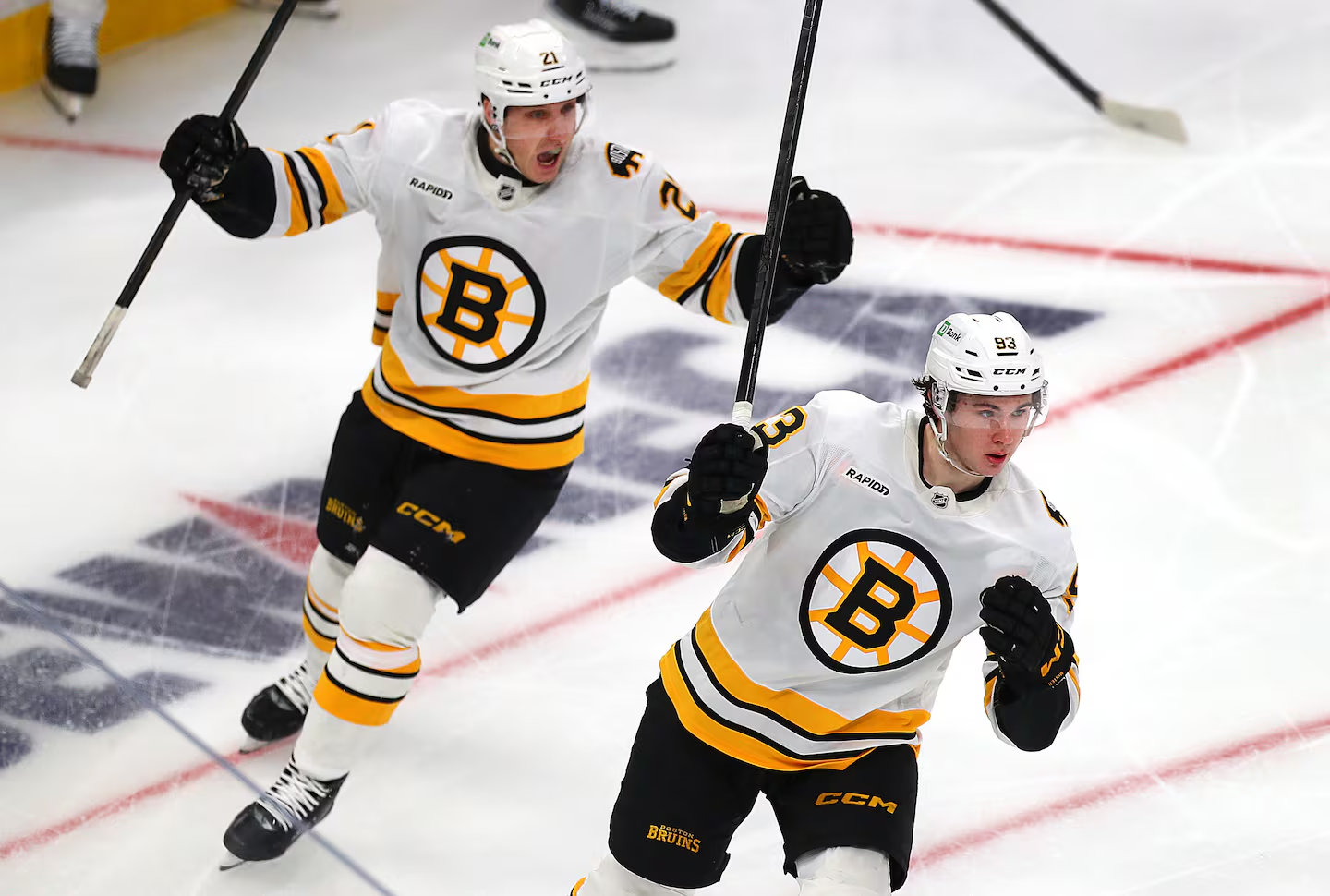
Alex Steeves recovers from ‘extremely painful’ final stretch for the Bruins with a confidence-building Team USA stint
Alex Steeves returned from Zurich on Monday, feeling more encouraged about his game after suiting up for a full tour of duty, eight games, with Team USA at the IIHF World Championship.
Read more Fox Sports, including Alexi Lalas, prepare for extensive coverage of upcoming World Cup
Steeves, 26, is hoping to find a permanent foothold in the Bruins’ forward corps next season, building on his 2025-26 debut in which he got hot off the hop following his recall from AHL Providence, then saw only limited duty after the Olympic break.
For many in the NHL, progress often isn’t a straight line. Upon reporting to training camp in September, now some 100 days on the horizon, the former Notre Dame winger would like to eliminate the detours from his career route.
“It was extremely painful,” said Steeves, reflecting on suiting up for only five of the final 25 regular-season games.
The United States did not medal at this year’s World Championship, 12 months after the Yanks clinched the gold with the Bruins’ Jeremy Swayman in their net. His play in Stockholm provided Swayman with a career booster shot. He got his game rebalanced, his head right, backed the Bruins to their return to the playoffs and was voted one of three finalists for the Vezina Trophy.
Steeves, playing wing on a variety of lines at the Worlds, delivered a goal and two assists and came away feeling the experience was “absolutely” a growth ring in his game. He and the Bruins can only hope it will prove to approximate the kind of growth it brought to Swayman’s game.
“My mind-set going in,” he said, “was to use it as a phenomenal opportunity to meet a ton of new people — teammates, coaches — and to use it as training to some degree. And to play games. Obviously, I didn’t play as many games as I wanted to, and this was a chance to work on parts of my game that I feel maybe got lost in the translation my rookie year.”
Upon his callup from Providence in November, a confident Steeves displayed an encouraging knack for getting to the net, oddly something not all wingers grasp, and finishing scoring chances. Too many of the other Bruins wingers, in fact, throughout the season and in the playoffs were spotty when it came to that essential get-to-the-net part of the job.
Steeves potted a pair of goals against the Islanders on Nov. 26 and two more on Dec. 2 at Detroit, followed by another two nights later vs. the Blues. Duly impressed with that kind of pop and promise, general manager Don Sweeney on Jan. 21 inked Steeves to a two-year contract extension, guaranteeing him his biggest paydays ($1.625 million average annual value) since turning pro with the Maple Leafs following his junior year at South Bend.
Coach Marco Sturm, impressed with Steeves from early in training camp, preseason, and upon his callup from the WannaB’s, remained encouraging about his game into and even after the Olympic break.
But the numbers grew deep at wing.
As the second line of Casey Mittelstadt–Pavel Zacha–Viktor Arvidsson became increasingly effective and inseparable, Strum began to platoon Steeves and Mikey Eyssimont. When Lukas Reichel came aboard as another winger after a March 6 trade with the Canucks, it meant more nights in the press box for Steeves.
In Zurich, be it because of the bigger ice surface or simply getting the regular game-to-game ice time and experience, Steeves gained confidence again in his game.
“I think it really just kind of reinvigorated my skill game,” noted Steeves, “and gave me the confidence to attack on the inside.”
With July 1 free agency now in the offing, there is no telling how the Bruins forward corps will be ordered.
Arvidsson, the right winger on the No. 2 line, has yet to sign an extension ahead of unrestricted free agency.
Mittelstadt, the No. 2 left wing, is likely to return, but his pay ($5.75 million) and the fact that he is but one year from UFA, could make him vulnerable to a trade. The Bruins somehow have to find a No. 1 center.
All of which should, as of today, position Steeves as fairly economical insurance in the forward mix, and potentially provide him with a prime chance in training camp to rediscover that scoring touch that brought him the two-year deal.
Year No. 1 in Boston didn’t play out exactly as he hoped, but Steeves progressed far more than he did during his four years with Toronto (14 games/no playoff experience) and the NHL time gave him bona fides for the season to come.
“Something I’ve thought about,” mused Steeves, “in many ways, the season was so extremely painful and a failure, if you measure it up to what my expectations are, which is to play every game. But at the same time, it really was a big success. I went through the free agency process (a year ago), was excited to come to the Bruins, saw the opportunity, broke into the NHL, showed I’m an NHLer, or showed I can produce in the NHL and play a lot of different roles.”
FORBIE NOT FORGOTTEN
Kennedy’s NHL farewell a real doozy
Former Bruins winger Forbes Kennedy, who forever will be remembered here for his wild night at the Garden as a member of the Maple Leafs in the 1969 playoffs, died May 25 in his beloved Prince Edward Island. “Forbie,” as he was known by teammates, friends, and the legion of NHL hopefuls he coached around PEI for decades after his playing career, was 90.
That crazy game on April 2, 1969, proved to be the fiery Kennedy’s final one in the NHL — and his exit was a doozy.
His Maple Leafs drubbed and humiliated in a 10-0 pounding in Game 1 of the quarterfinals, an incensed Kennedy took on both Bruins goalie Gerry Cheevers and Johnny “Pie” McKenzie in a protracted battle royale. The mayhem lasted some 30 minutes at the Bruins’ end of the ice with 3:46 to go in the third period.
The melee broke out near the Boston net and continued over to the sidewall, to the left of where Cheevers worked, at which point a fan reached over the short stretch of protective glass atop the boards and punched Kennedy on top of the head. No night for favored alums on Causeway Street.
“He was a tough little guy,” said Cheevers, reached by phone the other day at his Florida home. “Everybody loved Forbie.”
What truly set the episode apart, even by the day’s standards of the NHL Wild West, was that Kennedy one-punched linesman George Ashley to the ice. Be it intentional or not — and nearly a half-century later Cheevers believes it was not — it was the punch to Ashley’s kisser that led league president Clarence Campbell to suspend Kennedy for four games.
Toronto traded Kennedy to the Penguins for cash in the offseason and he was soon claimed by the Rangers in the since-scrapped intraleague draft, but he never played again in the league. Various reports over the years had it that he chose not to meet with Campbell for what was a necessary step toward being reinstated.
It turned out to be his lone playoff game that season, only the 12th of his long career, and he was finished as an NHLer at age 33.
Cheevers, in what he recalls as a moment of “arrogance,” sparked the brouhaha by slashing Kennedy some four minutes after Ken Hodge’s goal provided the 10-0 lead. If not for that slash, the brouhaha likely never would have erupted, noted Cheevers, which is why in part he said he “went to bat” for Kennedy in hopes that Campbell would not suspend him.
“I said I started the whole thing, that he shouldn’t be suspended,” recalled Cheevers, now 85, who went on to back the Bruins to their Stanley Cup wins in 1970 and ‘72. “I said he was really just protecting himself. I don’t know … I came up with some cockamamie story, that I started it and it was unfair for him to get penalized because of me.”
Cheevers took on Kennedy, he said, because Bruins defenseman “Terrible” Ted Green, perfectly capable of taking on all customers, was playing with a fractured wrist and couldn’t fight.
The netminder ultimately had two bouts with Kennedy, before and after Ashley was felled. Just as it looked like he was ready to leave the ice, Kennedy grabbed at McKenzie, who promptly gave his ex-teammate a beatdown. Kennedy’s face was a bloody mess when he finally headed to the locker room.
For his wayward ways, Kennedy was assessed 32 penalty minutes, including two minutes for slashing Cheevers, five minutes for each of the fights, a 10-minute misconduct, and a 10-minute game misconduct.
“How can I say it …?,” said Cheevers, reflecting on Kennedy’s contact with Ashley. “I don’t think there was any intent, any desire to [hit him]. I don’t think he was that way.”
A scrappy, tenacious, 5-foot-8-inch/150-pound winger — when scrappy and tenacious was the only way a 5-8/150 winger survived in those NHL days — Kennedy spent four seasons with the Bruins (1962-63 to ’65-66), in the era when the team lived on the dark side of the moon. His final days came in the seventh season in a row the Bruins missed the postseason.
Bobby Orr arrived in the autumn of ‘66, but Kennedy spent that season with the WHL California Seals and then was claimed by the Flyers in the 1967 expansion draft that doubled the size of the Original Six NHL.
Cheevers said he saw Kennedy ”at least 100 times” in the years after the two tangled. Over the ensuing decades, he played two or three times in the annual golf tournament Kennedy staged for countless summers in PEI, where he coached aspiring NHLers and also owned a bar.
“He was the king up there,” said an admiring Cheevers. “Fabulous guy, good sense of humor, perfect guy to sit with and talk, have a beer with, and smoke a cigar.”
Earlier the night of April 2, 1969, Maple Leafs defenseman Pat Quinn lined up Orr in the Boston end, Orr briefly gazing down at the puck as he began to wheel it up the right side for one of his trademark rushes. Quinn pinched down from the blue line and knocked Orr to Palookaville, sending the young phenom to MGH. Security personnel had to protect Quinn from irate fans as he sat in the penalty box.
The next night, for Game 2, a stuffed dummy in Quinn’s image, noose around its neck, hung from the Garden’s second balcony. The charged emotions around Quinn’s hit–Orr’s teammates yet to know that he was conscious and OK–undoubtedly were at play when the tempestuous Kennedy went off.
Historian Dave Stubbs, in his nhl.com remembrance piece of Kennedy, recalled what the little big man had to say upon being inducted in the Prince Edward Island Hall of Fame. Had he been dispatched to play in Timbuktu, Kennedy said, he would have arrived ready to go, hockey stick in hand.
“I believe to play hockey, you’ve got to love the game,” said Kennedy. “If you don’t, it’s a job. When we played hockey, it wasn’t a job, not for one guy in the league.”
ETC.
Andersen one of the oldies but goodies
Frederik Andersen, age 36 and 243 days when the Stanley Cup Final opened Tuesday, stands to be the third-oldest netminder in the 16-win era to get his name engraved as a his club’s workhorse if he and the Hurricanes prevail over Vegas.
Dominik Hasek was 37 and 135 days when he carried the Red Wings to the Cup in 2002. The Dominator went 16-7 that spring on Scotty Bowman’s final tour as coach. The Czech star won the Cup a second time with Detroit in 2008 as a 41-year-old, but it was Chris Osgood (14-4) who did most of the heavy lifting for Mike Babcock’s Red Wings that spring. Hasek backed up and went 2-2.
Tim Thomas was age 37 and 61 days when he completed his mesmerizing postseason run (16-9) in 2011, backing the Bruins to their first Cup in 39 long years (Dave Goucher: “Get the Duck Boats ready!”). “Tank” was named the playoff MVP/Conn Smythe winner with a 1.98 goals-against mark and .950 save percentage.
Andersen came out of Game 2 with a 13-3 mark, including series wins over the Senators, Flyers, and Canadiens. He held a miniscule 1.72 GAA and .917 save percentage.
The legendary Johnny Bower remains the oldest ‘tender to log all his club’s wins en route to the Cup. He was age 39 and 169 days when he finished backstopping the Maple Leafs to the title in 1964. It was still the NHL’s Original Six era when it took but eight wins to strike up the parade in the pre-Duck Boat era. The Maple Leafs that spring beat the Canadiens and the Red Wings, clinching both series in seven games.
Bower turned back 38 of 39 shots by the Canadiens in a 3-1 win at the Forum to clinch the semis. Dave Keon’s hat trick led the Toronto offense. Bower then shutout the Red Wings, 4-0, to clinch Game 7 and the Cup at Maple Leaf Gardens. Andy Bathgate provided the 1-0 lead early in the first and Bower turned back all 33 shots that Detroit mustered.
Loose pucks
Along with Arvidsson, the Bruins also have not agreed to new contract terms with unrestricted free agent defenseman Andrew Peeke. Both are worth keeping, but Arvidsson’s scoring touch (25 goals last season) would be far harder, and pricier, to replace … Rumors out of Detroit in recent days were that speedy, prolific center Dylan Larkin wants to be moved, the captain having grown tired of waiting for a franchise turnaround. He would be a prime fix to the Bruins’ No. 1 pivot vacancy and is under contract for four more years at a tolerable $8.7 million per. The starting offer would have to include Fraser Minten and a first-round draft pick. It could take a second first-rounder for it to be a serious bid. Larkin between Morgan Geekie and David Pastrnak the next four seasons could lift the the Bruins’ status from playoff-fit to Stanley Cup-ready … Brett Howden, proud son of Oakbank, Manitoba, entered Game 3 of the Cup Final Friday as the postseason’s No. 1 goal scorer (13). He was drafted by the Lightning, shoved to the Rangers, then sent on to the Golden Knights for a pocketful of mumbles in July 2021. Per ESPN’s Sean McDonough, during the Game 2 broadcast, it was former Boston University coach David Quinn, then the Rangers’ bench boss, who most shaped Howden’s game, encouraged the forward to play with grit and purpose. The fit in Vegas has proven perfect and he is under contract for four more seasons at a mere $2.5 million. If the Golden Knights clinch the Cup for a second time in four years, he’s currently the top Conn Smythe candidate for playoff MVP.
Read more The NBA still has not figured out the right timing for its regular-season awards



Post Comment