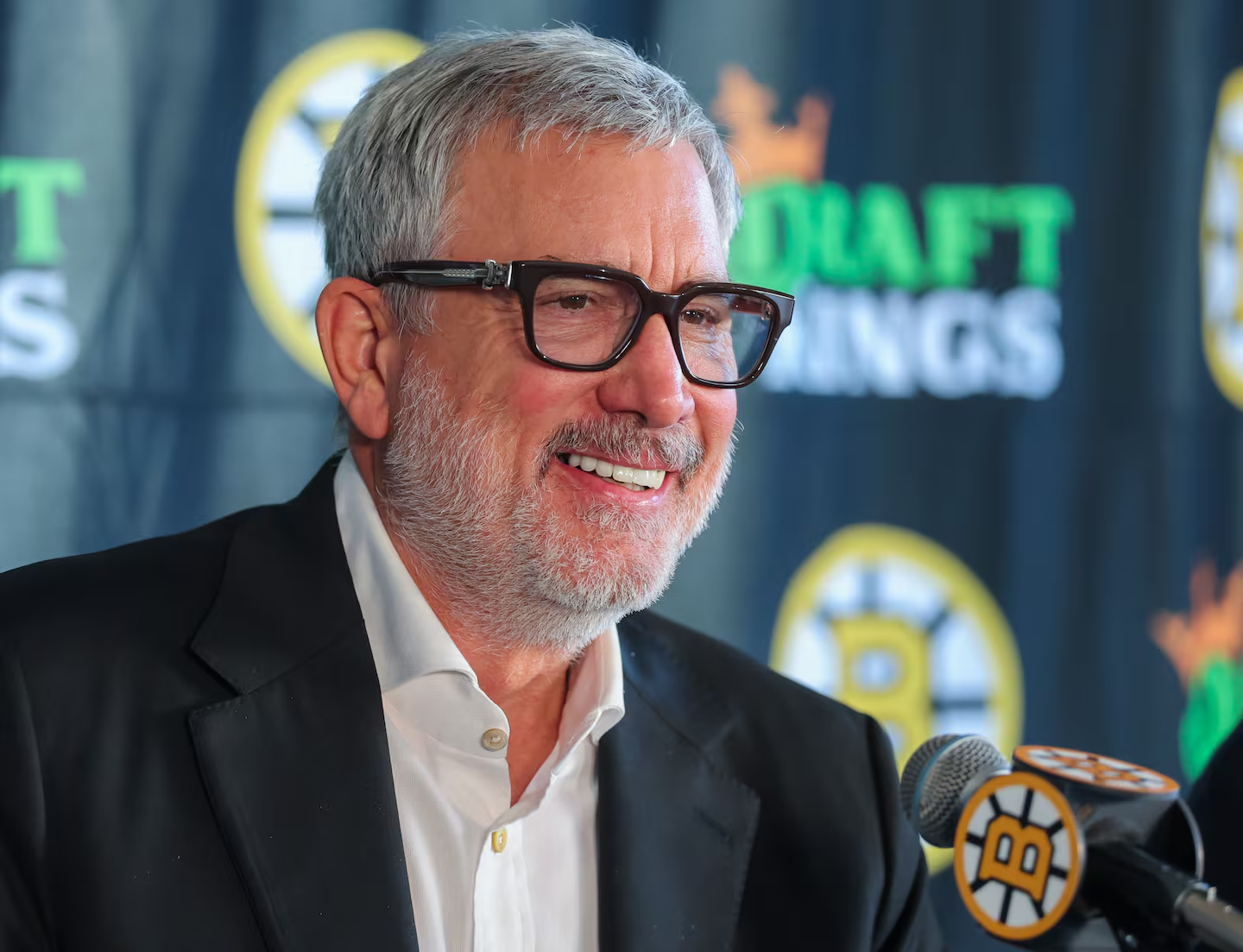
‘One of my best birthday gifts’: Forty years later, Bruins legend Cam Neely looks back on the trade that brought him to Boston
Cam Neely, headed to New York for a family wedding this weekend, on Saturday will celebrate his 61st birthday.
Read more In this sad Red Sox spring of 2026, they’re no longer the talk of the town, and other thoughts
“So all in all,” mused the Bruins’ president prior to leaving town, when asked how he’d spend his birthday, “nothing too exciting, really.”
For Neely, the day always carries meaning far beyond cake and candles and, this year, that giant step closer to filing for Social Security. June 6, 1986, precisely 40 years ago, was the day he was traded to Boston from Vancouver, a move that altered everything for the little-known right winger, and also dramatically revivified the sputtering Black and Gold.
“There’s certainly times I think about it,” said Neely, a hidden gem in Vancouver, lost amid the Canucks employing three bench bosses in his first three NHL seasons. “I say to myself, ‘What would my life have been if I didn’t get traded,’ right? I still think of it as one of my best birthday gifts.”
Indeed, there are rites of passage and then there are episodes, some subtle and some seismic, when one’s universe gets flipped and reconfigured. The deal by general manager Harry Sinden, then at the peak of his trading prowess, placed Neely immediately on a path to stardom and eventually on to the Hall of Fame, the C-suite, and his No. 8 lifted to the rafters on Causeway Street.
Neely’s acquisition reset a franchise that endured three consecutive first-round playoff knockouts by the Canadiens prior to his arrival. The Habs that spring won the Stanley Cup yet again, this time with rookie sensation Patrick Roy in net. The Bruins lost nine of their 11 games with the Canadiens across those three springs, 1984-86.
Montreal, Sinden noted to Globe writer Francis Rosa the day of the Neely deal, framed the league model for success and for how the GM was trying to remake his lineup. In the weeks and months prior to June 6, he’d added Reed Larson (D), Tommy McCarthy (F), and one of Neely’s Vancouver teammates, Thomas Gradin (F), all with an eye for creating a more consistent, balanced offense.
“I’d like to create a threat on every line,” said Sinden.
To make Neely a key piece of the mosaic, Sinden surrendered Barry Pederson, the popular and prolific center, but also acquired Vancouver’s first-round pick for 1986 or ’87. It was for the Bruins to choose, and Sinden quickly opted for ’87, a draft that already had Pierre Turgeon positioned to go No. 1 as a generational centerman. The Canucks ended up with the No. 3 pick in ’87, and the Bruins used it to select defenseman Glen Wesley. Turgeon went No. 1 to Buffalo.
The trade for Neely led the Globe sports section the next morning. The name of the spare part in the Canucks’ lineup did not make the headline.
“Bruins deal makes Pederson a Canuck,” it read in large type.
With 40 years of hindsight, Neely credits his near-instant success here to multiple factors, need and opportunity high on the list. The Bruins needed pop, both in a physical and scoring sense, and offered him the chance to grow his game right off the hop. Coach Butch Goring piled the ice time high on his plate.
“They put me with really good players right from training camp,” recalled Neely. “And I was like, ‘Wow, OK, this is different, I’ve never really had this opportunity. I better do something with it.’ ”
It was, recalled Neely, precisely what he tried to deliver in his three years in Vancouver. The smaller Boston Garden surface, its neutral zone the size of a twin bedsheet, played to his nature for getting into contact in open ice, along the boards, even in the hallway if so needed. The rough-and-tumble Adams Division was his bread and butter.
It was the polar opposite of Vancouver. After year No. 3 there, which had coach Tom Watt constantly harping on Neely’s need to build more defensive accountability into his game, he didn’t know what to think.
“I ended the year on a down note,” recalled Neely, his last shifts with Vancouver skated in a Round 1 playoff loss to the Oilers. “I remember one game I was centering the fourth line. I mean . . .”
Recalling that classic, perpetual back and forth, with a coach wanting one thing and a player another, today causes Neely, as team president, to chuckle, especially when looking at clips of his own early game.
“I look at the way I played,” he said, “and I’m like, ‘Oh, my God, what are you doing, why are you swinging out on that play?! Stop! Just stop!’ ”
Read more Three records fall, including the state triple-jump mark, during first day of Meet of Champions
Neely averaged just shy of 40 goals his first three seasons in Boston, by age 24, and followed with back-to-back seasons of 55 and 51. He helped the Bruins finally beat the Canadiens in the 1988 playoffs, and reach the Cup Final in ’88 and ’90. In the thick of those early years, Sinden dubbed him the NHL’s first power forward, a combination of brutal force, speed, and will to score. There were others in that era who played with similar gusto, such as Bob Probert, Rick Tocchet, and Kevin Stevens, but none who paired tenacity and scoring touch like Neely.
In today’s faster, leaner, and, shall we say, less ferocious NHL, Neely agreed, wingers such as Tom Wilson (Capitals) and Brady Tkachuk (Senators) still summon the good stuff. But the emphasis on speed and skill in NHL 2026 has sent players with his locomotive approach largely off the rails.
“It’s a little more friendly to get [to the net] now,” Neely said, not so much as a lament but as a way of noting how forwards look to gain “inside ice” by other means than sending opponents to Palookaville.
Neely was unaware during his playing days that it was western scout Bart Bradley, one of Sinden’s closest confidants and top talent assessors, along with assistant GM Tom Johnson, who pushed hard to bring Neely to Boston. Bradley, living in British Columbia, spotted in Neely what the Canucks could not see.
Scott Bradley, the late Bart’s son, still scouts for the Bruins. He sat aside Neely in the stands during a Bruins practice in Vancouver in early January of this year. If not for the keen-eyed Bart, maybe the June 6, 1986, ticket to Boston never gets written.
“Right?” concurred Neely, as he left the practice rink in Vancouver. “I didn’t find out about Bart for years and kind of feel bad about that because, my Hall of Fame speech, I would have mentioned Bart, for sure. I just didn’t know.”
Sinden, reached by telephone on Thursday, gave Bradley due credit for insisting that he make the deal.
“Oh, yeah,” said Sinden, 93, after first noting surprise it was 40 years since the trade. “In fact, we had a couple of guys on that [Vancouver] roster we liked. Every time I’d mention one of the other guys, Bart would yell at me, ‘Forget him. You want Neely!’ ”
Sinden noted he had no way to tell that Neely would turn into such a force, make such a profound impact on the franchise.
“The proof of that, I guess, is that [Vancouver] didn’t know, either,” said Sinden. “Because as we talked through the trade, every time I mentioned someone else, they said no, and kept bringing up Neely instead.”
The day the deal came down, Neely was working out at a health club in his hometown of Maple Ridge, just north of Vancouver. The family had a birthday party planned for him that evening. Everything turned upside down with a phone call from his sister, Shaun, telling him that he had to call GM Jack Gordon.
“She says, ‘You’ve been traded!’ ” recalled Neely. “And I’m like, ‘Uh, what?’ So I scrambled to get home and call. She didn’t know the details, just that I had to call the GM.”
The discussion with Gordon, said Neely, was “short and sweet,” Gordon confirming that he had been dealt — a local call that sent him long distance, some 3,200 miles east to a new life in Boston.
But first, a moment’s hesitation.
“Boston at the time was the better team,” recalled Neely. “And I’m like, ‘Well, if I’m struggling playing in Vancouver, how am I gonna play in Boston?’ ”
The answer came quickly, and still resonates, 344 of his 395 goals and 40 years later.



Post Comment