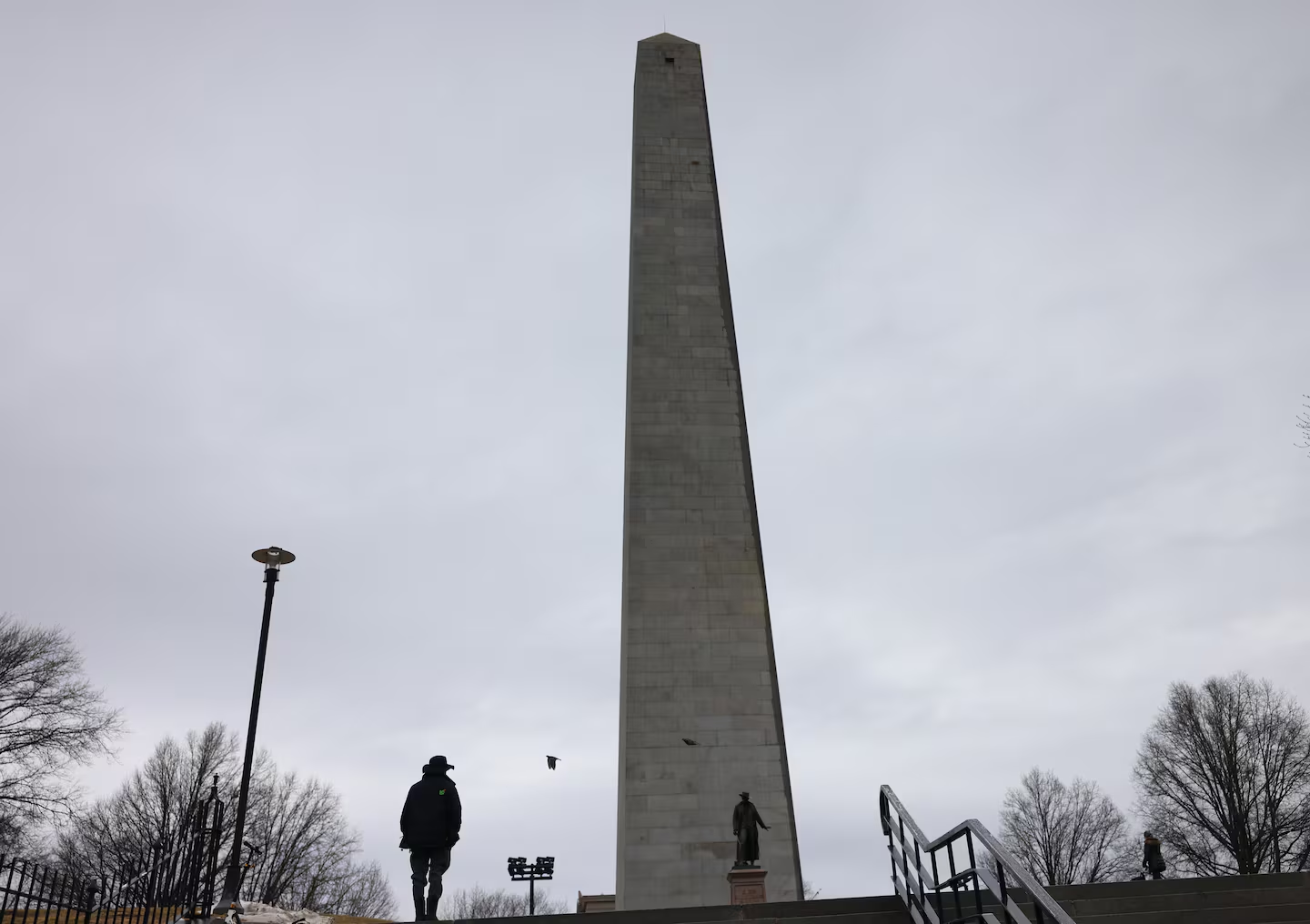
Quotes about slavery, immigrants, and war memorials slated for removal from Bunker Hill historic site
The National Park Service has ordered the removal of three quotes that reflect on slavery and immigrants’ places in the American Revolution and question war memorials built to honor death rather than “glorify life” frominterpretative panels at Charlestown’s Bunker Hill Monument, officials said Thursday.
Read more Graham Platner to hold Maine rally with Representative Ro Khanna as scandals shake up campaign
US Senator Edward J. Markey’s office confirmed to the Globe the three quotes are due to be removed from the historic site that is part of the National Parks of Boston.
In a statement, Markey criticized the Trump Administration for planning to remove the quotes on the memorial to one of the first major battles of the American Revolution.
“The Trump administration’s patriotism is weak enough to be threatened by American voices and American history, so they try to silence it with the implicit consent of Republicans in Congress,” Markey said in reaction Thursday. “But I know real Americans’ patriotism doesn’t need censorship to survive — American patriotism is backed by our freedom to speak and be heard.“
“And the Administration should learn from all the lessons of Bunker Hill: America was built on the fight for that freedom,” Markey said in a statement to the Globe. “No money from Congress should go to the Trump censorship brigade.”
The Washington Post first reported on the proposal to remove the quotes.
The proposed removal comes just weeks before the site is to celebrate the 251st anniversary of the Battle of Bunker Hill on June 17.
It also comes about year after the Trump Administration issued a directive targeting national park signs, statues, and other public monuments that “inappropriately disparage Americans past or living.”
The 221-foot tall granite obelisk,which soars over Charlestown, was restored ahead of the nation’s 250th anniversary celebration. The quotes appear to be on panels in a museum next to the monument.
A spokesperson for the Interior Department, which oversees the parks service, called the removal of the quotes “a routine exhibit refresh.”
“Efforts to transform a route exhibit refresh into a story attacking President Trump and this administration is tired, and the American people see through it,” the spokesperson said in an emailed statement to the Globe.
“Through President Trump, we have encouraged Americans to visit our cultural and historic sites and engage in meaningful conversations about the moments that have shaped our country,“ the email said. ”By telling the full story, every triumph, every challenge, and every step towards a more perfect union we strengthen our shared understanding and ensure that future generations inherit not just the land we love, but the truth of the journey that brought us here.”
Some preservationists criticized removing the quotes from a place devoted to public memory, with one advocate saying it amounted to censorship.
Kristen Sykes, Northeast regional director of the National Parks Conservation Association, an advocacy group, denounced the actions as contrary to the very ideals fought for in the Battle for Bunker Hill on June 17, 1775.
“As Americans, we rely on our national parks to help us understand the stories of our past and their relevance to our present-day struggles,” Sykes said. “Bunker Hill tells the story of our fight for democracy and for the rights of all people to be free.”
“It continues to be a place where people gather in protest and celebration still today,” she said. “Censoring the contributions of any people that came before us would go against the very ideals that were fought for at this place. Our national parks belong to all of us. Visitors deserve the chance to learn our struggles and triumphs alike, free of government censorship.”
Read more US employers likely added 105,000 jobs in May with labor market stable despite costly Iran war
One of the three quotes targeted for removal include one written by G.B. Stebbins in a letter to abolitionist William Lloyd Garrison on May 22, 1846.
“As we drew near to Boston, there stood Bunker Monument, towering up towards the heavens, as if in silent, bitter mockery of the millions of slaves guarded by the professed lovers of Liberty, who reared its lofty column,” Stebbins wrote.
Another of the quotes comes from an anti-war editorial printed in The Boston Globe in 1971. Arthur Johnson and Bestor Cram, of Vietnam War Veterans Against the War, wrote the editorial.
“We find, upon reflection, that our duty to our country has not ended … We as Vietnam Veterans, strongly feel that the United States should cease to build memorials to death and begin to glorify life,” they wrote.
The third quote, from May 8, 1875, also was published in The Pilot. It was addressed “To Our Irish Societies.” The Charlestown neighborhood around the monument was heavily settled by Irish immigrants.
“Now that a public orator has declared that foreign-born men have no association with the men of the Revolution, it is our duty to show that in love of freedom and loyalty to the republic, the citizens of foreign birth take no second place,” the quote said.
Tourists at the monument Thursday evening said they didn’t understand the impetus to alter the panels.
“I don’t see the sense in removing them,” said Josef Kracik, 35, a tourist visiting the Bunker Hill monument from the Czech Republic. “They’re helpful for tourists and for local citizens to get to know the history,”
“I think it’s important to keep reminding people what happened and how,” said Michal Jachym, another Czech tourist. “To avoid the mistakes we made or our ancestors made in the past.”
Kyera Singleton, executive director of the Royall House and Slave Quarters in Medford, said she was distressed by the decision to scrub the quotes from the public display.
“It’s extremely upsetting and disappointing that we’re in the midst of a celebration of freedom, and we’re being reminded of ‘freedom for whom’ and ‘freedom for whose stories,’“ Singleton said.
“You can’t talk about that battle without talking about the men of color who put their lives on the line there,” she said.
Brian MacQuarrie, Kathy McCabe and Jim Puzzanghera of the Globe Staff contributed to this report.


Post Comment