R.I. House unanimously passes bill to make crash data public record
PROVIDENCE — The Rhode Island House of Representatives this week unanimously approved legislation that would make clear that statewide traffic accident data is a public record.
Read more US sanctions Cuban President Miguel Díaz-Canel in latest move pressuring island’s leadership
But as of Thursday, and with the 2026 legislative session nearing an end next week, the Senate had not yet scheduled a vote on the bill.
The state Department of Transportation collects crash data for Rhode Island’s 39 cities and towns, but it has refused to make that information public, claiming the data is not a public record under state law and that federal law prohibits “the discovery of crash data in litigation.”
But advocates say 42 other states make crash data available to the public, showing that the federal law is not a barrier. And they note states such as Massachusetts go a step further and put the crash data on an online dashboard so people can easily see where traffic accidents are happening in their cities and towns.
On Thursday, the House voted 65 to 0 for introduced by Representative Rebecca Kislak, a Providence Democrat, that would declare crash data a public record, while stipulating that it may not be used in violation of federal law.
“Transparency about where crashes happen is in the best interest of the public and public safety,” Kislak said in a statement. “We should all know what is happening on our streets.”
She said there is no reason or benefit to keeping that kind of information secret.
“If anyone would like to help identify the places where people are getting hurt, their efforts should be welcomed and met with assistance,” Kislak said. “The public is much better served when people have the information they need to identify dangers and advocate for change.”
Senator Meghan E. Kallman, a Pawtucket Democrat, has introduced companion legislation, which has been held for further study by the Senate Judiciary Committee.
On Thursday, Senate spokesman Greg Pare said, “That legislation is under review.”
Cranston Police Chief Michael Winquist opposed the bill in written testimony submitted to the Senate Judiciary Committee, which includes Senator Todd Patalano, a Cranston Police Department major and second-in-command.
“While transparency in government is essential, this legislation raises significant concerns relating to privacy, misuse of sensitive information, and increased administrative burdens on law enforcement agencies,” Winquist wrote.
Police traffic accident reports often contain personal identifying information, including names, home addresses, phone numbers, and dates of birth, he said.
“Crash reports should be accessible to those with a legitimate need — such as involved parties— but should not be broadly available to the public,” Winquist wrote. “Accident reports are routinely used by predatory individuals and businesses to solicit victims, including aggressive tow operators, ‘runners,’ and third parties seeking to profit from a crash.”
Also, he said police departments face “significant staffing and resource demands,” and he predicted the legislation would result in more public records requests.
During a Senate Judiciary Committee, Patalano asked an advocate if the crash data could be sold.
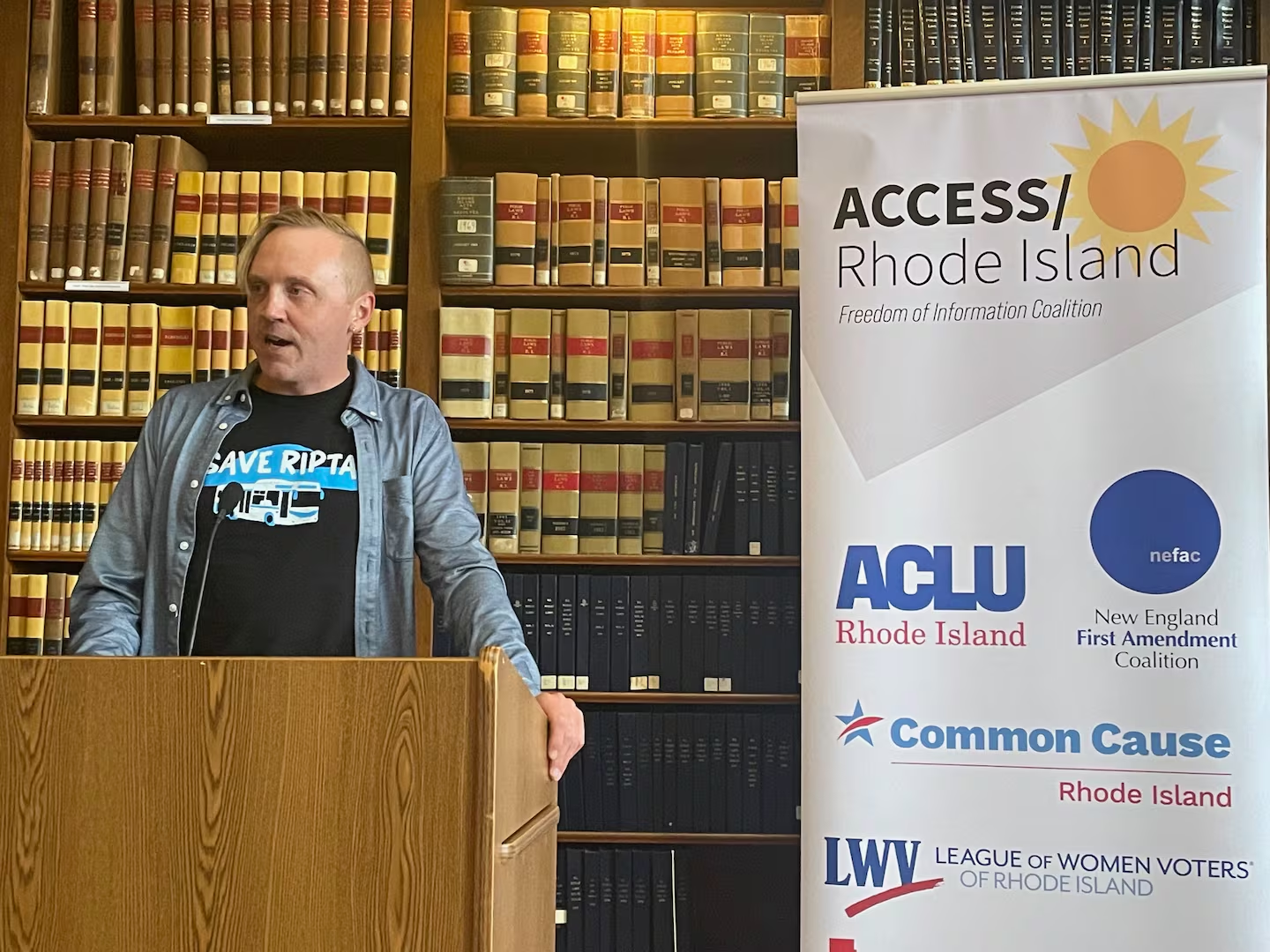
Dylan Giles, operations manager for the Providence Streets Coalition, said his organization is not planning to sell the information, and it’s not interested in any of the personally identifiable information, which can be removed from the public records. And if the data is public, there would no incentive to sell it, he said.
Giles said the coalition wants to assemble statewide data, as it did for Providence crash data, so it can map the locations of crashes involving automobiles, pedestrians, bicycles, and scooters.
Giles said he knows of no crash data portals that make personally identifiable information available. Rather, he said, the portals are focused on basic facts such as the location, time, and road conditions of a crash so that advocates can press public officials to make the streets safer.
“We have a duty to respond when crashes are happening on our streets — to respond forcefully to the people who make decisions,” Giles said. “RIDOT would want you to believe they are using the data, but I’m not willing to trust them when people continue to die on state roads throughout the state. It’s overwhelmingly in the public interest that this data should be made public.”
Giles emphasized that crash data is already available from individual police departments. Not all agencies have the technical means to compile reports that include all crashes, he said, but the Department of Transportation has that data in hand.
The legislation would actually lead to fewer public records requests, Giles said, because advocates could get statewide data from the Department of Transportation rather than requesting it from individual police departments such as Cranston’s.
While Cranston police are raising privacy concerns, the American Civil Liberties Union is backing the bill.
“The ACLU urges passage of this legislation in order to better promote the public’s right to know and to potentially promote better ideas for making our roads safer,” the ACLU of Rhode Island said in written testimony. “Contrary to the DOT’s disingenuous arguments to the contrary, nothing in federal law serves as a barrier to doing so.”
John M. Marion, executive director of Common Cause Rhode Island, questioned whether legislation is even necessary to make crash data public since the vast majority of states makes that data public while “RIDOT reflexively withholds it from the public.”
“Obviously, privacy concerns have not stopped 42 of the 50 states from releasing the information,” he said.
Marion noted the crash data bill is one part of another legislative proposal that would make 49 changes to the state Access to Public Records Act. But that overhaul — championed by Senator Louis P. DiPalma, a Middletown Democrat — is expected to once again die in committee while facing widespread opposition from Governor Daniel J. McKee’s administration.
Read more Kennedy Center tells staff to immediately remove Trump’s name from documents



Post Comment