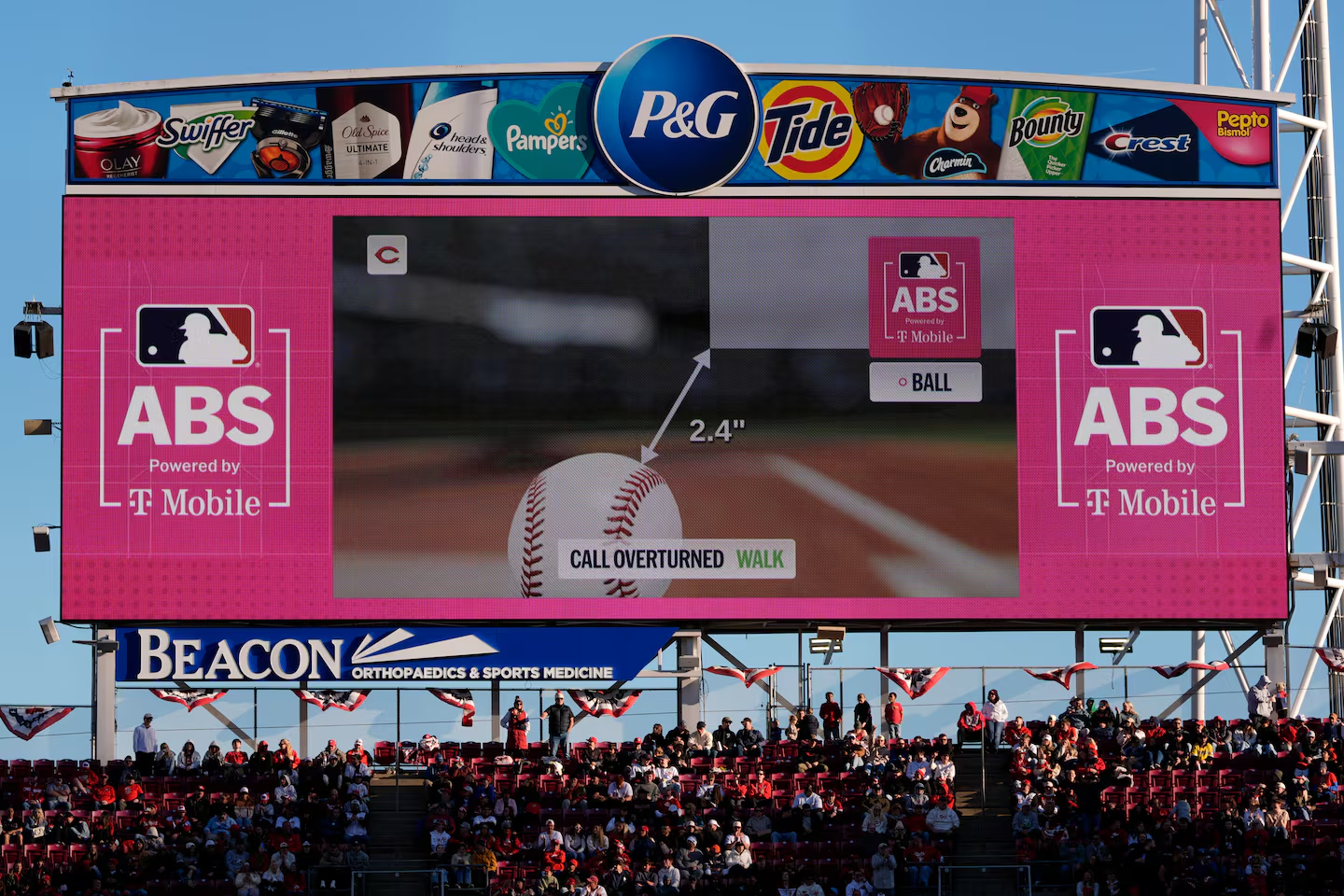
The Red Sox have been baseball’s worst team on challenges this season, and here’s what they’re doing about it
The Royals seem an unlikely source of inspiration for the Red Sox. After all, Kansas City is one of the few American League teams with a worse record than Boston.
Nonetheless, prior to the series finale at Kauffman Stadium on May 20, the Royals ran through a drill that captured their opponent’s attention.
Four hours before the game, their catchers squatted behind home plate and practiced receiving pitches fired from a machine to the edges of the strike zone. The catchers would identify the pitch as a ball or strike, then turn to a nearby iPad to see whether their “call” had been accurate — a simulation of the automated ball-strike challenge system (ABS) implemented this year.
The Royals have done this all season. They track the results, which serve as the basis of a friendly competition among their catchers. The practice was notable given that the Royals have been one of baseball’s best teams on challenges.
They rank fourth in challenges won (78) and success rate (59 percent). Salvador Perez alone has won 33 overturns behind the plate, second-most in MLB. How much does the nine-time All-Star feel the practice has helped him?
“A lot,” said Perez. “Every other day we go outside and use the ABS, because we’ve got to get used to it.”
Given the Royals’ pregame work, their success in games, and the deficiencies of the Red Sox using ABS, there was a natural curiosity: Why weren’t the Sox doing the same thing?
Through May, the Sox had not practiced using ABS. On Tuesday at Fenway Park, that changed.
Four hours before their game against the Orioles, catchers Mickey Gasper, Carlos Narváez, and Connor Wong squatted behind the plate with a succession of batters (Romy Gonzalez, Caleb Durbin, Isiah Kiner-Falefa, as well as the three catchers). Interim bench coach José David Flores served as an umpire. Based on his calls, catchers decided whether to challenge. The location of the pitch then appeared on the scoreboard to demonstrate whether the challenge was successful.
The impetus for the pregame work?
“We just haven’t been as good at it as we need to be,” interim manager Chad Tracy said.
That is an understatement. The Sox have been baseball’s worst team on challenges.
Read more Wednesday’s boys’ volleyball roundup: Amaris Cotto, Newton North KO Lexington in five sets
Through Tuesday, they’d challenged less than any team (86 times), secured the fewest overturns (38), and posted the third-worst success rate (44 percent). Their batters had won just 19 challenges, second-fewest. Their catchers had likewise won 19 challenges, fewest in the big leagues.
The way Sox catchers, in particular, have used the system has been a subject of discussion. Not only have the backstops had a modest 51 percent success rate (23rd in MLB), they’ve been far and away the most cautious. Sox catchers have challenged roughly one-third (37) that the major league-leading Marlins have (109).
After the Sox had a second game derailed by a pair of early failed challenges — leaving them without any means of protesting a staggering succession of missed calls by home plate ump Laz Diaz in a loss to the Rays — they overcorrected while trying to preserve challenges for high-leverage spots. The Sox concluded that they needed to encourage their players to be more aggressive in using challenges early in games.
“We had reached the one-third point of the season, and we look back and we’re like, ‘This is something that we can be better at. How can we do that?’ ” said catching instructor Parker Guinn. “One, probably in some messaging to the players, and then, two, why not practice it a little bit more?”
During the recent trip to Cleveland, Sox coaches emphasized to players that challenges are renewable when correct, meaning that — especially with two challenges in the team’s pocket — players shouldn’t shy from protesting calls they consider obvious. The introduction of pregame drills to reinforce the players’ sense of the strike zone is meant to add to the confidence of hitters and catchers to challenge.
“When you get one right, you don’t lose it. It’s not like you can only use two challenges every game. So when our guys feel that the call wasn’t right, they should feel confident letting it go,” said Guinn. “On ones that they’re fringe on, they should probably make sure that it’s the right situation. But these environments hopefully will help them kind of calibrate if the call was right or not.”
The Sox have seen the difference a challenge — or non-challenge — can make. On Sunday in Cleveland, the Guardians’ lack of a challenge on a full-count pitch set in motion a winning Red Sox rally. Each successful challenge is potentially the first of a series of game-altering dominoes, with the potential for one pitch to alter the outcome of one at-bat, which can influence an inning or a game. Even when the outcome of an at-bat isn’t changed, a starting pitcher might get bounced from the game earlier, with implications for that game and the rest of a series.
Given the potential value of a challenge, the Sox want their players to be less shy.
“We’re just making sure that our guys know that we have confidence in them, and that they should have the confidence to go any time that their eyes tell them that the call wasn’t right,” said Guinn.
Read more Jalen Brunson, Knicks finish on 11-0 run to steal Game 1 of NBA Finals from Spurs



Post Comment