How the World Cup has changed since the last time it was held in the United States in 1994
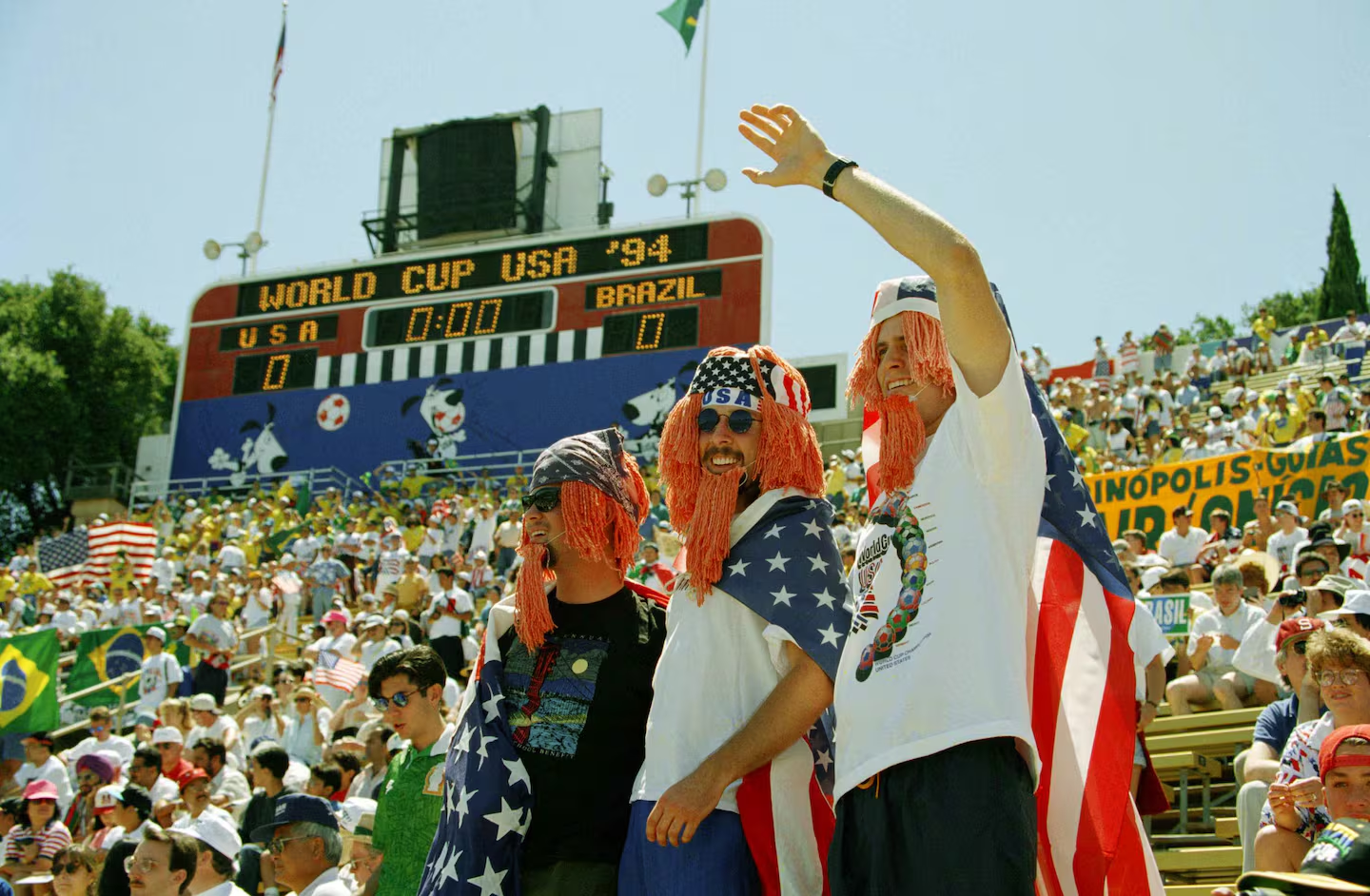
When the United States last hosted the World Cup in men’s soccer, the home team was delighted to be still playing on the Fourth of July.
Read more The most Seth Moulton-like candidate running to replace him just may be a Republican
“Hopefully two or three Cups from now it’ll be whether they’re going to win the World Cup,” mused goalkeeper Tony Meola, whose teammates survived their group in 1994 despite being 80-1 underdogs.
More than three decades later as the United States cohosts the quadrennial footwork festival along with Canada and Mexico, the question is whether the Americans can reach the quarterfinals of what has become a bewildering 48-country block party.
That hasn’t happened since 2002 in Korea, when the field numbered 32. Since then, the Yanks have survived their group in three out of four appearances. Four years ago in Qatar they drew with England and gave the Netherlands a spirited go in the second round before bowing out.
“We’re moving in the right direction, for sure,” captain Tyler Adams said then. “But we need to keep pushing because we’re not there yet. But we’re close.”
The team’s slogan then was “Only Forward,” which has been the objective ever since the United States ended 40 years in the global wilderness by qualifying for the 1990 tournament in Italy.
“I don’t believe in the Big Bang Theory,” said coach Bob Gansler, whose wide-eyed bunch of young amateurs performed respectably that summer despite losing all three matches to favored European sides. “It’s an evolutionary process.”
The Americans’ evolution since then has hardly been linear. The promise of 1994, when the United States held eventual champion Brazil to a goal in the second round before nearly 85,000 spectators at Stanford, was followed by a three-and-out pratfall four years later that a French newspaper called “la illusion Americaine.”
“We are not leaping forward,” observed US Soccer president Alan Rothenberg. “We are inching forward.” The early exit prompted a $50 million investment in what the federation called Project 2010, aimed at turning the national team into a top Cup contender by then.
“If we can put a man on the moon we can do this,” said secretary general Hank Steinbrecher.
The 2002 squad was composed of a cadre of seasoned veterans and precocious youngsters such as Landon Donovan and DaMarcus Beasley.
“There was some scar tissue from 1998,” observed coach Bruce Arena, whose squad was a 300-1 long shot. “Getting them to believe they could win was a challenge.”
But the Americans shocked Portugal in the opener, drew with the Koreans, and blanked Mexico before falling to the Germans by a goal. Yet if the hosts hadn’t beaten the Portuguese the United States, which had lost to Poland, would have been eliminated.
“The thing that everybody forgets is that we squeaked into the second round in 2002,” midfielder Pablo Mastroeni said when the United States was bounced after three matches four years later in Germany after scoring one goal in 270 minutes. “And all of a sudden we were the best thing since 1950.”
When the Americans have advanced in the Cup they’ve had to walk the high wire to do it. In 2010, after rallying to draw with England and Slovenia, they needed a 91st-minute goal from Donovan against Algeria to move on.
In 2014, having conceded an added-time draw to Portugal and losing to Germany in the “Group of Death,” the United States stayed alive on goal differential. Last time, the Yanks had to sweat out nine minutes of added time to beat Iran when a draw would have finished them.
The margin of error in the Mundial is minimal at a time when the rest of the world has caught up even to the traditional masters.
England, which invented the game, hasn’t hoisted the trophy since it hosted 60 years ago. Brazil, which claimed the Cup three times when Pele played, hasn’t managed it since 2002.
After Italy won in 2006, the Azzurri went out twice in the first round and have failed to qualify for the last three tournaments.
Read more Smiley, Morales spar in first Democratic primary debate of Providence mayor’s race
Germany, the 2014 victor, hasn’t survived group play since. Argentina’s triumph four years ago was its first since 1986. And the Netherlands never has won the Cup.
The sport moves on and countries that stand still soon find themselves moving in reverse. “This isn’t a time trial,” federation president Sunil Gulati mused two decades ago after the Americans finished 25th of 32 in Germany after coming eighth in 2002. “Other countries are getting better, too.”
Four years ago nations from four continents won their groups and three reached the semifinals. The upsurge from Africa and Asia was startling.
Morocco, which tied Croatia and beat Belgium, the 2018 silver and bronze medalists, also took out former titlist Spain, shut out Portugal, and pushed France to the 79th minute in the semis.
Tunisia beat the French, Cameroon knocked off Brazil, and Senegal went 99 minutes with the Dutch. Saudi Arabia stunned Argentina and South Korea denied Portugal.
And Japan, which came from behind to beat former champions Germany and Spain, went to a shootout with Croatia.
When the Japanese made their Cup debut in 1998, all of their players came from the domestic league from teams such as the Kashima Antlers and Shimizu S-Pulse. Last time 19 of them performed for European clubs, eight of them in Germany.
The US roster, which was dominated by players from the American Soccer League, Western Soccer League, and college varsities in 1990, had half a dozen members of European clubs on the 1994 squad.
Despite the advent of Major League Soccer, the US team’s focus on the Continent intensified in 2002 with a dozen players from four countries on the list. By 2010, all but four played in Europe, eight of them in the English Premier League.
This year’s Cup roster has the customary European emphasis with even broader representation, with 17 players suiting up in seven countries on the continent, eight of them projected starters.
Chris Richards, Antonee Robinson, and Adams play in England, Christian Pulisic and Weston McKennie in Italy, Tim Weah and Folarin Balogun in France, and Malik Tillman in Germany.
Yet the Americans’ longstanding familiarity with European players and styles hasn’t helped them in the Cup, where they’ve won only one of 20 meetings since 1990.
“There is still a little too much respect on our end when it comes to the big stage,” coach Jurgen Klinsmann observed in 2014, after the United States went out to Belgium in extra time in the second round. “Why not really play? It is something that we have to go through. I don’t know how many years it takes.”
The Yanks produced draws with Wales and England in 2022, before being schooled by the Dutch. Since then, they’ve lost all seven meetings with European rivals and have been outscored, 19-5.
That was the initiation for Uncle Sam’s novices when they returned to the global stage in 1990 after four decades in the outback and were beaten by the Czechs, Italians, and Austrians. “We had to start somewhere,” said Meola, whose colleagues were 500-1 long shots. “And we started at the bottom.”
A dozen years later the US made the final eight and pushed the Germans to the limit before going out. Since then, the Americans haven’t survived a knockout round.
“You would think that we would have gone further,” Donovan, who played in three Cups, told Rich Eisen recently. “How we haven’t done that since is alarming.”
With 16 teams added to the field the hosts will have to survive an extra round to get to the quarterfinals. Simply getting out of the group won’t be deemed enough, especially in a foursome that doesn’t include any rivals ranked in the top 20. This time, the hosts playing on Independence Day won’t be celebrated but assumed.
Read more Trading for A.J. Brown was the right move for the Patriots, but there’s a lot not to like about it



Post Comment