New Balance has invested in Boston’s sports landscape — especially running — and it’s paying off
If you’ve spent any time in north Brighton, or happen to commute in and out of Boston on Interstate 90, it’s hard to miss New Balance’s growing miniempire at Boston Landing.
There’s the New Balance world headquarters, which looks a bit like a massive cruise ship ready to sail west down the Mass. Pike. Just next door, the Celtics and Bruins practice at adjacent facilities owned by the Boston-based footwear and apparel giant.
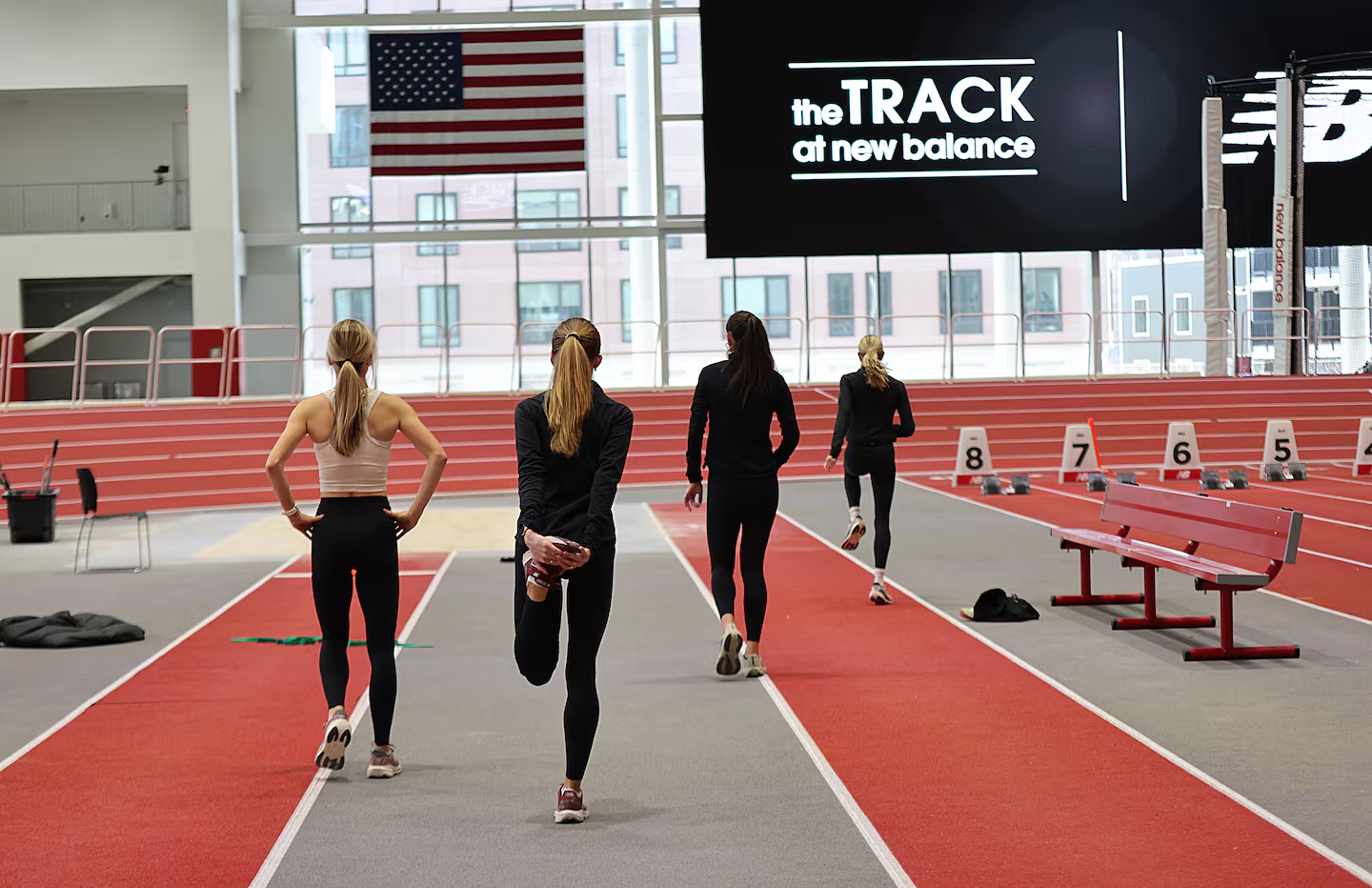
And across the street is the state-of-the-art “TRACK at New Balance,” which already has established itself as one of the premier indoor track facilities in the world, among a few dozen other uses.
Team New Balance Boston, the elite running group based out of the Brighton facility, has spent a decade or so churning out Olympians and national champions, all under the guidance of Olympian and Attleboro native Mark Coogan.
Coogan’s a New Balance lifer, from qualifying for the 1996 Olympic marathon in Atlanta in a pair of New Balances to his return to the brand to head an elite training group in 2014.
“I don’t think I’ve put on another pair of shoes, other than New Balances, since 1993,” he joked.
With a relationship spanning 20-plus years, bringing him aboard to coach the group was obvious.
“He was a no-brainer,” said Tom Carleo, New Balance’s vice president of running for North America. “I’ve known him for years and years, he’s a very, very dear friend of mine. It’s a very New Balance kind of thing, very connection-based. We like to use that word ‘family’ a lot, but it was a very family sort of feeling.
“It was the perfect fit. He’s kind of proved that to be the case for the last 10 years or so.”
Coogan’s work back at New Balance started with Abbey D’Agostino, a seven-time NCAA champion under Coogan at Dartmouth, who in 2016 reached the Olympics in the 5,000 meters.
Vermont native Elle Purrier St. Pierre, who ran collegiately at New Hampshire, and Peabody’s Heather MacLean, a UMass grad, each claimed Olympic spots for the 1,500 meters in Tokyo in 2021.
Purrier St. Pierre won an indoor world championship in the 3,000 meters, returned to the Olympics in Paris in 2024 (teammate Emily Mackay made those games, too), and has set a number of American records running for New Balance.
Outside of Purrier St. Pierre, the team has undergone plenty of evolution. New Zealander Kimberley May and Britons Alex Millard and Shannon Flockhart all joined the team for 2026 after standout careers at Providence College, along with Mattapoisett’s Margot Appleton and 800-meter US champion Roisin Willis.
For the trio of Providence products, joining the team came down to two things: Coogan’s track record of success, and their own connection with New Balance.
“We all had NIL [deals] in college, so we worked with the brand first, we had a relationship with everyone, which made it really easy,” May said. “It felt very family. They do preach family a lot [at New Balance], and we felt that. We wanted to go to a brand that feels like home.”
Homegrown stars such as Purrier St. Pierre and MacLean (who left the team last summer) have been, naturally, a marketing dream.
“I grew up in Massachusetts, so I was always aware of this team and really looked up to them, especially Elle going to school in New England,” said Appleton. “I just thought it was really cool, seeing them at lesser-known schools . . . I definitely always looked up to them, and that made it extra special coming to the group.”
“It’s cool that my team is having a little bit of that influence,” Coogan added.
For high school runners local or otherwise, New Balance is everywhere, particularly since the construction of the TRACK allowed the company to bring two of its marquee events — New Balance Indoor Nationals, the most prestigious meet on the high school indoor track calendar, and the New Balance Indoor Grand Prix — in-house.
Massachusetts high school meets have come to Boston Landing, too, from run-of-the-mill dual meets to the MIAA Meet of Champions.
Read more The decision is in: It’s the PGA Tour over LIV Golf, by knockout
“We want to treat these kids like the athletes they should be treated as,” Carleo said. “Some of those meets were run in a very old-school format, and if a kid was playing another sport, they were experiencing a lot more of a professional, polished feel when they got to that highest level of national competition. We wanted to replicate, and go even beyond, that.”
High school athletes don’t have access to the lower floors at the TRACK, where New Balance’s investment in running further shines.
On one side of the hallway of the second floor is Team New Balance Boston’s personal space, which features room to relax and recover with hot and cold therapy, massage, and more available to the athletes.
On the other is New Balance’s “Sports Research Lab,” where the rubber meets the road on product development.
Behind one door is the “smash lab,” where stress-testing machines are designed to extract every ounce of information (and, in turn, performance) from the litany of shoes strewn around the room.
Behind another is the “run lab,” where athletes can step onto a dual-belt treadmill for testing, with dozens of cameras and sensors keeping a watchful eye.
Then there are testing spaces for tennis, basketball, baseball, and football (both American and otherwise), and even a turf treadmill to test footwear meant for grass.
If there’s anything about performance — athletic, footwear, or apparel — that can be measured, they’re probably measuring it on Guest Street.
That data is especially necessary as a post-COVID running boom has coincided with a growing supershoe arms race, as each of the major running companies tries to build the lightest, fastest, springiest carbon-plated shoe on the market.
“The product at the end of the day needs to really work for athletes,” Carleo said. “They’ve become more discerning than they used to be. A 3:40 marathoner now really cares about trying to run 3:34 the next year. It used to be, just finish it and hang the medal up in your office cube or something. And now it’s, ‘Can I run all the majors?’ or ‘Can I someday get close to three hours?’ ”
It’s been a strong couple of years on the business side for New Balance, which claimed $9.2 billion in revenue in 2025 — a 19 percent uptick over 2024 and nearly triple its revenue from 2020 — while competitors such as Nike saw retail sales decline.
Some of that success has been renewed interest in New Balance’s “dad shoes” inventory. Partnering with global superstars such as two-way baseball phenom Shohei Ohtani and US Open tennis champion Coco Gauff didn’t hurt, either.
“We used to go to Europe, and you wouldn’t see a ton of New Balance over there,” Coogan said. “Go to Europe now, there’s New Balance all over the place. We were in Tokyo for the [track and field] world championships and it’s hilarious walking down the street, there’s New Balance stuff all over the place.”
But running has always been at the core of it all for New Balance, from Boston’s place at the epicenter of the 1970s running boom to a similar phenomenon taking place in the 2020s. Staying true to Boston is crucial, too.
Along with building practice facilities for the Celtics and Bruins, New Balance has a longstanding partnership with the Red Sox. The Patriots recently opened the New Balance Athletics Center in Foxborough.
Add in partnerships with Boston College and UMass Boston, plus everything going on at the TRACK, and you see just how much New Balance is building on its home turf.
“We just felt strongly that really doing more in the city that’s hosted us for so many years was really important,” Carleo said. “We do a lot of it here in our backyard, but a lot of the things that we tested, learned here, we’re able to expand around the world.”
Read more Why Trump’s summit with Xi may be the most consequential meeting of his presidency


Post Comment