‘Keep our little kids safe.’ Healey issues guidance for schools, churches, and other locations in dealing with ICE
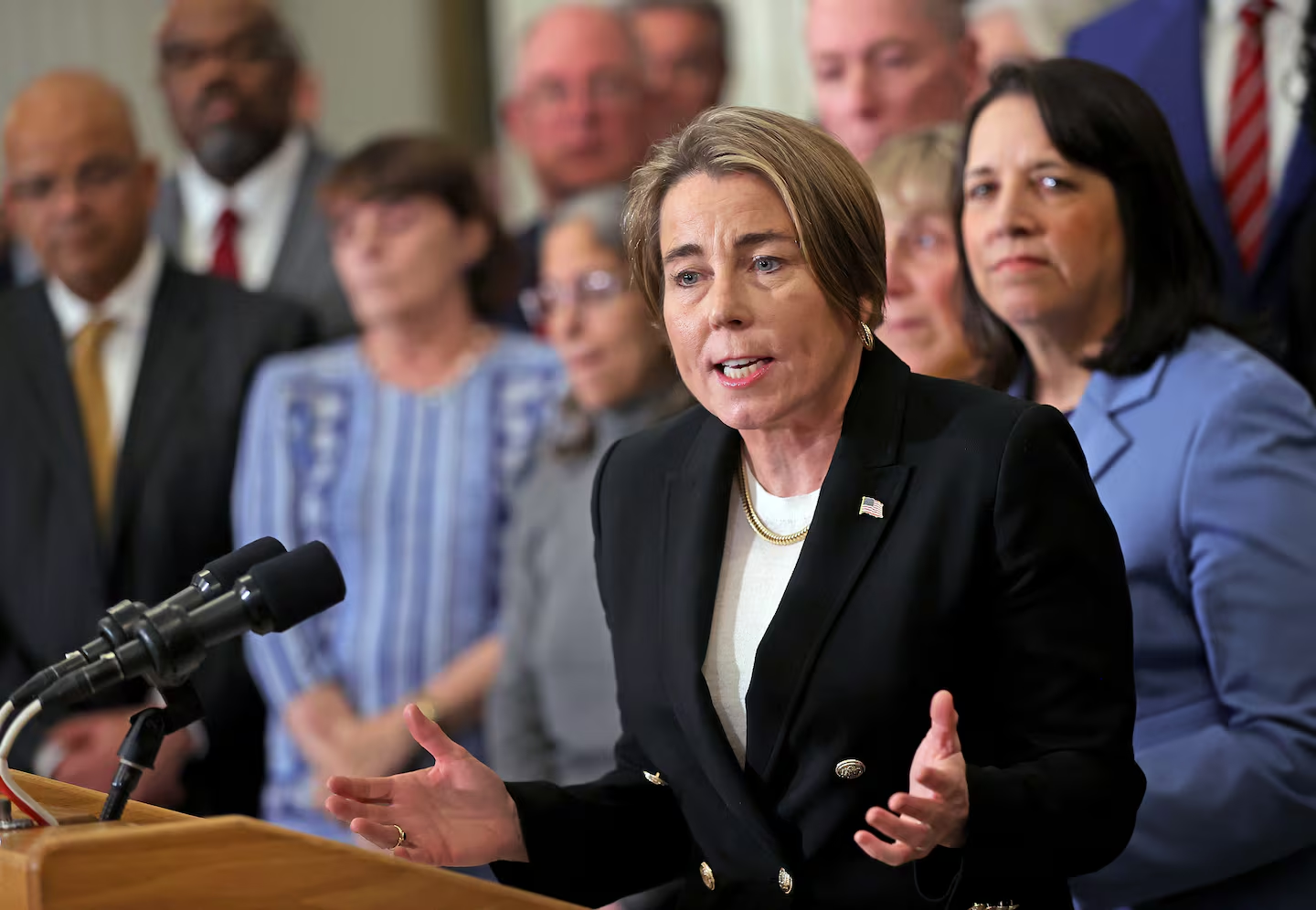
In a warning to federal officials, Governor Maura Healey on Thursday rolled out new guidance on how school officials, child care and healthcare providers, and others should interact with immigration enforcement agents when they show up in so-called sensitive locations in Massachusetts.
Read more These are some of the Trump Justice Department’s targets
The guidance was required under an executive order Healey signed in January, which sought to prohibit Immigration and Customs Enforcement agents from making arrests in non-public areas of state facilities and barred the use of state property for immigration enforcement staging.
Healey unveiled that order when she filed legislation that would ban federal immigration enforcement from entering churches, schools, courthouses, and other locations, which she called an attempt to address the feeling of instability among immigrants who are afraid to send their children to school and day care amid the Trump administration’s crackdown.
“I’m taking action to do whatever I can to keep our little kids safe, to keep their parents safe, and to send a message loud and clear to ICE that they need to stay out of Massachusetts and stay out of vulnerable, sensitive spaces,” Healey said at an event at the State House on Thursday announcing the guidance.
The guidance spells out how schools, child care centers, health care facilities, and places of worship have the right to require federal immigration officials to present any warrants before entering a facility, and deny access to non-public areas without a valid judicial warrant. It also recommends that facilities have lawyers on calland train staff on how to respond if federal immigration officers show up at their places of work.
The new rules also clarify that administrative warrants issued by ICE or the US Department of Homeland Security — unlike judicial warrants signed by a judge — do not authorize their entry into nonpublic spaces.
Healey said she hopes the guidance will help restore any drops in school enrollment, attendance at places of worship, and patients seeking medical care, which she said have taken a dip in communities with high immigration populations amid ICE enforcement,citing complaints shared with state officials.
“These are the noble care professions that society depends on each and every day,” Reverend Mariama White-Hammond, founding pastor of the New Roots AME Church in Dorchester, said at the State House on Thursday. “This advisory gives practical guidance on how we honor the laws of this land and how we fulfill our responsibility to the rights and the requisitions of God.”
The guidance outlines the kinds of signage places can post to clearly designate nonpublic areas, as well as advice on adopting written visitor policies and procedures.
Read more Trump appointees push $250 banknote with his portrait
It also urges employees and staff to “remain calm” and to “never attempt to physically interfere” with ICE agents, and instead contact the highest-ranking staff member on site, who should call an attorney.
The guidance asks that staff members document their actions, as well as information about the ICE agents, and contact the families of children who may have witnessed the interaction.
The state also offers examples of what are considered public and non-public spaces. Offices, classrooms, stairwells, and nursery and play areas are all non-public, according to the guidance. So are storage areas, athletic fields, parking lots, dormitories, research labs, and exam rooms.
Healey on Thursday said she couldn’t say how this guidance would be enforced in a situation where federal agents clash with, say, a faith leader or a school employee.
“I expect this to not be an issue, because I expect them to actually follow the regulations,” she said of federal officials. “Should they not do that, and I would be very disappointed if I saw that . . . that will be immediately reported to the Attorney General’s office and to our office, and appropriate action will be taken.”
Earlier this year, the governor also prohibited the state from entering into any new agreements with ICE unless there is a public safety need. Her own Department of Correction is the only entity in Massachusetts that has an existing deal with ICE, called a 287(g) agreement. It allows local law enforcement to act as deputized immigration agents for the purpose of identifying noncitizens who could be eligible for deportation once they complete their sentences.
She said at the time that she supported the existing agreement, which was implemented in 2007, because if someone is incarcerated in a state prison, they’ve “done something pretty bad.”
The DOC’s agreement is among 12 such arrangements between federal immigration agents and state prison systems around the country, and Massachusetts is one of only two of those states — Arizona being the other — that are currently led by a Democratic governor.
Read more New York and New Jersey are investigating FIFA’s ticket practices as World Cup prices soar


Post Comment