Minor details: How can teams like the Red Sox develop durable big leaguers?
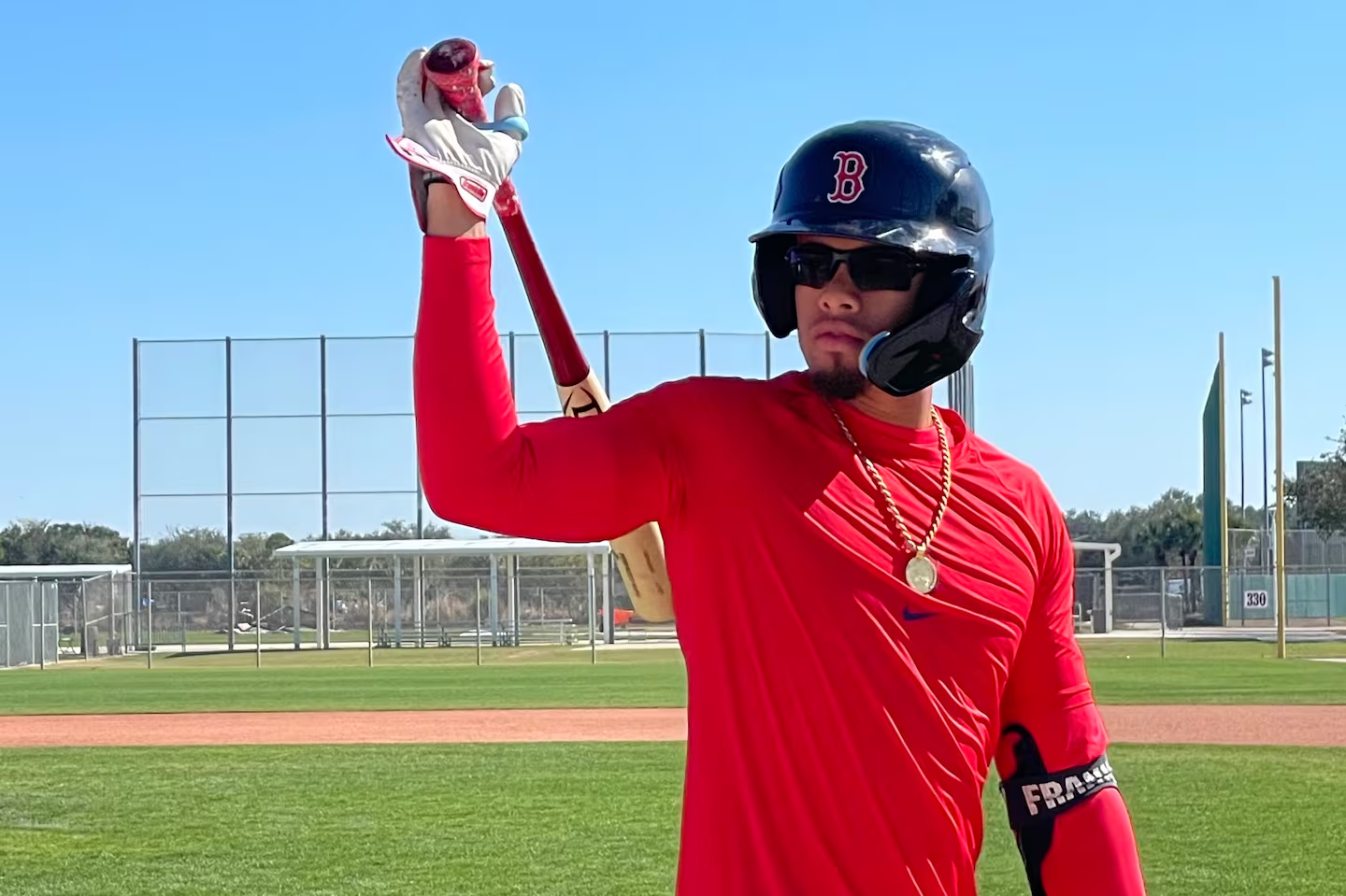
Franklin Arias has been little short of dazzling in Double-A Portland this year.
The shortstop has asserted himself as the unquestioned top prospect in the Red Sox system and one of the best in the minors, looking like a defensively gifted shortstop while adding an unexpected degree of power to his excellent bat-to-ball skills.
Read more Loathed or loved, state Auditor Diana DiZoglio knows exactly what she’s doing
In 36 games this year, Arias is hitting .346/.422/.662 with 11 homers and 19 extra-base hits. There have been only two questions surrounding him from evaluators: When will he move up to Triple-A, and why isn’t he playing more?
The first question: Not this week, but Arias is forcing the Sox to have internal conversations about when he’ll move up. As for the second question about the extent to which Arias is playing, there are some fascinating layers that play into another, broader curiosity: How do teams develop players who can stay on the field?
“It’s a good question,” said Red Sox interim third base coach Chad Epperson, who’d been managing in Double-A Portland. “I don’t know if anybody has the correct answer. But I think playing is the biggest thing — being able to go out and post every day in the minor leagues.”
In 2019, then-Red Sox prospect Bobby Dalbec was tied for third among all minor league players with 135 games played. That same year, Jarren Duran played 132 games in the minors, then another 24 in the Arizona Fall League. But after the 2020 minor league season was canceled and the 2021 season compressed due to the pandemic, the Red Sox haven’t had a player come close to that mark.
Between 2022-25, there were 162 instances of minor leaguers playing at least 130 games, topped by the Dodgers, who had 15 players hit that mark. The Red Sox, meanwhile, were the only organization that did not have a single player reach the 130-game threshold in the minors during that time.
So, what do the Sox target as a reasonable games played mark?
“I don’t think we have a set game schedule [for the season], as much as mileage,” said farm director Brian Abraham. “We push our guys significantly.”
A lot of that push comes in work occurring prior to games. During the six-game minor league week (Tuesday through Sunday, with industry-wide off days on Mondays at full-season levels), the Sox schedule two high-, medium-, and low-intensity workdays per week for each minor leaguer.
A high-intensity day might include significant running in the outfield as players try to push their defensive range on drills simulating game speed. They will also have higher-volume days in batting cages or bullpens.
Sometimes, high-volume training days will be accompanied by either an off day or a day as a DH or pinch-hitter in order to balance the player’s overall workload. The Sox monitor player workloads using wearable Catapult devices that measure physical stress and workloads.
Read more Here are four positional battles worth watching as the Patriots begin organized team activities
Other considerations beyond training that may play into off days include: The need (especially in Triple-A) to have fresh reinforcements for the big-league roster, the need to get playing time for all the players at an affiliate to help them develop, and, of course, health.
In the minors, teams tend to be more conservative about putting a player in the lineup as he works through discomfort. That said, the Sox recognize the need for players to understand that they not only can but must play through injuries to emerge as reliable big leaguers.
“We definitely try to push our players to play when they’re not feeling 100 percent,” said Abraham. “The reality is they know once they step on the field in spring training, they will not be 100 percent for the rest of the year.
“[But] because wins [in the minors] that particular night aren’t as important [as in the big leagues], we might be more willing to give a guy an extra day if they need versus trying to push them out to get those three at-bats and grind it out,” he continued. “But I do think understanding [how to play hurt] and learning that is a valuable part of being a young player and developing and preparing for the big leagues.”
So where does all that leave Arias?
He’s played in 36 of Portland’s 44 games thus far, ranking among the team leaders in games played. He’s come off the bench as a pinch hitter twice. But while his volume of games has increased as he’s gotten further into the season, Arias hasn’t had a week where he’s started every one of Portland’s games, partly in an effort to preserve strength gains he made during the offseason.
“You take a couple steps back [in terms of early season games played] to not miss a beat moving forward, protecting the weight he did gain and making sure they were finding routines for him to establish and sustain that,” said Epperson.
It’s not a black-and-white issue. Some teams put greater emphasis on in-game exposure as a developmental tool in the minors; the Sox, relative to league peers, lean harder into training in the minors. But ultimately, the team’s hope is to eventually produce big leaguers who have the tools to impact games and the durability and drive to stay on the field.
“I like to think we’re doing our best to help them understand that when they get [to the big leagues], it’s a different brand of baseball, different expectations, a different need and responsibility,” said Abraham. “We can educate and we can talk about it. But it’s really hard to replicate that, even at the Triple-A level.”
Read more Globe Top 20 girls’ lacrosse poll: No. 1 has a new challenge in Division 1



Post Comment