Bob Lobel and Mike Lynch were rivals. Now friends, they’ve bonded through life’s challenges.
Bob Lobel is sitting inside the dining room of a Quincy golf club, a smile creasing his face. His eyes have that mischievous twinkle — a look instantly recognizable to generations of New England sports fans. It’s also the expression he gets when ribbing his friend Mike Lynch.
Read more Jorge Elorza to endorse David Morales for Providence mayor
“I think we kicked your ass,” he says.
Lobel, for decades a fixture as sports anchor for WBZ-TV (Channel 4), is reminiscing about the 100th running of the Boston Marathon, in 1996. Specifically, he’s goading Lynch — back then, his professional rival at WCVB (Channel 5) and every bit the household name — into debating which station provided the best coverage.
To be fair, WBZ had a jump on its competition as the official local broadcaster of that year’s race. But Lynch is willing to take the bait — these days, it’s a familiar routine whenever the two converse.
“Really?’’ he asks, looking bemused. “I’ll have to check that.” He wonders aloud whether he was in the anchor chair that day, or broadcasting live from the course.
“I think you were in the back of the truck,” says Lobel. “If you were in the anchor chair, you would have won.”
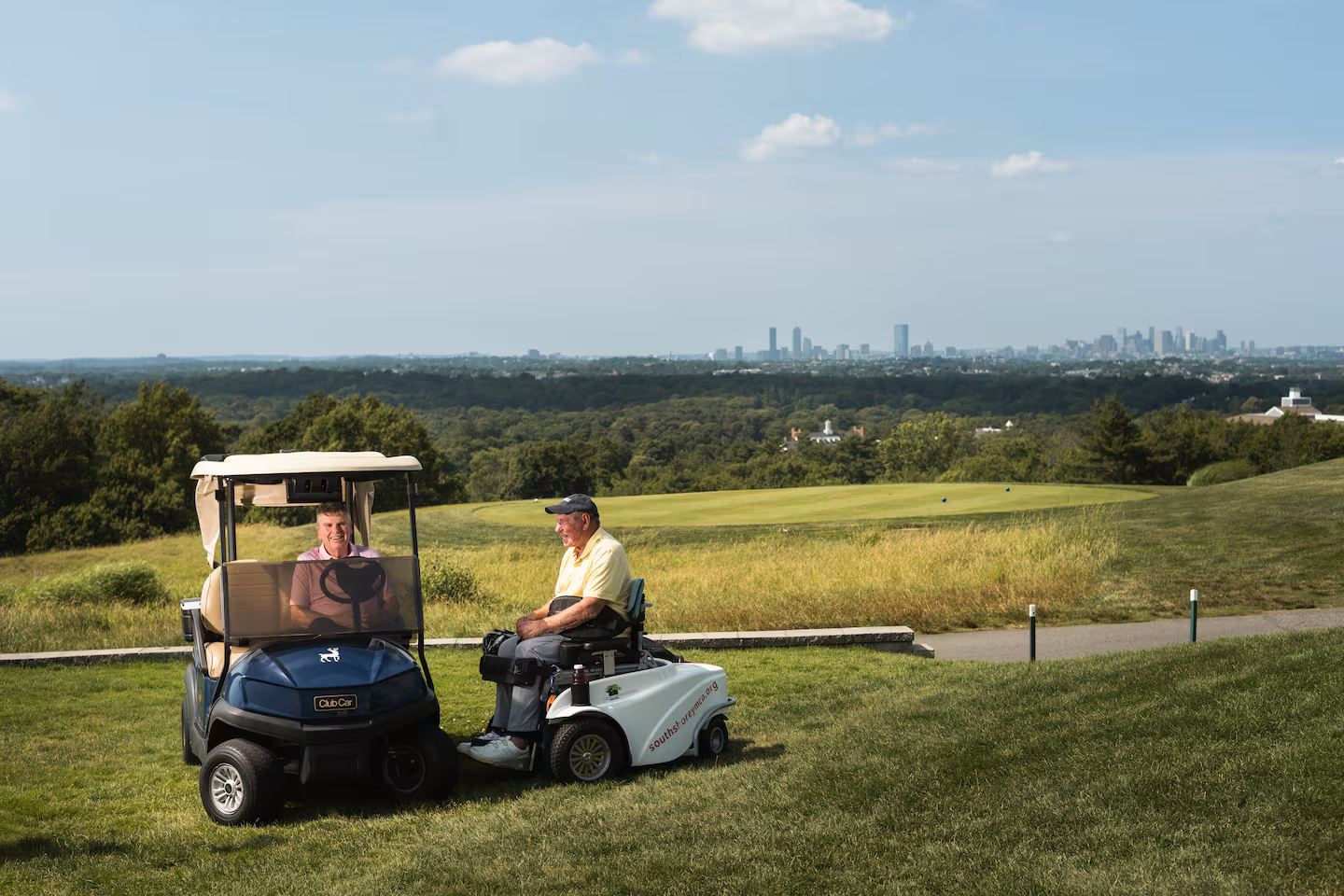
The pair have come to Granite Links Golf Club, where Lobel is a member, on a scorching July afternoon to chat with this reporter about their podcast, UnAnchored Boston. A weekly delve into the Boston sports scene, Lobel and Lynch have been recording the show over Zoom since the fall of 2019.
This is also a reunion of sorts. Though Lobel, 82, and Lynch, 72, talk and send text messages most days, they haven’t seen each other in person since … well, neither can quite remember. “Jesus, how long has it been?” Lynch says.
The logistics of getting together are not easy. Lobel, who has had a long history of back problems, was left paralyzed from the waist down in 2020 after being stricken with transverse myelitis, a rare neurological disorder caused by inflammation of the spinal cord. Lynch suffered a stroke in 2022, affecting his right side.
It’s easy to presume that the podcast — for which the friends often revisit stories from their primes and chat with old pals — is simply a flashback to the good ol’ days and, for the hosts, a welcome respite from physical challenges.
But listen to the show — or spend any time with the pair — and one quickly realizes it is much more. It’s a rare example of longevity in a rapidly changing, cutthroat industry. And it’s a tribute to a friendship that has blossomed between the former competitors since their retirements from television — one that has been there when they needed it most.
It’s also a reminder that their personalities remain as wry, appealing, and self-aware as ever.
“I think we ought to change the show from whatever it’s called now… We ought to call it The Disabled List,” Lobel tells me, referring to a term sports teams used in the past to report player injuries.
“Don’t you think that’s a great name? He’s got a walker and I’m in a [expletive] wheelchair. I’m going to have to pitch that to him again.”
With temperatures approaching the triple digits, there will be no golf on this day.
Lobel, who lives in Quincy, typically plays at the club a few times a week, using a special wheelchair called a ParaGolfer that elevates him so he can hit the ball. “It doesn’t go too far off the tee,” he says, “but I have about 85 putters.”
Lynch no longer plays. These days, he gets around with the help of a walker, and navigation can be slow. (“Figures I’d have a steep driveway,” he tells me when I pick him up at his Winchester home before we make our way to the golf club.) His car is rigged so he can push the pedals with his left foot.
Otherwise, friends marvel that they might not know he’d had a stroke if they hadn’t seen him with his walker. “He could be behind the anchor desk and you wouldn’t know a [expletive] thing,” one tells me.
When Lynch is out of earshot, Lobel confesses that his memory of the ’96 Marathon might not be as accurate as he let on. “One of the great things about our relationship,” he says, “is you can hassle each other about things you know probably aren’t true, but pretend they are. At least, that’s what I like to do.”
The podcast came together in the summer of 2019, when Hank Morse, a veteran producer in local radio, approached Lobel. The two had crossed paths when Morse produced a talk radio program on which Lobel was a regular guest. Morse wanted to launch a podcast featuring the sportscaster alongside Dan Shaughnessy, but when the Globe columnist could not commit to a weekly show, Lobel suggested Lynch.
By then, neither Lobel nor Lynch was working regularly in television — and not exactly by his own choice: Lobel’s time at WBZ ended amid a budget slash in 2008, and Lynch, not entirely happily, had retired from a full-time role at Channel 5 in 2019. At Morse’s behest, the two put together a mock show. “It went really, really well,” Morse recalls. The podcast officially launched that fall.
Listen to them now and one gets a sense of what it must have been like to hear them banter in a press box during their heyday as fierce but friendly competitors.
“It’s so funny — they’re like Statler and Waldorf talking about sports now,” says Scott Isaacs, Lynch’s sports producer at Channel 5 for more than a decade, referencing the balcony-perched curmudgeons from The Muppet Show. “You spend all these years throwing jabs back and forth, good naturedly but competitively, yet Rocky and Apollo ended up being best friends too, right?”
While the podcast isn’t overwhelmingly nostalgic, the friends’ banter shines when they relive moments from their time covering the likes of Larry Bird, Roger Clemens, and Cam Neely, and when guests such as former Red Sox pitcher Jim Lonborg or 1980 US Olympic hockey hero Mike Eruzione appear on the show.
“Mike is very traditional — ‘Let’s get the real news out there and talk about this’ — but Bob is always going to try to sneak something in, so you have to pay attention,” says Lonborg, the ace of the Sox’s 1967 “Impossible Dream” squad. “You have to be on your toes with him. Slips a curveball in, you know.
“But Mike is always ready for him. I really love who they are and how those two are together.”
One topic rarely, if ever, mentioned: their health issues.
“Why don’t we talk about it? I don’t know,” Lobel says. “I don’t know if he likes to talk about it. I’ve never brought it up with him because I just sense that he doesn’t like to talk about it.”
In a separate conversation, Lynch offers his explanation. “Lobie never talks about it. I admire him greatly for that. Most people would say ‘Woe is me’ . . . but he never says anything.
“I had my stroke four years ago, and I think something happens inside of you… I spent zero time saying, ‘Why me?’ All my energy is focused on, ‘How can I do better today than yesterday?’”
‘That was how you consumed sports then if you really cared about the teams. You read Ray Fitzgerald, Leigh Montville, and Bob Ryan … and you watched Lobie and Lynchie.’
Bill Simmons, founder of The Ringer and lifelong Boston sports fan
In the heyday of local news in the ’80s and early ’90s, Boston sportscasters were nearly on par in celebrity with the athletes they covered. The same was true for news anchors, meteorologists, and entertainment reporters, especially co-anchors Chet Curtis and Natalie Jacobson at Channel 5 and Liz Walker and Jack Williams at Channel 4.
These were, after all, the days before regional and national cable sports networks, social media, smartphones, and streaming services put sports highlights and news just a tap of the finger away.
“It was a golden era for one reason: We were the only game in town,” says Alan Miller, Channel 4’s executive sports producer for two decades starting in 1981. “ESPN was just starting out and didn’t make the impact that [local sportscasts] were. It was Channel 4, Channel 5, and Channel 7. And we would get astronomical ratings.”
Lobel, who bantered breezily with Walker on the air, ruled the ratings in the ’80s. Lynch, on the more formal Channel 5 newscast, also had strong numbers. Interest was fueled by a fervor for sports during a decade that saw the Bird-era Celtics win three championships, the Red Sox’s ultimately heartbreaking run to the 1986 World Series, and even the Patriots’ ill-fated trip to Super Bowl XX against the Bears.
At the height of their success, Lobel and Lynch each had as many as nine minutes during a half-hour newscast for sports (nowadays, they’d be lucky to get more than one). And their sportscasts were staggered — Lynch’s had a commercial break in the middle, meaning an enterprising sports fanatic could watch both if they played it right.
“That was how you consumed sports then if you really cared about the teams,” says Bill Simmons, founder of sports and culture site The Ringer and a lifelong Boston sports fan. “You read Ray Fitzgerald, Leigh Montville, and Bob Ryan in the Globe, and you watched Lobie and Lynchie. They were a big deal.”
During this period, Channel 7’s ratings did not measure up to those at channels 4 and 5. “They beat my ass,” admits John Dennis, a sports anchor and reporter at WHDH-TV from the late ’70s until leaving for sports-radio station WEEI in 1998.
Stylistically, the two rivals couldn’t have been more different.
Lobel was authentically irreverent and off the cuff. His Thursday night program, Sports Spotlight, was full of humorous clips, and later, his Sunday night wrap-up show, Sports Final, as Simmons remembers, “set the conversation for the week.”
Lynch exuded a more straightforward vibe, but he could be funny with a one-liner, too. “Lynchie was so prepared,” Isaacs remembers. “He could have his whole day planned out on a sheet of recycled paper you always saw him holding in his hand on the newscast.”
“We would look at Bob Lobel as the Los Angeles Lakers, kind of the glitzy team that rolled in,” recalls Karl Ravech, who interned for Lynch in the ’80s before a 33-year stint as an ESPN broadcaster. “And Mike Lynch was the gritty, grimy Boston Celtics. He was Larry Bird and Lobel was Magic Johnson.”
Lynch broke into the region’s consciousness in the late 1960s as a football and baseball star at Swampscott High School. Competition was in his blood. His father, Dick, was a legendary three-sport coach at Swampscott, and his own sports acumen became apparent early on.
As a 16-year-old junior in 1969, Lynch kicked a winning 21-yard field goal with just over a minute left to defeat Marblehead, securing a 27th-straight victory and the state title.
A few years later, as Harvard University’s quarterback and kicker, Lynch had the chance to clinch a win over the Bulldogs — and the Ivy League title — at the Yale Bowl in New Haven. He lined up a 26-yard field goal attempt in front of 66,000 people in the stands. “I was afraid of shanking it,” he told the Globe after the game in 1975.
Lynch’s kick sailed through the uprights, giving Harvard a 10-7 win.
It was Lobel, the apple-cheeked native of Apple Creek, Ohio, who made it to the airwaves first. After graduating from Kent State University, he earned his master’s in education at the University of Vermont, with the idea of becoming a guidance counselor. (“Imagine that,” he says now.) When a job proved hard to come by, he switched gears. “I walked into Channel 22 in Burlington, and was hired as a sportscaster. I had no experience. And they paid me like it.”
Lobel eventually found his way to Boston in 1976, joining Upton Bell on WBZ Radio’s call-in show Calling All Sports.
When that show was canceled in 1979, he moved to television, becoming Channel 4’s weekend anchor. By the winter of 1981, he had moved to weeknights. “You can’t measure it, test it, or prove it,” wrote Globe sports media columnist Jack Craig in 1982, “but you can sense that Bob Lobel is the hottest TV news personality in Boston.”
Lynch, like Lobel, got his start in radio. While attending Harvard, he served as the color analyst on high school football and basketball broadcasts for a local radio station. After graduating, he became a host on WITS sports talk radio.
Lobel, aware of Lynch’s athletic heroics and impressed by his hosting ability, recommended him for a weekend opening at Channel 4 in 1982. Management opted for someone else, but Lobel imparted a bit of wisdom about keeping close to the action. “He said, ‘Whatever you do, just be there,’” Lynch recalled recently on the podcast. “That was great advice.”
Lynch landed a part-time gig at Channel 5 that year, rising to weekend sports anchor in April 1983. “It was a remarkable beginning,” wrote Craig in 1984. “He was articulate and cool as no other Hub TV neophyte had been before or has been since.” By 1985, Lynch had taken over the main chair.
In 1992, Lobel landed icons Larry Bird, Bobby Orr, and Ted Williams for a joint interview on Sports Final— a Boston sports coup that demonstrated his knack for navigating complicated show logistics and charming high-profile personalities.
By that time, he had genuine star power of his own, an easy charisma that landed him a cameo on Cheers in 1984 and convinced CBS to pursue him for a national role in 1985. He said no — “Why would I want to leave what I had in Boston?” he says now. CBS turned instead to Jim Nantz, who became one of the biggest names in sports television.
For all of his wiseacre charm — asking “Why can’t we get players like that?” whenever a former Boston athlete would do something of note elsewhere, or deploying a prop “panic button” when losses were mounting for a local team — he also has an empath’s heart.
Read more Pass rusher Jadeveon Clowney reunites with the Texans on a one-year deal, AP source says
Lobel consoled the late Tim Wakefield after the knuckleballer gave up the winning home run in the Red Sox’s devastating loss to the Yankees in the 2003 American League Championship Series.
“Bob and I were standing out by the exit of Yankee Stadium and Wakefield came out,” recalls Dan Roche, a sports reporter and anchor at WBZ. “He had been crying in the clubhouse, just brokenhearted about the whole thing.
“Lobie stopped him and said, ‘Listen — You’re gonna be back here next year. You guys are gonna bounce back and you’re gonna be a big part of it.’ Wake said, ‘I can’t tell you how much I appreciate that, Bob.’ And of course, Lobie was right.” Wake was a crucial part of it when they won it all in 2004.”
Lynch’s style was different, in part because the Channel 5 newscast, built around Chet and Nat, was more formal. Isaacs, Lynch’s former boss, said Lynch’s trustworthy personality and local ties made him feel like “your buddy that grew up to do this” — a quality emphasized in Channel 5’s ubiquitous “I Like Mike” commercials in the early ’90s. His upbringing as the son of a coach, former colleagues say, helped him build a bond with Patriots coaching legend Bill Belichick, who had more Super Bowl rings in New England than warm relationships with media members.
Lynch’s local roots shone during his weekly High-Five segment, each of which highlighted a high school athlete, often one who had overcome an obstacle, and his saturation coverage of football games on Thanksgiving.
“His love of high school sports was just legendary,” says Mike Eruzione, who, as a star athlete at Winthrop High in the early ’70s, played against Lynch’s Swampscott teams.
Jack Edwards, the former voice of the Bruins who worked as a sports reporter alongside Lynch at Channel 5 in the ’80s, puts it this way: “The difference between very good and great is consistency. Lynchie was the embodiment of that.”
Lobel and Lynch may have had different styles, but both had a reputation for mentoring the next generation of sports commentators, a rarity in an ultra-competitive field.
“He was kind of like Lorne Michaels that way,” Simmons says of Lobel, who, in 2001, invited the ascending writer to appear on Sports Final as a guest.
Lynch, meanwhile, mentored numerous interns who later became prominent in sports media, including Ravech, Tony Massarotti (an afternoon drive co-host at 98.5 The Sports Hub), former Channel 7 sports anchor Joe Amorosino, and former SportsCenter anchor Michelle Bonner.
“He made people feel comfortable, included, and capable,” Bonner says. “I owe him an incredible debt of gratitude. He made me feel like I belonged in a business that, at the time, belonged to the men in the room. I still can’t quite believe I got that lucky.”
While friends say the two felt competitively toward each other during these years, they maintained a friendly relationship based on deep mutual respect.
Peter Brown, a former WBZ news director, recalls a December night in 1987 when the Bruins retired the number worn by Phil Esposito, who starred on two championship Boston teams in the early 1970s. His old No. 7 was presented to him by Ray Bourque, who had been wearing the same number. Bourque removed his Bruins sweater and revealed that he now wore No. 77.
“Everybody went to a news conference where Espo is very emotional,” Brown says. “Well, Lynchie gets back to his car and his photographer is looking at him, stunned. ‘I wasn’t recording,’ the photographer says. Lynchie thought to himself, I’m fired. Everyone else in this town is going to have it, and I won’t, and I’m going to get fired.
“So he calls Lobel. And Lobie listens and says, ‘It could happen to anyone,’ then tells him to have a cab at WBZ at 10:45 p.m. and there will be a copy waiting for him. He could have screwed him over, and he didn’t. And you know Lynchie would have done the same for him.”
Both retell this moment separately when interviewed for this story. But every time Lynch brings it up in conversation, Lobel pretends he doesn’t recall.
“He says, ‘I don’t remember doing that,’” Lynch tells me. “I said, ‘What are you talking about? I’ll never forget it as long as I live.’ He goes, ‘Well, I don’t know. We were pretty competitive. Why would I give you a thing?’”
I ask Lobel about it again later. “Oh, I remember,” he says. “I’ve just got to keep him on his toes.”
Years later, Lynch was there for Lobel — and eventually vice versa — when it mattered even more.
Lobel’s partner, Deedee O’Brien, remembers the exact day he lost his ability to walk. “March 2, 2020,” she says. “Right when all of that was starting.” Meaning, of course, the COVID-19 pandemic.
It also came as UnAnchored Boston was finding its groove. Since leaving WBZ, Lobel had worked in various media ventures, including a stint as a host on nostalgia network MeTV Boston alongside his former wife, Susan Wornick, who had been a longtime WCVB anchor. Lynch, meanwhile, had effectively retired — but the podcast was giving both a chance to show their sports acumen was still sharp.
Lobel and O’Brien were in Naples, Florida, closing on a condo, when it happened. “We literally put the money down,” she recalls. “He didn’t feel well and went back to the [hotel] room. I finished the paperwork and went back to the room, and he was on the floor. And that was that.”
Lobel had previously been diagnosed with spinal stenosis, a narrowing of spaces in the spinal canal. Doctors told Lobel that the viruses that can trigger transverse myelitis tend to hit the weakest place on the spine. “It was so hard,” O’Brien says. “He had to deal with the reality that this actually had happened.”
Lynch was on a flight to Florida that day with his wife, Mary Ellen, also headed to Naples. He got a call from Morse, who told him what had happened.
“I dropped Mary Ellen off and the bags, and I went right over to Naples Hospital,” Lynch recalls. “I was with him for a while.” When Lynch came back “a day or two later,” Lobel had been moved to another room.
“The first thing I saw,” says Lynch, “was his feet sticking out from the blanket. I pinched his big toe, and he said he hadn’t had feeling in the toe until I had pinched him.”
“We joked that he was a miracle worker,” O’Brien says. “It was really meaningful for him to be there.”
Remarkably, Lobel missed “just a show or two,” recalls Morse. “He had a computer and mic setup, and would do it propped up in his hospital bed. I give him so much credit. He swung the bat every day.”
A little more than two years later, in May 2022, Lynch faced a frightening medical episode of his own. While waiting on a Tuesday night for a Celtics’ playoff game to tip off, he decided to take a walk around the neighborhood.
“He told me he was heading out and which direction he was going,” Mary Ellen says. “I thought to myself, You know, I probably should have asked if he wanted me to come along. So I just went out and headed in the opposite direction so we’d loop around and see each other.”
As he came into her vision, she noticed that his face appeared slack. “And then, boom, down he went.”
Mary Ellen called their daughter, Kelly, who lived nearby in Woburn. She came over and helped load him into the car before they raced to the hospital.
It was now Lobel’s turn to check in on his friend. He did so frequently — as often as he could while facing his own challenges.
“It wasn’t phony, a token call or text,” Lynch says. “It was real, and it was genuine — and that’s his personality. It meant the world to me.”
Lobel and Lynch both have their bad days — and some chronic struggles. Lobel has had five surgeries since 2020, including one last winter that left him bedridden for 12 weeks. Lynch goes to physical therapy at the Spaulding rehabilitation center in Medford two or three times per week. Though that is going well, he has ancillary issues, such as a torn rotator cuff that can’t be treated because of increased risks from anesthesia following his stroke.
But their attitudes rarely waver, they say, in large part because of the support that they have at home.
Mary Ellen is a former flight attendant with a warm, patient nature. Deedee founded a program in Andover that used therapy horses to help children with disabilities, and later patients with cancer and other health issues. She calls helping people her “life’s work.”
“I hit the lottery and I didn’t even play,” Lobel says of O’Brien.
“It’s impossible to measure, the support and care that she has given me,” says Lynch of Mary Ellen.
He looks at Lobel. “I would probably be in some assisted living facility if not for her,” he says.
“I could be too,” says Lobel. “We could be roommates. That would be something, huh?”
‘ Me and Lynchie, we were the luckiest people in the luckiest time at the luckiest place.’
Bob Lobel
Their visit at Granite Links winding down, the conversation turns to the podcast and candidates for their next guest. Lobel hopes to get Governor Maura Healey — a former basketball star at Harvard — to return to discuss WNBA star Caitlin Clark as well as the World Cup.
I ask Lynch and Lobel, in all seriousness — right, good luck with that — what they like best about each other.
Lynch goes first. “He cares about people,” he says without pause.
Smiling, he adds: “And he has a great sense of humor, I suppose. He brings out the best in me now, and he brought out the best in me on the air, those [30-plus] years of banging heads when we were against each other.”
Lobel starts with an old standby. “Well, I like him because I can tease him about going to Harvard, and all the perks with that, and ‘Do I have to listen to the story of the winning field goal against Yale again?’
“I mean, what do I like about him? So much. He was there for me in ways I don’t know if I can repay. But the biggest thing might be that he’s such a down-to-earth guy.”
He changes the subject, throwing one of those classic Lobel curveballs.
“What did you do on Earth Day?” he asks Lynch.
“Who asks that?” Lynch says.
The conversation meanders, and the laughs keep arriving. When Lynch briefly leaves the room, Lobel flashes back to a moment from earlier in their visit, when a group of golfers had recognized his friend. “From Channel 5!” one had exclaimed.
“I loved it when he came in the dining room and I was able to introduce him,” says Lobel. “It was a thrill for me. Stuff like that still makes you feel special.”
A song plays unobtrusively over the clubhouse sound system: “Take It Easy,” by the Eagles.
We may lose/and we may win/though we will never be here again.
“They do play good music here,” says Lobel.
He pauses.
“Those times will never be back again,” he says. “Never again. Me and Lynchie, we were the luckiest people in the luckiest time at the luckiest place. TV will never be like that. We didn’t realize it at the time. We do now.”
Read more While Saturday was a squander in Montreal, Revolution appear to have shaken their post-Arena malaise


Post Comment