In Waltham, big landlords want to replace an old office complex with new homes. The mayor says no.
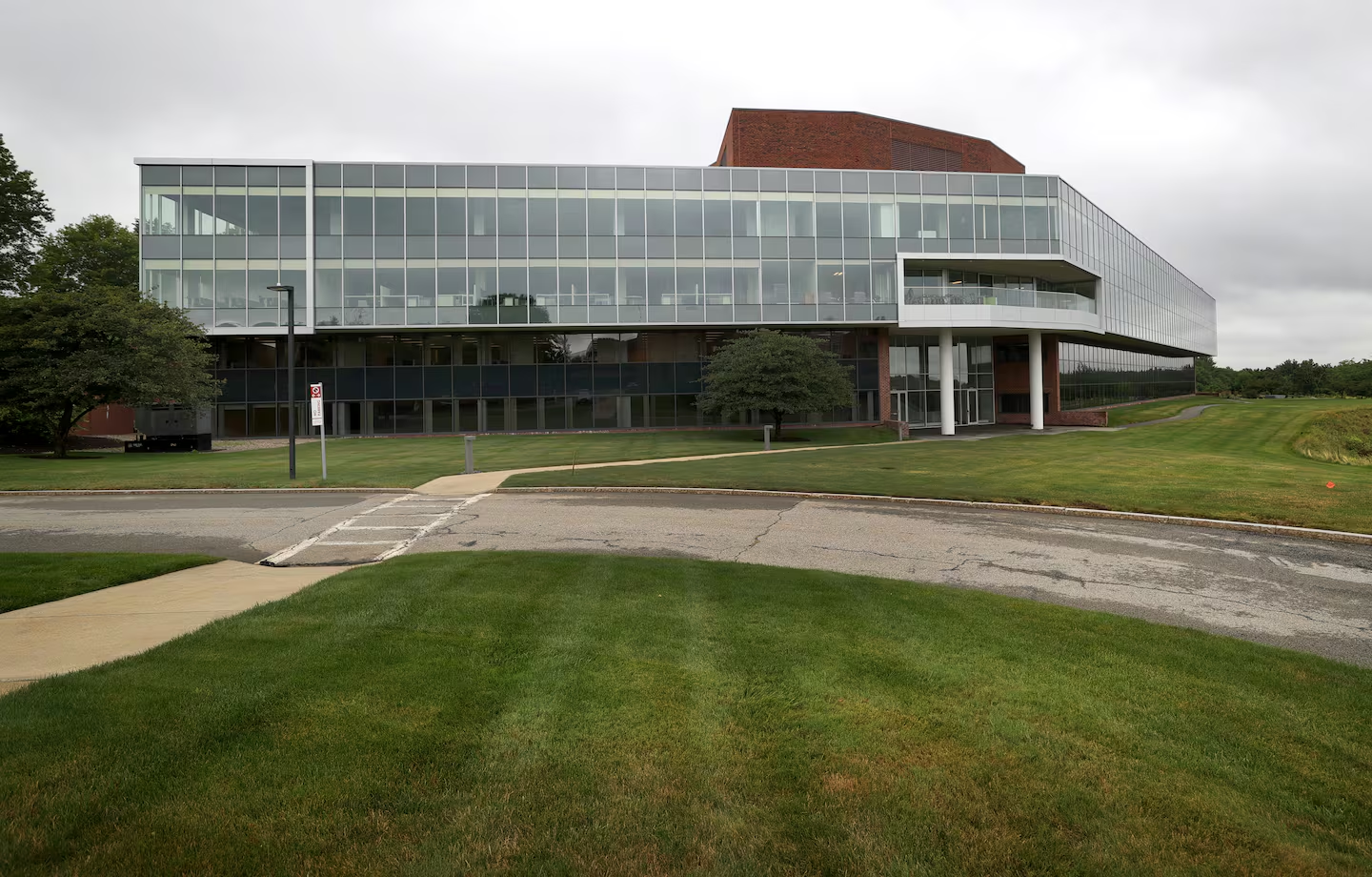
In the sprawling reaches of the commercial office corridor arrayed along Route 128 in Waltham, a slumping market has forced local officials to confront a thorny new feature of the suburban fabric: empty buildings, one seemingly after another.
Read more Haeran Ryu takes a one-shot lead after 36 holes of the British Women’s Open
Two of the city’s biggest owners of those buildings, as well as members of the Waltham City Council believe they have a solution: turn three of the downtrodden commercial districts into more than 2,000 new units of housing. They would be the biggestresidential development projects in recent memory in this city of 65,000, bringing a neighborhood feel to what is largely a forlorn stretch of business.
But earlier in July, Waltham Mayor Jeannette McCarthy vetoed a measure that would clear the way to redevelop the largest of the three office parks, citing concerns about density, and observed the fact that the project would be “conveniently placed next to a residential neighborhood.”
“Why, with all the land that is available on the site, was it placed so close to the existing neighborhood?” she wrote in a letter to the City Council.
And she worried big developments would only worsen the city’s already notorious traffic.
The mayor declined to be interviewed or answer questions, referring instead to her letter to the council.
McCarthy’s objection surprised several city councilors, and the panel will now consider overriding McCarthy’s veto at a special meeting Monday. If they don’t, planning for the property will go back to square one, which could put funds for key transportation improvements from the developer and the state at risk.
More than that, it would also significantly delay development of up to 1,200 units on a property where little else is going on these days, at a time when Greater Boston is desperate for new homes.
“We are at a crossroads in our city — our growth is stagnant,” said City Councilor Cathyann Harris. “And we are in a unique position with all of this underutilized office space to do something about it and transform the city for the future. To waste the opportunity would be a shame.”
The Route 128 corridor in Waltham has long been acommercial hub and was one of the biggest beneficiaries of the boom in life sciences and technology companies, full of shiny new office and lab buildings housing big companies such as AstraZeneca and Boston Dynamics. Today, nearly half of Waltham’s property tax base comes from commercial real estate, a higher share than any where else in Massachusetts except Cambridge and Boston.
And while there is still some growth in the business district — Boston Dynamics announced a $100 million expansion there earlier this year — the post-COVID downturn in the suburban office market has hit Waltham hard. Many office buildings are now vacant, and their owners are asking Waltham for tax abatements. This year, the city raised its residential tax rate by 5 percent to account for lost revenue.
Waltham’s biggest taxpayer is real estate firm BXP, formerly Boston Properties. Last year the developer approached the City Council with a proposal: rezone three big districts along Route 128 — two owned by BXP totaling 155 acres in all, and the sprawling former Polaroid campus on Main Street owned by local developer J & CO LLC — to allow for mixed-use development that could bring retail and housing to otherwise under-used space.
In all, the properties could hold 2,100 apartments and condos — a stretch of mostly empty office buildings along Winter Street, known as Bay Colony, could become 1,200 units; 20 acres off Jones Road could hold 300 to 400; the old Polaroid site, now a Market Basket, 600 more.
The City Council saw the proposal as an opportunity to push Waltham forward, and in January began workshopping three special zoning districts that could host neighborhood-sized developments. For all its job growth, Waltham has added relatively little new housing during McCarthy’s 22-year tenure, beyond a handful of apartment buildings downtown and nearby along the Charles River. This offered the opportunity to build more, at scale, with relatively little impact on existing residential neighborhoods, said City Councilor Colleen Bradley-MacArthur.
“It is incumbent upon Waltham to grow as a city,” said Bradley-MacArthur. “You don’t get many opportunities to build new neighborhoods.”
A key part of the negotiations centered around a broader vision for this part of Waltham, which hasn’t had much new residential development and is often deluged with traffic from drivers passing through to reach Route 128.
That traffic was one of the big concerns from opponents of the projects. Wouldn’t adding housing next to the highway responsible for so much congestion only make the problem worse?
The developers agreed to help out with several key infrastructure upgrades, including setting aside land for a new fire and EMS station, upgrading a road through a nearby residential neighborhood, and helping pay for a new connector between heavily trafficked state roads, after the state chips in what the city expects will total $15 million.
In neighborhood meetings, there were some concerns about traffic, especially around Bay Colony, Harris said, as well as whether buildings could obstruct views in spots. But the Jones Road site is near the site of a planned new bus hub and commuter rail station, and the Market Basket site has regular bus service. Moreover, Harris said, BXP was responsive and made some changes to its plans.
BXP declined to comment for this story.
All three projects, Harris noted, are intended to be mixed-use developments, less auto-dependent than the office buildings there now. Altogether, she said, they could make western Waltham “a very different kind of transit hub than the car-oriented one we’re used to seeing.”
In June, the council unanimously approved the three new zoning districts, which provide a framework for what the projects could look like. Developers would still have to go through a special permit process to actually get project approvals, and buildout could stretch out over a decade.
McCarthy approved the Jones Road and Polaroid sites, and there was little hint she was thinking of vetoing zoning for Bay Colony until she sent a letter to the City Council on July 1.
That zoning, she wrote, would establish bad development standards, including “dramatically decreasing parking requirements for all uses both residential and commercial, setting a dangerous precedent for the city,” and “redefining height for just these overlays, treating them differently from all other sites in the city.”
To some in town, McCarthy’s veto “came out of nowhere,” said Tom Benavides, founder of the local pro-housing group Waltham Inclusive Neighborhoods. If McCarthy had objections, there were opportunities to raise them earlier.
“This whole project would not have happened without the mayor being a facilitator in the background,” said Benavides. “She has been attending these meetings. She’s had opportunities to provide input and feedback. And then after the fact without warning, she chooses to veto it. It’s in bad form.”
Those concerns, said Bradley-MacArthur, could still be addressed in the special permitting process each project still must go through.
The 15-member council’s meeting on Aug. 3 is its only opportunity to override McCarthy’s veto, which both Bradley-MacArthur and Harris said they would vote to do. Several other councilors, including council President Robert Logan, did not return requests for comment.
Read more NESN’s Women’s Celebration Night at Fenway on Wednesday adds a new wrinkle: The next generation



Post Comment