Electric shock: Insurer drops EV coverage for longtime customer
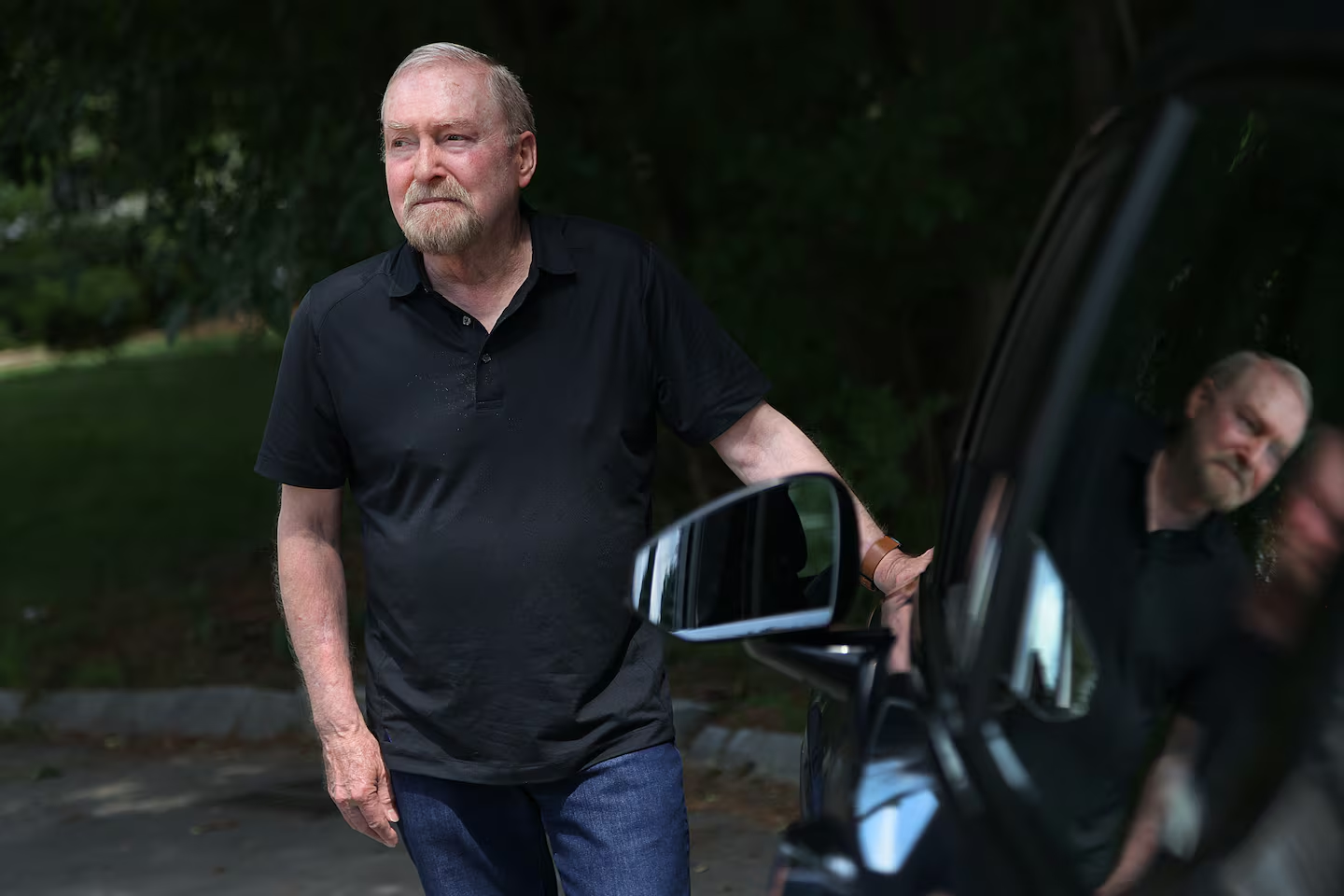
Ron Eastman got an unpleasant surprise from the insurance company that has provided coverage for his electric vehicle, a Polestar 2 sedan, and a previous electric hybrid, for more than a decade.
Read more Biking to work: Tips to get started, stay safe and look presentable when you arrive
“The 2023 Polestar vehicle … does not meet company underwriting guidelines,” the notice from the insurer, Quincy Mutual, read. “This vehicle is electric and not eligible for coverage.”
A 76-year-old retired professor, Eastman said he’s never before had an issue with Quincy Mutual, “which is why I was very surprised when I got those letters. It’s like, wow, what’s going on?”
What’s going on is that electric vehicles areoften so much more expensive to repair than gas-powered cars that insurers are either charging significantly higher premiums or, in extreme cases such as Eastman’s, even dropping coverage altogether. This comes at a time when Massachusetts is already falling behind on its goal of convincing nearly 1 million drivers to switch from gas-powered cars to help cut climate emissions.
Massachusetts has the highest difference in insurance costs between electric vehicles and gas-powered: $3,560 on average, for EVs in 2025, compared with $2,318 for gas-powered cars, according to rankings from Insurify, which compares insurance rates.
That’s yet another hurdle to going electric, after the Trump administration cut federal subsidies and automakers canceled or delayed some low-priced models. Loren McDonald, chief analyst at EV advisory firm Chargeonomics, said although higher insurance rates may be “a minor annoyance” for most people seriously considering an EV, they may end up being “an additive deterrent” for those already concerned about driving range, reliability of charging, and other hurdles.
With 171,000 EVs and plug-in hybrids on the road in Massachusetts, 12 percent more than a year ago, the reasons for the cost difference in the convoluted world of insurance rates are many.
On average, EVs are newer and more valuable than gas-powered cars. Six out of seven EVs on the road in Massachusetts are five years old or less, while almost half of the gas-powered vehicles are more than 10 years old.And particularly for vehicles from EV-only brands, they can be more expensive to repair.
On the other hand, EV owners typically get in fewer accidents and make fewer claims per mile driven than owners of gas cars, according to an insurance industry study.
But the state is also notorious for its aggressive motorists. From the Kosciuszko “circle of hell” rotary in Dorchester to the narrow on-ramps of Route 3, Massachusetts has more insurance claims per mile driven than any other state, according to data from the insurance industry’s Highway Loss Data Institute. So the risk of insuring a car here is higher for companies than in most other states.
Also, there are fewer repair shops and mechanics certified to work on electric vehicles relative to the growing number of EVs in the state.
“There’s always a lot of things going on,” said Insurify economic analyst Julia Taliesin, who is also a licensed insurance agent. “When you have a lower repair capacity, and a higher claim volume, that can contribute to a bigger gap in the cost of insuring an EV versus a gas-powered car.”
In addition to a driver’s record, hometown, and other individual characteristics that insurers use to set rates, the value of a car is an important factor. For example, an insurer likely would charge more to cover a $44,000 Tesla Model 3 Premium all-wheel-drive sedan than a $28,000 Honda Civic Sport, other things being equal.
And in a wealthy state like Massachusetts, “we may have some higher-value EVs on the road,” fueling the insurance cost gap, Taliesin said.
Another issue driving the discrepancy is that high-tech safety features that rely on camera or radar sensors can be expensive to repair and require a specialist to recalibrate after replacement. Such features are common in EVs but not in older gas-powered cars. At the same time, the safety features may help explain why EV drivers have fewer accidents.
Tesla claims its semiautonomous driving feature has seven times fewer major and minor collisions than human drivers. However, the National Highway Traffic Safety Administration escalated its investigation this year into possible safety defects in the feature.
A 2023 insurance industry study compared national claims data for 11 types of EVs, though none were Teslas, to gas-powered vehicles over the prior decade. After adjusting for the number of miles driven, the EV contingent was involved in 19 percent fewer collision claims, but damages cost 2 percent more.
For any individual driver, the numbers can come out all kinds of ways.
Software developer Mike Champion is paying $1,912 this year to cover a Polestar 2 and an older Honda CRV. That’s about $700 more than he paid before he leased the Polestar and drove a gas-powered Audi Q5. Champion, who lives in Newton, attributed the increase to the higher value of the new Polestar versus his older Audi.
Read more The ‘rockets and feathers’ effect: Inflation eases but grocery bills do not
Louis de Geofroy, a home inspector living in West Tisbury, pays $632 a year to insure an electric Mini Cooper versus $605 for a Volvo XC 60 hybrid, even though the Volvo is the more expensive car.
On the other hand, some new EV owners are finding their cars are less expensive to insure than their older, albeit flashier gas vehicles.Craig Wylie and his wife saw their premiums drop by about three-quarters when they bought a pair of Teslas, trading down from even more expensive luxury brands Audi and BMW. They now pay about $3,000 a year for the two cars.
“For us it’s a non-story,” said Wylie, a consultant in his mid-60s. “The car itself is cheaper … and this resulted in a lower cost for insurance.”
Insurers weigh how often particular car models get into accidents, as well as the cost of repairs.
A basic Honda Civic model was involved in more accidents than all other models, on average, over the past three years; but the bill to repair those Civics was also well below average, according to the Highway Loss Data Institute.
Meanwhile, a Tesla Model 3 AWD had nearly the same high frequency of accidentsbut is much more expensive to repair than the Civic. Taking both factors into account, insurers’ losses were 24 percent above the average for all vehicles on the Civic but 41 percent higher on the Tesla.
The Polestar 2 that Eastman owns started at $53,000 for the 2023base model and has a wide array of advanced safety features, such as automatic emergency braking and lane-centering assistance, that can increase repair costs.
Eastman feared Quincy Mutual was dropping coverage of all EVs based on the notice he received.
But Andrew Greene, assistant vice president for personal lines underwriting at Quincy Mutual, said that wasn’t the case.
“The wording on their notice should have been clearer,” Greene said. “We insure many EVs, but not every make and model under our underwriting guidelines.”
Greene said the company’s guidelines could rule out extremely expensive cars, cars with high repair costs, or cars with excessive performance. He declined to discuss any specific case, but said Quincy Mutual dropped Polestar because the Trump administration banned the company, based in Sweden, from selling new vehicles in the United States starting with the 2027 model year. “That complicates repairs of the brand going forward,” he said.
“It doesn’t make any sense,” Eastman said. Polestar has told customers they can continue to get service from Volvo, a sister brand; both are owned by Chinese automaker Geely, he said. And the Trump administration hasn’t penalized Volvo, he noted.
Other insurers were less eager to discuss their EV policies.
Among the top auto insurers in the state, Geico, Plymouth Rock, Arbella, and Travelers did not respond to requests for comment. Liberty Mutual and Farmers Insurance referred questions to the industry-backed Insurance Information Institute. Progressive referred questions to other industry groups.
A spokesperson for the institute, Loretta Worters, said that while “EVs remain more expensive to insure on average, the gap appears to be narrowing for newer vehicles. As the EV market matures, repair networks expand, replacement parts become more available, and insurers accumulate more claims data, pricing is likely to become more refined.”
In the end, Eastman got comparable coverage from Plymouth Rock. The auto policy for two cars cost $2,000 a year, about the same as his old policy.
Other EV owners are saving money in more unusual ways. Chris Sousa, 42, who lives in Attleboro, said he has been so impressed with the semiautonomous driving mode in his Tesla Model 3 after using it to drive more than 100,000 miles that he dropped collision coverage from his auto insurance policy, saving about $1,000 a year.
Sousa will have to pay for repairs on his Tesla if an accident is his fault, but he is undeterred. “I trust the software enough that I suspect I won’t be in any major collisions.”
Read more US says it will begin lifting a suspension of Mexican cattle imports starting in August




Post Comment