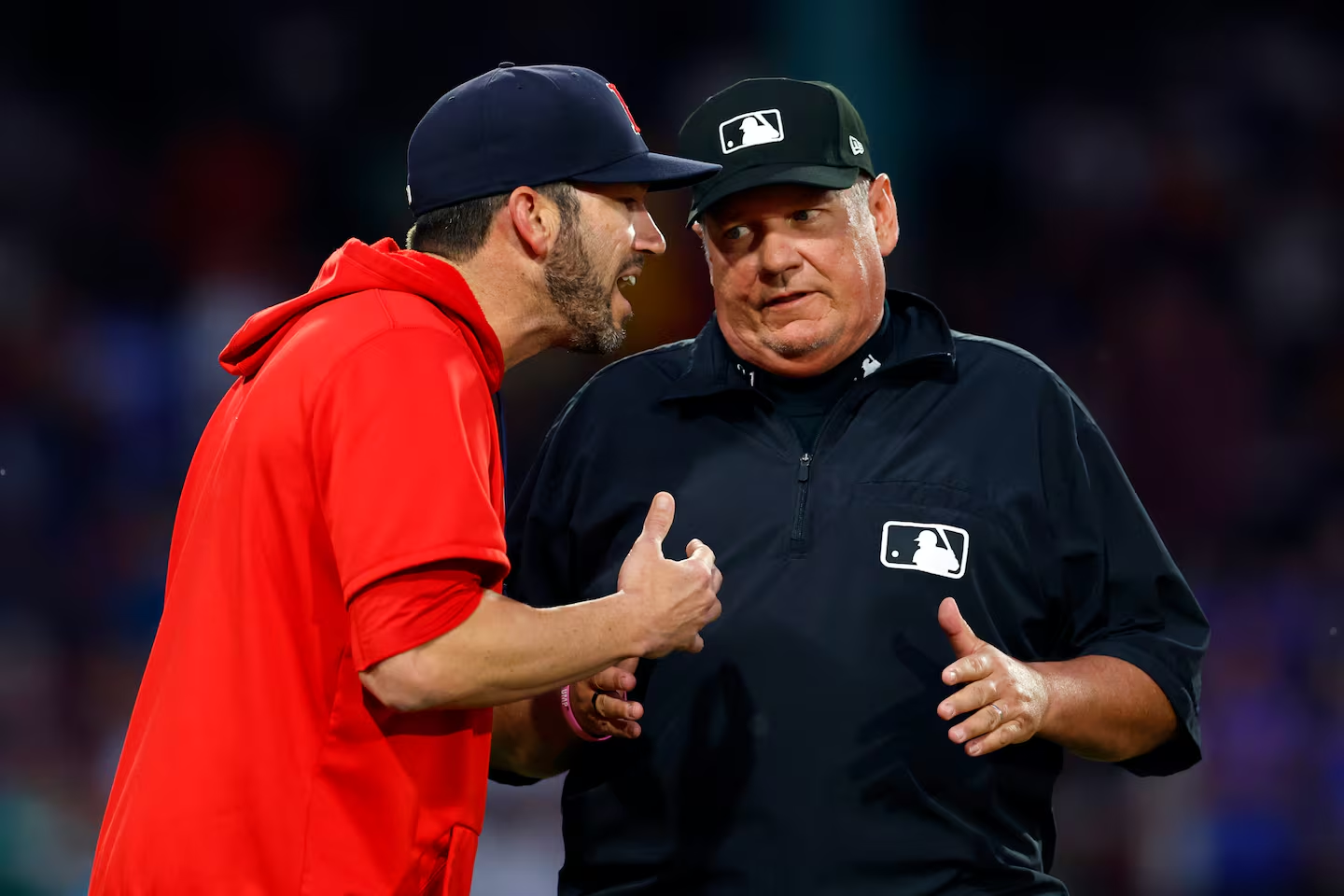
From a powerful late-night message to new routines, Chad Tracy has played a key role in Red Sox’ turnaround
How to measure interim manager Chad Tracy’s contribution to the dramatic and now historic Red Sox midsummer U-turn that turned a last-place team into an unstoppable force? Start with the night of June 22.
Read more Thinking about how far the Red Sox have come, and how they might navigate the trade deadline
The Sox suffered a startling, 3-2 loss to the worst team in baseball when closer Aroldis Chapman yielded a walkoff, three-run triple to the Rockies. Despite improved play, the Sox repeatedly found novel ways to lose, yielding a 31-45 record and making the playoffs seem remote.
In his hotel room after that loss, Tracy — who hates team meetings, and almost never holds them — felt a need to connect with his players.
“There may be times where something’s on your heart,” said Tracy. “You’re sitting there in your room [thinking], ‘If I’m feeling this way, maybe they need to hear from me.’ ”
Tracy periodically uses team-wide messages sent through Teamworks. In Denver, he sent a middle-of-the-night missive. The gist?
“I’m not gonna turn on you. I know what you’re going through. I’ve been here. All these losses, we’re doing it together, and we’re gonna find a way to win together,” Tracy recounted. “When you guys are rolling in the [expletive], we’re rolling in it with you. And when we get to the point where all the flowers come out, we’ll be there with you.”
The sentiment resonated.
“You feel your club. Your club’s telling you exactly what they need and what they don’t,” said interim third base coach Chad Epperson. “No doubt Tracy’s attached to that heartbeat.”
That message wasn’t necessarily the catalyst for the Tracy Transformation — the reversal of an awful start to forge a best-in-baseball 20-3 record since June 25, including a historic 15-game winning streak that has the Red Sox mounting one of the most unexpected midsummer charges in generations. After all, the Sox suffered another crushing loss just two days later on the way out of Colorado.
Still, at a nadir, the message was powerful. Several team members identified it as a tone-shifter.
“Win or lose, we know our manager, the guy who’s leading us, is going to be the same guy every single day,” said third baseman Caleb Durbin. “That goes a long way, especially in a market like this.”
A Ted Lasso-esque message of trust and belief is not the only way Tracy made an imprint. He and his staff helped the team gain an offensive identity, improve in crucial areas that have helped elevate the team’s play, and create an atmosphere and routines that helped the Sox escape from seemingly impossible circumstances.
“It just feels like everybody’s pulling in the same direction and operating in lockstep,” said chief baseball officer Craig Breslow, who elevated Tracy from Triple-A Worcester manager for the big league role on April 25.
Show-and-go-Sox
One of the biggest changes came by accident. After a crushing loss in the series finale in Denver, the Sox had a horrible night of travel, landing at 5 a.m. in Boston.
Tracy told the players to get some sleep, skip pregame work, and report late to Fenway — a “show-and-go” day for a game against the Yankees and ace Cam Schlittler.
The Fenway experience to that point had been bleak. The Sox were 12-25 at home, aware of boos cascading from their own fans, flailing for answers during hours of dead time before home games.
“Paralysis by analysis becomes a real thing,” said reliever Justin Slaten.
With streamlined preparation following the late reporting time, the Sox showed uncharacteristic energy, beating the Yankees, 6-3. That win kickstarted a four-game sweep and 7-2 homestand, which in turn served as a springboard for the remarkable winning streak.
The Sox have had late report times at home during nearly every game of their streak. If players feel they need extra work, they come in early. But otherwise, the players have seemed energized by shortened work days.
Read more Is R.I.’s ‘Taylor Swift tax’ the beginning of an era, or an error?
“As crazy as it sounds, there’s something to it,” said Durbin. “There’s nothing to think about. Just go out and play. It kind of frees you up.”
Offensive identity
The team’s hot stretch also points to between-the-lines elements influenced by Tracy and his staff. For instance: After spending two-plus months as the worst team in baseball on ABS challenges, the Sox front office incorporated training on the system to start achieving improved results.
Likewise, in recognition of one of the team’s undiscerning offensive approach, the team spent more time working with players to evaluate the quality of their swing decisions and dedicated pregame time — both in conversation and drills — to improving them.
“If you had a pie chart of what we talk about and what we message in the cages, more of that pie chart will have gone to swing decisions in the past six weeks,” said hitting coach John Soteropoulos.
The team has chased fewer pitches out of the zone and swung at more strikes during the run, contributing to an increase in everything good (walk rate, hard-hit rate, runs per game) and a decrease in undesirable outcomes, particularly strikeout rate.
More visibly, after concerns about a lineup where players constantly appeared to overswing, the Sox — aided an injury-driven lineup makeover that resulted in regular playing time for Anthony Seigler, Tsung-Che Cheng, and Andruw Monasterio — have created an offensive identity built around players operating within their skill sets.
The team’s at-bats are attuned to the flow of the game, employing walks, bunts, speed, and balls in play, a willingness to manufacture runs in a way that has allowed the Sox to go from feeling hopeless when playing from behind to more often taking early leads and relying on the pitching staff to expand them.
“Our daily message to the players is creating our team identity, making players understand what type of team we actually are in comparison to teams in the past, with Xander Bogaerts, Mookie Betts, [Rafael] Devers, Big Papi [David Ortiz], Manny [Ramirez], [Dustin] Pedroia, [Jason] Varitek,” said bench coach José David Flores. “It’s a totally different ball club, and as a staff, we have to create an identity. When you respect the game and play the game as a team, not just for your own stats or for your own self, the game comes and rewards you. … I just call it the baseball gods.”
Keep pushing
Despite his distaste for team meetings, Tracy has conducted two since being thrust into his job. The first was unavoidable: He introduced himself to the club when he joined it in Baltimore on April 26.
The second came in the visitor’s clubhouse in Citi Field on July 12, eight games into the winning streak and just before the final game leading into the All-Star break. His message?
“Don’t let go of the rope,” said Epperson. “Unplug, but don’t unplug so far where you’re caught off guard with a doubleheader [when returning from the break].”
When roughly 90 percent of the team showed up for a voluntary workout on the final day of the All-Star break, Tracy and his staff knew the message had taken hold — one of many communiques that have seemingly landed of late.
As he sat in the Sox dugout on Tuesday afternoon, contemplating his team’s streak, Tracy — who chuckled that he hadn’t sent any messages on Teamworks in quite a while — knew that there would be another to come.
Inevitably, streaks end. The identity and connection the team found leading and during it need not do so.
“What we are doing, what we have done it’ll be for me to get across to the players. It’s not, ‘Cool, special run, now it’s over,’ ” said Tracy. “It needs to be, ‘This is who we are now, and how we play baseball.’ So whenever we do lose, let’s go again the next day.”
Read more What are the positional battles to watch when the Patriots open training camp?




Post Comment