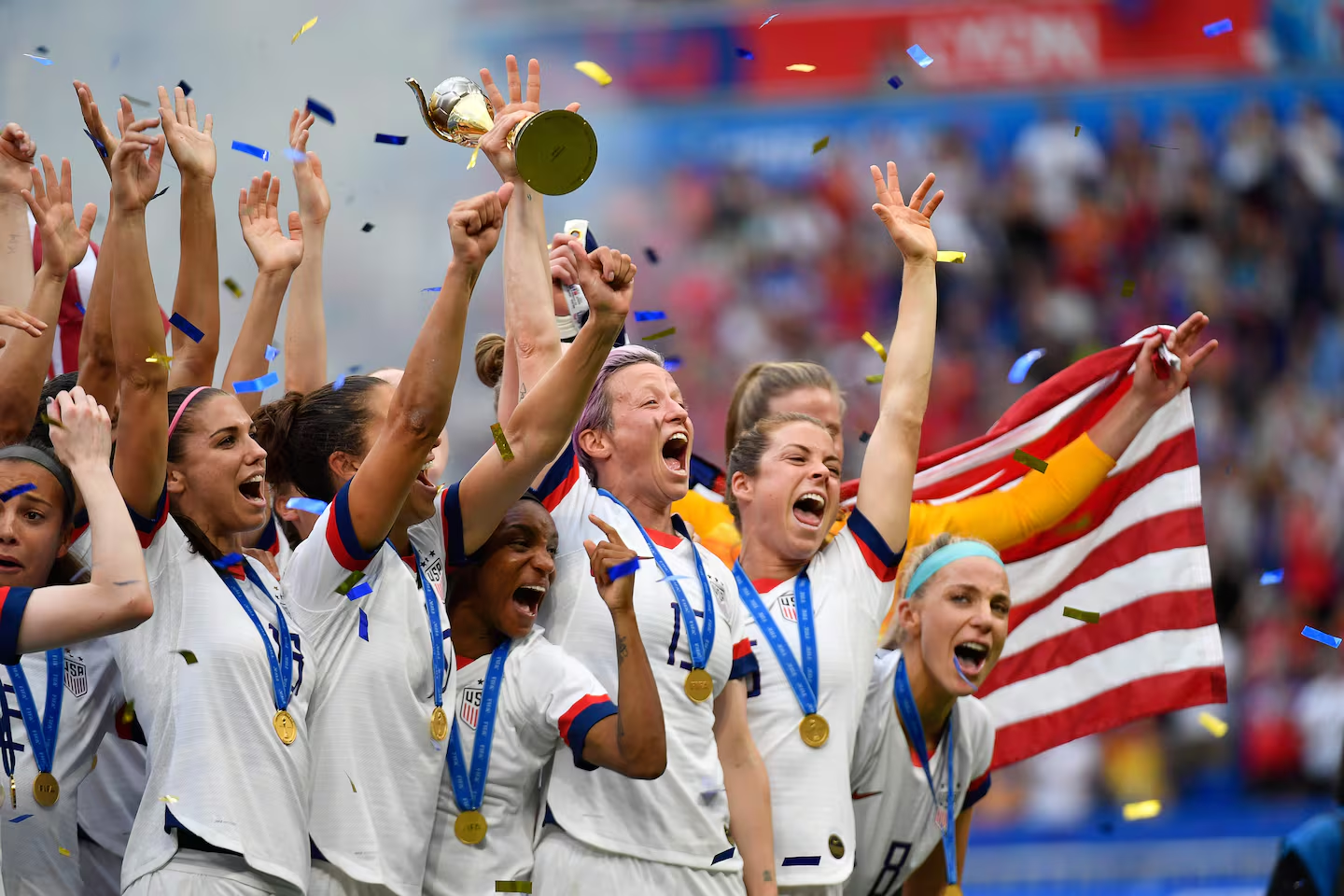
It’s time for Boston to put its best foot forward to host the Women’s World Cup
In this edition: Hottest PR job in town, the push for AI guardrails, Amherst College’s “turn around, bright eyes”
Shirley here, experiencing World Cup withdrawal but hopefully not for too long. Brazil hosts the FIFA Women’s World Cup next year, and the tournament could come to Boston in 2031. But only if we start planning now.
Read more Stefanie McKeough leaving Fleet for assistant coaching job with Seattle Torrent
Send us tips like who could have been (or wants to be) Boston’s next economic chief. And if someone has been sending you this newsletter, it’s time to get your own. Sign up at globe.com/powerplay.
Featuring: Sam Mewis, Martha Sheridan, Ben Grossman, Julian Cyr, Dylan Fernandes, Robyn Kennedy, Pavel Payano, Jo Comerford, Adam Gomez, Paul Feeney, Michael Rodrigues, Scott Wisor, Ben Snyder, Donna LaVoie, Jim Steinman, and more.
Boston, are we ready to host another World Cup?
It’s not a rhetorical question: We’ve got another shot with the Women’s World Cup heading toward the US in 2031. Now is the time to put our best foot forward.
With the conclusion of the men’s World Cup on Sunday, FIFA will turn its attention in the coming weeks to selecting the host of the 2031 women’s tournament.
The soccer overlords are weighing only one proposal: a jointbid led by the US, with Mexico, Costa Rica, and Jamaica. According to Politico, FIFA has signaled to President Donald Trump that the bid will prevail, meaning the World Cup will return to the US in 2031.
All good, right? Well, here’s the bad news: Competition to host those games will be stiff.
Just six weeks ago, being a World Cup host city was viewed by many as a risk and a burden. Not so now. Exhibit A: Chicago. Cities that hosted this year — Boston was among 11 US locations — will likely want to do it again; soccer fans weren’t just good for the bottom line, they lifted spirits and built international goodwill.
Even before Spain hoisted the Cup on Sunday, campaigning to host the next American soccer derby was well underway. Some pitches are not-so-subtle, like a Minnesota Star Tribune op-ed by Minnesota United and Angel City soccer investor Ben Grossman headlined: “Let’s bring the 2031 Women’s World Cup to Minnesota.”
Meanwhile, Atlanta is reportedly already positioning itself for the most coveted match of the 2031 tournament: the final.
So where is Boston in all of this? Technically, we’re part of the 2031 bid with Gillette Stadium listed in US Soccer Federation’s 273-page proposal as potentially available.
But Boston is not among the 14 US markets highlighted as a potential host. Instead, Atlanta, New York/New Jersey, and Kansas City, Mo. — which all hosted this year — are prominently featured, as are Denver, Minneapolis, San Diego, and Charlotte, N.C.
Does this signal Boston is a long shot? A US Soccer spokeswoman said the proposal aimed to showcase geographic diversity, and that cities in the broader bid framework will “continue to be equally considered.”
Meet Boston CEO Martha Sheridan, who’s leading the local effort, confirmed that the region remains in the mix.
Read more Patriots place edge rusher Harold Landry on physically unable to perform list ahead of training camp
“There’s still a lot of negotiation to be done with FIFA on this and on the city’s end,” she said. “But I don’t think that dampens the enthusiasm for hosting it.”
Still, we shouldn’t take anything for granted. This successful World Cup required Governor Maura Healey, Boston Mayor Michelle Wu, Beacon Hill, and business leaders coming together at the 11th hour to pull together funding and necessary laws (such as temporarily extending last call to 3 a.m.) to show international soccer fans a good time.
Maintaining momentum requires political leaders to stay in the game. Beacon Hill created the Sports & Entertainment Events Fund, which can help finance the next World Cup, and now the Senate’s Julian Cyr, along with Dylan Fernandes, Robyn Kennedy, Pavel Payano, Jo Comerford, Adam Gomez, and Paul Feeney, are pushing a “fun agenda,” a package of bills to help the state loosen up, like making 3 a.m. last call permanent.
Here’s another reason why all of this matters. A global tournament would put Boston on the soccer map and show that this summer wasn’t a fluke.We have what it takes – plus, men’s and women’s teams and two soccer stadiums underway.
Take it from Sam Mewis, a Hanson native who played on the US team that won the 2019 Women’s World Cup in France and now serves as editor-in-chief of “The Women’s Game,” which is part of the Men in Blazers Media Network.
“This World Cup has just really kind of been validating for Boston soccer fans in that we are a great city for soccer to be played in,” said Mewis.
Now Boston has a really good chance to score.
“It really felt like everybody in France knew that the Women’s World Cup was happening, so everybody was out celebrating it all the time, which is kind of how I think it felt in Boston when the Scotland fans were here,” she added. “Which is why I think Boston would be such a great host city for the Women’s World Cup.”
Consider this a hydration break. Massive events don’thappen on their own, and Boston can’t simply count on this summer’s success to carry us through.
JON’S TAKE
YOUR TAKE
Should Boston pursue hosting more major events like the Women’s World Cup? Take the survey here and we’ll share results in an upcoming edition of Power Play.
And join the conversation in the comments here.
HEARD AROUND TOWN
WHO’S WHO IN PR
The hottest PR job in town? It might just be representing the Massachusetts Convention Center Authority. The MCCA’s hunt for a new PR firm has drawn a who’s who of Boston publicists through, now, two rounds of bidding. Last year, the authority received bids from 14 firms, but suspended the bid process, ostensibly to revise the approach, and reopened it this year. The hope now is to hire one or more consultants for project-type work, and possibly another on a monthly retainer, as it has with Castle Group since late 2023. By the July 6 deadline, bidders included Dot Joyce Consulting, Media Men, Castle Group, Slowey McManus Communications, Colette Phillips Communications, Denterlein, Comsint, and LaVoie Strategic Communications. All of them except Media Men, Comsint, and Donna LaVoie’s firm submitted in the first go-around as well.
PASS AI SAFEGUARDS, PLEASE
First, giant AI company Anthropic came out in favor of proposed guardrails and safeguards for artificial intelligence in Massachusetts. Now, more than 50 AI professors and researchers in Massachusetts are joining in. Earlier this month, they signed a letter to Michael Rodrigues and Jo Comerford, the chair and vice chair of the Senate’s ways and means committee, urging support for a set of AI reforms being pushed by Senator Barry Finegold. So far, so good: Senate leaders signaled support by including the reforms in their version of the economic development bill known as the “Mass Wins Act,” to be debated by the Senate on Wednesday. The next question: Will the House go along? The letter was organized by Scott Wisor from the Secure AI Project and Ben Snyder from Encode, both national nonprofits. They say they plan to lobby House leaders as well once the bill goes to a conference committee. (Anthropic rival OpenAI joined the chorus today as well.)
YOUR TURN
Rocker Bonnie Tyler died on July 8, and in her honor we asked readers to guess the Massachusetts campus where the refrain of her biggest hit — “Total Eclipse of the Heart” — was first created in a college production. Most guessed the Berklee College of Music, but the correct answer is Amherst College. That’s where songwriter Jim Steinman (class of ‘69) first wrote the immortal words “turn around, bright eyes” for his campus musical, “The Dream Engine.”
THANKS FOR READING POWER PLAY.
Today’s edition was edited by Tim Logan and Greg Huang, and produced by Jack Osmond.
Have a question for the team? Email us at [email protected].
Delivered Tuesday and Thursday (at least for the summer).


Post Comment