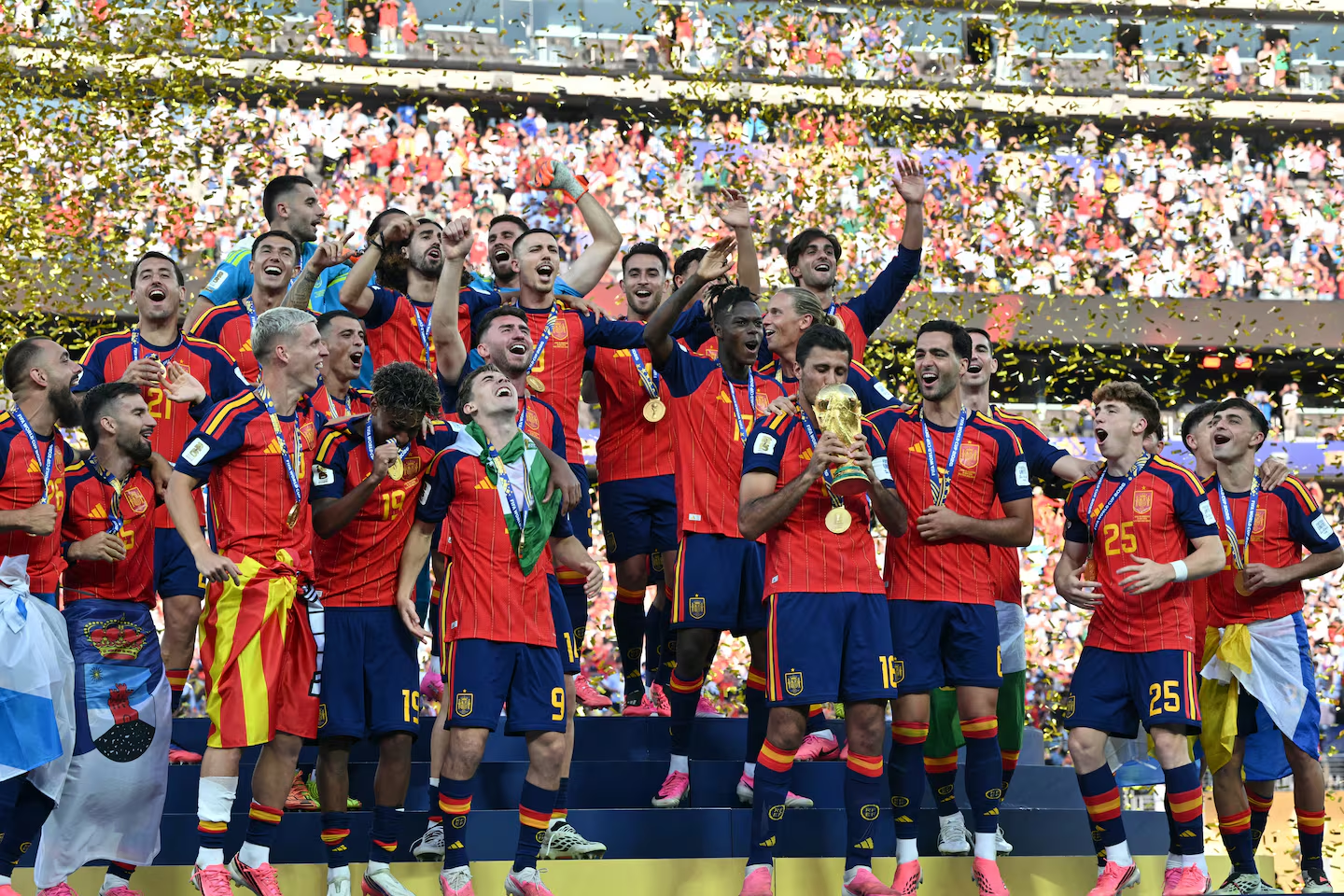
The 2026 World Cup was an enthralling spectacle from beginning to end, with a worthy champion
Aristotle may not have known about soccer, but he defined catharsis as “the agonizing tension that builds to a fulfilling release.”
Read more Ryan Fox wins the British Open with birdie on the final hole
If this World Cup was the most riveting of them all, it was because it was about catharsis from beginning to end.
Spain deserved to win Sunday’s final in the Meadowlands. La Roja dominated Argentina, outshooting the defending titlists, 20-2, with a 9-4 advantage in corner kicks.
And yet all it would have taken was one magical moment from Lionel Messi, the world’s best player, one lucky bounce of the ball or one goalkeeping bobble, and the Albiceleste would have been the first country to repeat as champions since Brazil in 1962.
That moment came from Ferran Torres, the Spanish substitute who fired home the only goal in the 106th minute. The best team in the 48-nation field prevailed, but what made this Cup enthralling was the gripping uncertainty across an event that began in spring and ended almost a month into summer.
Once Cape Verde held the eventual victors to a scoreless draw in their group opener, anything seemed possible.
Could the Blue Sharks beat Argentina in extra time? Could Egypt hang on to a two-goal lead over Messi and his muchachos? Could Norway knock out Brazil? Could England hold off Mexico playing a man down in Azteca’s sparse air?
Thus did the planet’s beautiful game hold Americans spellbound in a way that the 1994 tournament, the last one held in the States, did not. In an era of YouTube and social media and podcasts, this one was inescapable.
Yet who would have wanted to miss this fascinating festival of feet? This country is all about FOMO, about once-in-a-lifetime experiences. The World Cup was King Tut in cleats. Who didn’t know the words to Flower of Scotland? Who didn’t see Erling Haaland with his stuffed raccoon?
Customarily when the home side goes out interest disappears quickly. But even after Team USA was booted by the Belgians in the round of 16, everyone from Boston to Seattle remained tuned in.
There were so many intriguing clashes in the knockout rounds. Paraguay-Germany. Brazil-Japan. Morocco-Netherlands. Belgium-Senegal. Portugal-Croatia. England-Norway. England-Argentina.
And has there ever been a more entertaining match than the one that neither team wanted to play, Saturday’s third-place encounter between France and England?
Read more Rory McIlroy has another Masters and little else at the rest of the majors
If you switched off the set at halftime (assuming that you even turned it on) with England leading, 4-0, you missed one of the most unlikely resurrections imaginable as Les Bleus scored four times in a 6-4 goalfest that belonged in an adult rec league in a public park.
We don’t see that kind of freewheeling game in a World Cup. The stakes simply are too high. Anyone who’d watched Spain and Argentina work their way through to the final likely was prepared for a one-goal decision, either in stoppage or extra time, or possibly a shootout.
Had Messi been allowed a sliver of daylight, he might well have provided deliverance for his teammates as he had so often during the past five weeks. But the Spaniards stifled him, as they had everyone else on their way to their first title since 2010.
It’s no accident that no champion has repeated in 64 years. When Pele and his canary-colored colleagues accomplished it, the soccer world was significantly smaller. Of the 16 countries in the 1962 field, all but one came from Europe and South America. There were none from Africa or Asia. Virtually all of the players competed for domestic clubs.
Pele’s salary with Santos was $150,000, then the highest of any athlete in the world. When Inter Milan wanted to sign him for $1 million, the Brazilian government declared him a national treasure. Messi’s final contract with Barcelona a decade ago was 138 million euros.
What was telling about this Spanish side was its absence of ‘galacticos’ — expensive superstars like Messi, Haaland, France’s Kylian Mbappe, Portugal’s Cristiano Ronaldo, and Brazil’s Vinicius Junior.
But what La Roja has is a distinct identity and philosophy that goes back nearly two decades. Its Tiki-Taka style is built around ball possession, precise passes, constant movement, and a shutdown defense.
It’s a system designed to control, to deny, to frustrate, and, ultimately, to conquer. The Spaniards played 750 minutes across eight matches and conceded one goal, to Belgium. They never trailed.
It often took them a while to achieve the kill — a minute into stoppage time to beat Portugal, 88 minutes to dismiss the Belgians, the full 120 against Argentina. But La Roja, like a matador, is disciplined, patient and lethal. Eventually, Spain gets both ears and the tail.
The beautiful game comes in a variety of styles. Across the decades the Brazilians, Germans, Italians, French, and Argentines have left their distinctive imprint on the sport while hoisting the golden trophy.
Spain’s time came again this summer. That cathartic whoosh you heard was 50 million people from San Sebastian to Sevilla exhaling in rapture and relief.
Read more Former Sun star DeWanna Bonner scores season-high 21 to power Mercury past Connecticut to end skid



Post Comment