EV sales have slowed down. That puts pressure on Massachusetts’ climate goals.
Sales of electric vehicles in Massachusetts short-circuited at the beginning of the year, after the elimination of federal tax credits and a pullback of new models by the auto industry, according to the most recent state data.
But analysts say the transition to EVs from gas-powered cars, a key part of the state’s plan to reduce carbon emissions, is likely to get plugged back in over the next few years, as the cost of EVs drops and the charging infrastructure improves.
Prices are falling fast. More affordable electrics like Rivian’s new R2 SUV, starting at $45,000, and Kia’s EV3 crossover, expected to cost about $35,000. And those look positively pricey compared to California upstart Slate’s new electric pickup with an entry version priced around $25,000. It has no touchscreen, radio, nor even power windows, meaning the truck’s “minimalism makes the average Tesla seem lavish,” Wall Street Journal car reviewer Dan Neil wrote.
Higher gas prices due to the war in Iran have also increased interest in EVs. And Massachusetts has continued adding charging stations at a rapid pace. Legislators, too, could eventually restore tax breaks and other programs supporting electrification, if Democrats regain control of Congress and the White House.
“It’s more clear than ever that the transition to electric transportation is going to happen regardless of the decisions happening in Washington,” said Daniel Gatti, director of the transportation program at the nonprofit Acadia Center in Maine, pointing to the declining cost of batteries and improving technology aroundthe world. “It’s just a question of the speed of that transition and some of the immediate headwinds that we’re facing.”
The Massachusetts climate plan to reduce fossil fuel emissions included a goal of getting almost 1 million EVs and plug-in hybrids on the road by 2030, or about one-fifth of all vehicles. But in the first quarter of 2026, the number of electric vehicles registered with the Registry of Motor Vehicles declined slightly from the end of last year to about 167,000, the first dipin four years.
Over the past six months, state drivers have registered fewer than 4,000 battery and battery-hybrid passenger vehicles, compared with more than 17,000 in the prior six months before the federal credit was eliminated. The RMV totals include new and used EVs that drivers register here, while subtracting vehicles takenoff the road.
The state may have to adjust the date of its EV target due to the slowdown, Anna Vanderspek, EV program director at the Green Energy Consumers Alliance, said. But the transition is still needed as soon as possible to meet the state’s climate goal of cutting greenhouse-gas emissions in half, she said.
“The goal is based on the science and all the math that [the state] did in writing the clean energy and climate plan,” Vanderspek said. “We need to reduce transportation emissions this much to do that.”
EV sales have slowed nationwide since the Trump administration and Republicans in Congress killed the federal tax credit for EVs at the end of September. That prompted automakers to cancel production or US sales of nearly 20 models and take tens of billions of dollars in losses as they shuttered EV assembly lines.
Despite the setbacks, more affordable EVs will arrive over the next few years and charging stations are proliferating, Stephanie Valdez Streaty, director of insights at Cox Automotive, noted in the research firm’s first-quarter report. “Those longer-term fundamentals continue to support EV growth,” she wrote. “The timeline has shifted, but the direction hasn’t.”
In terms of the charging infrastructure, Massachusetts currently has 1,921 EV fast charging ports, according to the US Department of Energy. That’s up 36 percent from 1,408 a year earlier and double the number from two years ago.
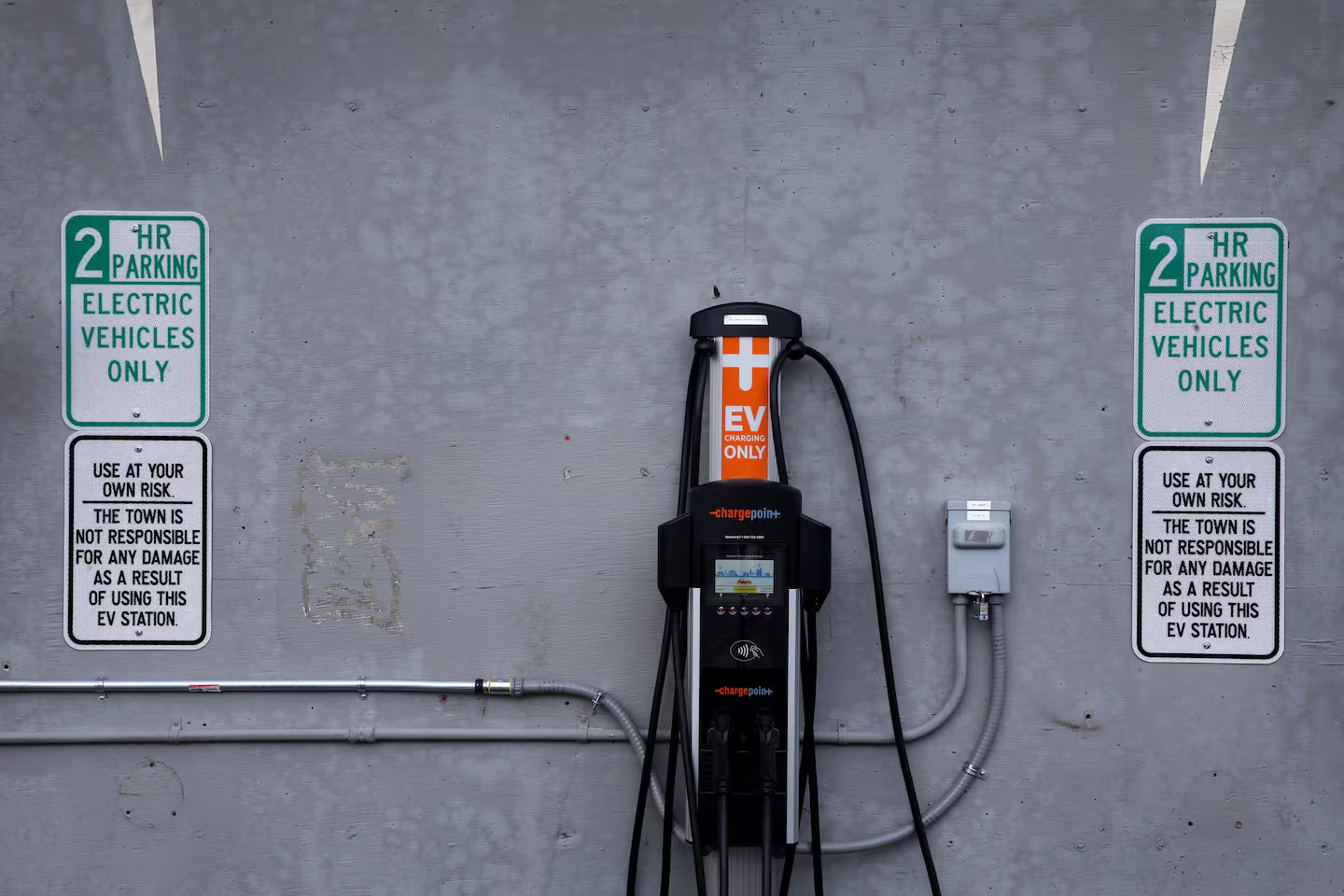
Last week, the Massachusetts Department of Transportation christened its latest state-owned charging station behind a McDonald’s at a rest stop in Plymouth off Route 3. The four gleaming orange and white chargers, installed in just three months, can refill a battery at up to 320 kWh, adding about 200 miles of range to some of the latest EVs in 10 minutes.
Read more Taylor Swift and Travis Kelce marry in front of famous friends at Madison Square Garden
Dave Depatie, a retired engineer who drives for Uber and Lyft, pulled up in his Hyundai Ionia 6 sedan as the first customer. With current gas prices, Depatie said he is saving more than $200 a month with his EV, which he bought in January, compared to his prior car, a hybrid gas-powered sedan.
“I’m definitely going electric from now on,” Depatie, who lives on Cape Cod, said. “I haven’t touched the gas pump and had gas on my hands since January.”
With multiple incentives from the state, including one targeted at ride-sharing drivers, and an incentive from Uber, Depatie got $15,500 backin immediate incentive payments/credits for switching to an EV.
MassDOT has struggled at times to add fast chargers. The agency has yet to open any charging stations funded under the five-year-old National Electric Vehicle Infrastructure program. And improving the relatively slow chargers at rest stops on the Mass. Turnpike has been delayed after the contractor selected torevamp the stops backed out last year.
Still, the agency has other funds it can use, such as its regular capital budget that paid for the site in Plymouth and another opening soon in Barnstable.
“We said, well, let’s go with non-federal aid and just go with state funds for the Barnstable and Plymouth build-out,” Andrew Paul, MassDOT’s director of strategic initiatives and highway design, said.
With the opening of the Plymouth chargers, the state so far has built 12 fast charging stations with a total of 30 ports.
Other state agencies are also funding charging stations. Construction is starting over the summer on six fast charging stations, from Springfield to Brockton, chosen to be convenient for ride-sharing drivers. The state-funded Mass. Clean Energy Center paid for the installations, with four to eight ports each.
“Ride-sharing drivers are just such a valuable target for the state,” Acadia’s Gatti said. “They’re the some of the highest mileage drivers on the road, so you’re getting more bang from your buck in terms of emissions [reductions].”
At the same time, the private sector has been on a massive charging station expansion in the state. Tesla last year opened fast charging stations, now compatible with all EV brands, in Holyoke, Marlborough, Medford, Methuen, Plymouth, Revere, and Worcester. And new charging companies have entered the Massachusetts market, including Ionna, formed by major automakers with an emphasis on adding the same amenities found at gas stations.
The state is planning to add plain blue, square signs with an icon of an EV charger to alert drivers to the new stations in Plymouth and Barnstable.
“All the sites that come online will have something at least as simple as that,” MassDOT’s Paul said. “There could be some more sophisticated ways of communicating to drivers, but working with our traffic engineers who approve signs, it turns out it’s complicated.”
Read more Trump mixes patriotism with partisanship as he celebrates America’s ‘joyous’ 250th anniversary



Post Comment