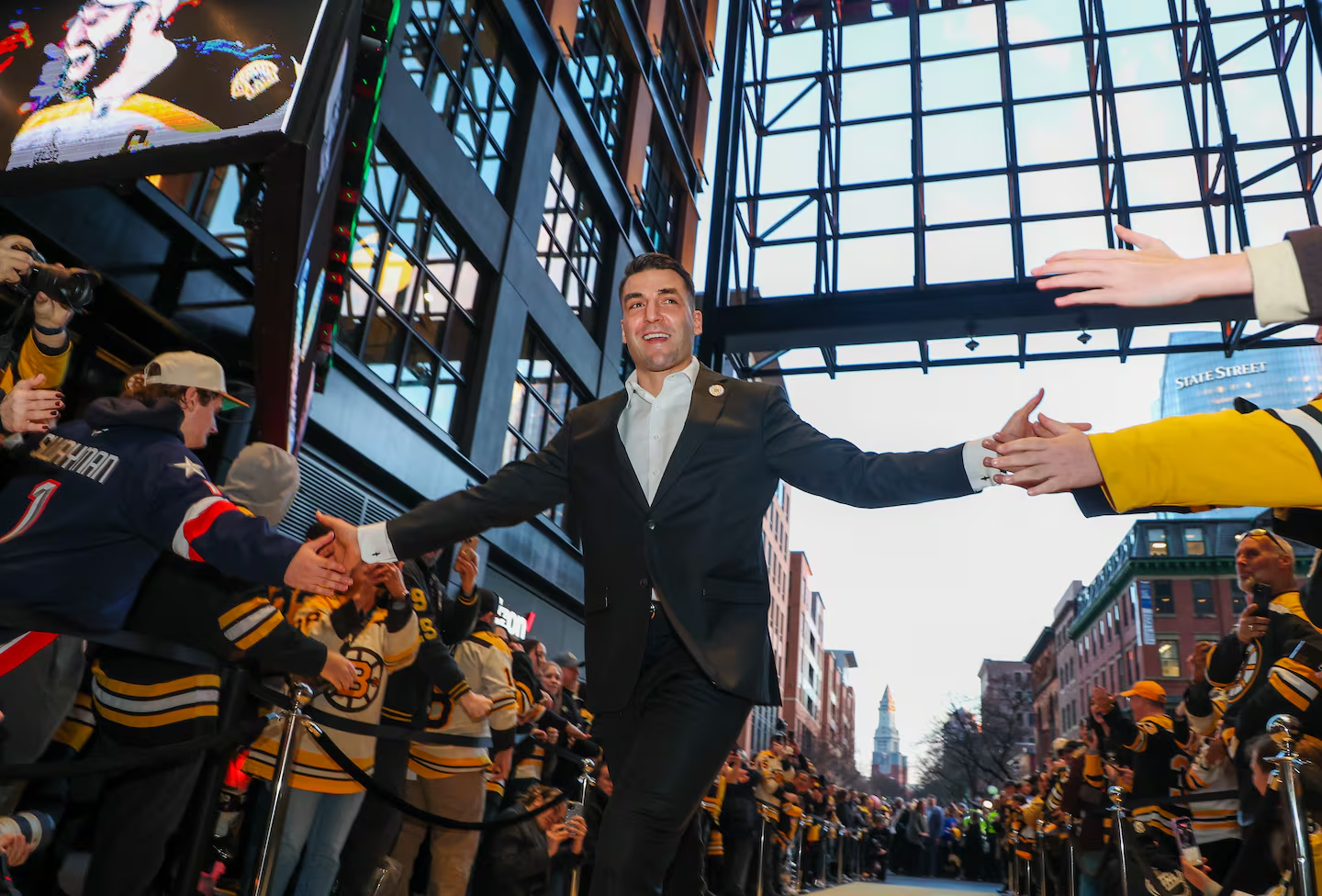
Patrice Bergeron arrived in Boston as a baby-faced rookie. On Monday, he could be called to the Hockey Hall of Fame.
Patrice Bergeron’s initial NHL address was 8 Cormiers Way in Andover. His final hockey residence could soon be 30 Yonge Street in Toronto.
Read more Trying to get to the World Cup at the last minute? Here’s a trick: Don’t give up.
The first domicile belonged to onetime Bruins teammate Martin Lapointe and his family, where the 18-year-old Bergeron learned the ins and outs of professional life. The second is home to the Hockey Hall of Fame, where he can unpack his hockey bag for good.
Bergeron, who set the standard for two-way play during a 19-year career that included 427 goals, 1,040 points, a Stanley Cup championship, and a record six Selke Trophies, given annually to the NHL’s top defensive forward, gets his first chance to join the game’s elite Monday.
Bergeron arrived in Boston in 2003, a rookie second-round draft pick from L’Ancienne-Lorette, Quebec. The baby-faced center spoke little English and was given little chance by most to break camp with the big club.
Lapointe felt an immediate connection with Bergeron. A native Quebecois himself, Lapointe acknowledged he had a bad experience during his first training camp in Detroit. A veteran Red Wings player, also from Quebec, refused to help Lapointe acclimate.
“I knew English enough to get by, but that guy, he didn’t help me out at all. He tried to make it worse for me,” Lapointe told the Globe. “So, I’m like, if I have a chance to help a kid from Quebec, I will do it. So, I think I took it upon myself to do it and without knowing him at all, but the few signs that Patrice showed me at training camp, I knew that it was going to be easy.”
So, Bergeron accepted Lapointe’s offer and moved in. He had his own room and became an instant big brother to the Lapointes’ three young children.
“He took time to play with them, played shinny [hockey] with them. Yeah, he was easy to be around, and he helped my wife at the time, Tania, and was really helpful and really respectful,” said Lapointe. “The kids loved him and I think he enjoyed it. It was fun for him, too.”
Lapointe assisted Bergeron with all kinds of tasks, including opening a local bank account and getting a car.
On their daily drives to Ristuccia Arena in Wilmington for practice and on road trips, Lapointe made sure to speak to Bergeron mostly in English.
“Basically, I just guided him because he didn’t speak a lot of English,” said Lapointe. “But he was a pretty mature kid. I didn’t have to do much at all.”
Those treks up and down I-93 reinforced their bond.
“Along the rides, he was asking a lot of questions, sometimes he was getting frustrated, he didn’t think he was good enough and he messed up in practice and I’m like, ‘Hey, hey, you’re going to make mistakes. It’s OK,’ ” said Lapointe. “And I remember him being hard on himself a lot and I had to calm him down and say, ‘It’s OK.’ I’d bring him down, ground him a little bit more because he was hard on himself, very hard on himself.”
Once at the rink, Bergeron didn’t need much mentoring.
“I didn’t have to say much because he had the work ethic. Sometimes I had to wait after practices, I had to wait because he was doing something extra and I’m like, ‘All right, Patrice.’ I was like, ‘OK, when are you going to be done?’ He’d go, ‘Well, give me another half-hour.’ I’d say, ‘OK, no problem,’ ” said Lapointe. “So, he was always the last one out of there, and I didn’t mind it because I was one of them, too, that was pretty late getting out of there, and we both enjoyed being around the rink and around the guys, so that wasn’t a problem. But he knew there’s an unwritten rule as a rookie that you have to be the first on the ice and you have to be last off the ice, and I didn’t have to teach him that and didn’t have to tell him that.”
As Bergeron’s confidence grew, so did his game. It wasn’t long before he was constantly turning heads in practice and preseason games.
Bergeron’s hockey IQ was off the charts — particularly for a player his age. He saw the game exceptionally well and always seemed to be in the right place at the right time.
“There’s not too many kids at that age that had a very detailed game like he did. When you see that these days, you’re like, ‘Wow,’ ” said Lapointe, who now serves as the Canadiens’ director of player personnel, as well as the director of amateur scouting.
Young players tend to concern themselves more with offense. A well-rounded game normally takes time as players learn the importance of being responsible in all three zones at the NHL level.
Bergeron was an exquisite exception to the rule.
He became a nightmare to play against. He shadowed opponents with a relentlessness that often lead to frustration.
To watch him on television was a treat, but to watch him in person was an education. That’s where his work in all three zones and away from the puck stood out. Many players who defend that hard spend a good chunk of their careers in the penalty box. Again, Bergeron was the exception. He averaged just 26 penalty minutes per season across his career.
As Bergeron’s defense remained consistently excellent, his offensive game consistently grew.
“I didn’t think he had the offense that he’s shown. So that was the thing that surprised me the most,” said Lapointe. “Defensively, he was so detailed, so committed in his own zone. He never cheated for offense, so I didn’t think that he had that offense that he showed.”
Bergeron’s popularity grew by leaps and bounds. His No. 37 sweater dominated the Garden landscape, while thousands of youth hockey players asked for his digits and tucked the back of their jerseys into their hockey pants, as Bergeron did early in his career.
In 2006, Zdeno Chara arrived in Boston and was named captain. Bergeron was named alternate captain, and the two drove each other — and their teammates — on a daily basis. They leaned on each — literally and figuratively — and helped lead the Bruins to a Stanley Cup title in 2011, and two more trips to the Final. Bergeron succeeded Chara as captain in 2021.
Chara, who was enshrined in the Hall of Fame last November, summed up their relationship during his induction speech.
“I want to single out one player. I want to thank Patrice Bergeron. One of the greatest leaders and people I have ever met and played with. My longest teammate, my cocaptain,” said Chara. “Bergy, I can always count on you. You showed me and helped me to become a better leader and player, but more importantly, a better person.”
A reciprocal thank you is likely when Bergeron takes the podium in Toronto, which could come as early as this November.
Read more Harry Kane ties England’s record for World Cup goals in opening win over Croatia





Post Comment